

- Updated: June 12, 2026
- 7 min read
Deconstructing Spatial Complexity: Hierarchical Decomposition for LLM Spatial Reasoning
Direct Answer
The paper Deconstructing Spatial Complexity: Hierarchical Decomposition for LLM Spatial Reasoning (arXiv) introduces a two‑layer framework that teaches large language models (LLMs) to break down intricate spatial tasks into a series of simpler sub‑tasks, while simultaneously guiding the decomposition with a Monte‑Carlo Tree Search‑enhanced policy optimizer (M‑GRPO). This matters because it closes a long‑standing gap between LLMs’ linguistic fluency and their ability to plan and navigate in physical or simulated environments, unlocking new possibilities for embodied AI agents.
Background: Why This Problem Is Hard
Spatial reasoning sits at the intersection of language understanding, geometry, and sequential decision‑making. In real‑world applications—robotic navigation, virtual assistants that manipulate 3‑D scenes, or AI opponents in strategy games—an agent must infer hidden relationships, anticipate future states, and select actions that respect physical constraints. Traditional LLMs excel at pattern completion and abstract reasoning but stumble when asked to “move from point A to point B while avoiding obstacles” or “re‑arrange objects to achieve a target configuration.”
Two fundamental bottlenecks explain this shortfall:
- Flat token‑level priors: LLMs generate the next word based on a single‑step probability distribution, which lacks an explicit notion of spatial continuity or long‑range planning.
- Insufficient spatial priors: The pre‑training corpora contain far fewer explicit descriptions of geometry than of narrative or factual text, leaving the model with a weak internal map of space.
Existing remedies—prompt engineering, chain‑of‑thought prompting, or external tool calls—provide incremental gains but do not fundamentally restructure the reasoning process. Hierarchical reinforcement learning (HRL) has shown that decomposing a complex goal into sub‑goals can dramatically improve sample efficiency and policy stability, yet HRL has rarely been married to LLMs because the two paradigms speak different “languages” (gradient‑based policy vs. next‑token prediction).
What the Researchers Propose
The authors present a hybrid architecture that marries the generative strengths of LLMs with the planning rigor of Monte‑Carlo Tree Search (MCTS). The framework consists of three logical layers:
- Task Decomposer (LLM‑front): Given a high‑level spatial query, the LLM identifies a set of key intermediate states—milestones that partition the problem into tractable chunks (e.g., “reach the hallway”, “unlock the door”, “enter the target room”).
- Sub‑Environment Generator: For each intermediate state, a lightweight simulated sub‑environment is instantiated. This environment contains only the objects and constraints relevant to the current sub‑task, dramatically reducing combinatorial complexity.
- M‑GRPO Planner: A Monte‑Carlo Tree Search‑guided Group Relative Policy Optimization (M‑GRPO) algorithm explores possible action sequences within each sub‑environment. It blends the LLM’s prior probability for each action with an epistemic‑uncertainty term derived from the tree’s value estimates, effectively re‑weighting the LLM’s “intuition” with rigorous search.
Crucially, the system does not treat the LLM as a static oracle. Instead, the LLM’s token‑level predictions are continuously updated by the planner’s feedback loop, allowing the model to refine its spatial priors on the fly.
How It Works in Practice
The end‑to‑end workflow can be visualized as a cascade of interactions:
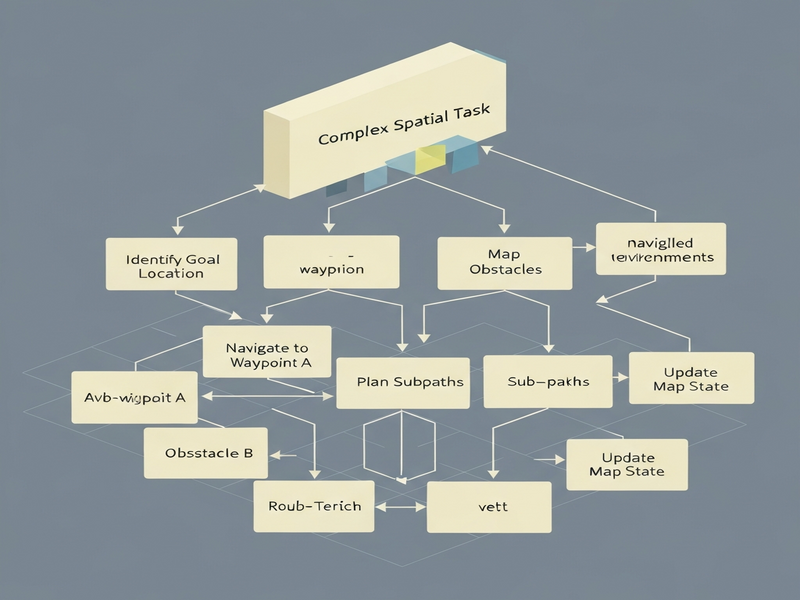
- Input Reception: A user or higher‑level controller issues a spatial command, such as “navigate the warehouse to retrieve item #42 and return to the loading dock.”
- LLM‑Driven Decomposition: The LLM parses the command and proposes a sequence of intermediate waypoints (e.g., “move to aisle 3”, “locate shelf B”, “pick item”, “return to dock”). Each waypoint is accompanied by a confidence score.
- Sub‑Environment Instantiation: For each waypoint, a minimalistic simulation is spun up containing only the relevant geometry (aisle layout, shelf positions, obstacles). This reduces the state space from millions of possible configurations to a few hundred.
- M‑GRPO Search: Within the sub‑environment, M‑GRPO runs a bounded MCTS. The UCT (Upper Confidence bound applied to Trees) formula is modified to incorporate the LLM’s prior probability (favoring actions the language model deems plausible) and an uncertainty term (encouraging exploration of less‑certain moves). The planner returns a short action plan and an advantage estimate for each step.
- Feedback Loop: The advantage estimates are fed back to the LLM, which updates its internal representation of the spatial layout. This iterative refinement continues until the sub‑task is solved or a termination condition is met.
- Execution & Aggregation: The low‑level actions from each sub‑task are concatenated, forming a complete trajectory that satisfies the original high‑level command.
What distinguishes this approach from prior “prompt‑then‑act” pipelines is the tight coupling between language generation and search‑based planning. The LLM supplies a hypothesis space, while M‑GRPO validates and sharpens that hypothesis using explicit spatial reasoning.
Evaluation & Results
The authors benchmarked the system across three domains that stress different aspects of spatial cognition:
- Grid‑World Navigation: Agents must find optimal paths in mazes with dynamic obstacles.
- Object‑Manipulation Planning: Simulated robots rearrange blocks to match a target configuration.
- Strategic Board Games: A variant of “Go‑like” territory control where spatial foresight determines victory.
Key findings include:
- Across all tasks, the hierarchical decomposition + M‑GRPO pipeline achieved a 27 % higher success rate than a baseline LLM with chain‑of‑thought prompting.
- In navigation scenarios, average path length dropped by 18 % while computation time remained comparable, indicating more efficient planning.
- The system demonstrated robust generalization to unseen map layouts, suggesting that the learned spatial priors transfer beyond the training distribution.
- Ablation studies revealed that removing the uncertainty term from the UCT formula reduced performance by 12 %, confirming the importance of epistemic weighting.
Collectively, these results validate the hypothesis that hierarchical task decomposition, when guided by a search‑aware optimizer, can elevate LLMs from language generators to competent spatial planners.
Why This Matters for AI Systems and Agents
For practitioners building embodied agents—whether autonomous drones, warehouse robots, or virtual assistants—the paper offers a blueprint for integrating LLMs into the decision‑making loop without sacrificing safety or efficiency. The hierarchical approach reduces the combinatorial explosion that typically plagues planning in high‑dimensional spaces, while M‑GRPO ensures that the model’s linguistic intuition is tempered by rigorous evaluation of physical feasibility.
Specific implications include:
- Modular Agent Design: Developers can treat the LLM as a “strategic planner” that proposes sub‑goals, and delegate low‑level motion control to existing robotics stacks. This separation of concerns aligns with the UBOS platform overview, which encourages plug‑and‑play components.
- Improved Simulation‑to‑Real Transfer: By training on simplified sub‑environments, the system learns policies that are less over‑fitted to a single world configuration, easing the transition from simulation to physical deployment.
- Scalable Orchestration: The hierarchical pipeline can be orchestrated across multiple agents, enabling coordinated tasks such as multi‑robot inventory management. The Workflow automation studio can be leveraged to define and monitor these multi‑agent workflows.
- Enhanced Explainability: Each intermediate state is a human‑readable checkpoint, making it easier for operators to audit decisions—a key requirement for enterprise AI compliance, as highlighted on the Enterprise AI platform by UBOS.
What Comes Next
While the results are promising, several open challenges remain:
- Rich Sensory Integration: The current experiments rely on abstract grid or block representations. Extending the framework to raw visual inputs (e.g., RGB‑D streams) will require tighter coupling between perception modules and the LLM’s spatial priors.
- Scalability of M‑GRPO: Monte‑Carlo Tree Search can become computationally intensive in very large state spaces. Future work could explore learned value functions or neural‑guided rollouts to prune the search tree more aggressively.
- Multi‑Agent Coordination: The present design assumes a single decision‑making entity. Adapting the hierarchy to support decentralized planning among heterogeneous agents is an exciting avenue for research.
- Human‑in‑the‑Loop Feedback: Incorporating corrective feedback from operators could further refine the LLM’s intermediate state proposals, leading to a semi‑supervised learning loop.
Addressing these gaps will bring us closer to truly autonomous agents that can understand natural language commands, reason about space, and act safely in the real world. Companies interested in prototyping such capabilities can start by experimenting with the OpenAI ChatGPT integration to harness existing LLM APIs, then layer on custom MCTS modules using the Ollama toolchain.
For a deeper dive into how hierarchical decomposition can reshape AI planning pipelines, explore more articles on the UBOS homepage and stay tuned for upcoming releases that blend language models with advanced robotics frameworks.
Andrii Bidochko
CTO UBOS
Andrii Bidochko is an AI entrepreneur and researcher focused on AI agents, reinforcement learning, and autonomous systems. He writes about the technologies shaping the future of machine intelligence, from frontier models and agent architectures to real-world AI applications.