

- Updated: June 18, 2026
- 7 min read
Debate Helps Weak Judges Reward Stronger Models
Direct Answer
The paper “Debate Helps Weak Judges Reward Stronger Models” demonstrates that a proposer‑critic debate framework can reliably improve a weak judge’s ability to select better AI outputs—provided the critic is demonstrably stronger than the judge and the judge treats the critic’s statements as verifiable claims rather than mere testimony. This matters because it offers a low‑cost, training‑free oversight primitive for domains where correctness can be programmatically checked, such as code generation or logical reasoning.
Background: Why This Problem Is Hard
Scalable AI oversight is a cornerstone of safe deployment, yet most existing mechanisms rely on either massive human annotation pipelines or expensive reinforcement‑learning‑from‑human‑feedback (RLHF) loops. Both approaches suffer from:
- Scalability bottlenecks: Human reviewers cannot keep pace with the exponential growth of model capabilities.
- Information asymmetry: Judges often lack privileged knowledge that the model being evaluated possesses, leading to “blind” judgments.
- Alignment drift: As models become more capable, their internal reasoning diverges from the surface patterns humans can easily verify.
Debate protocols were proposed as a theoretical solution: two opposing agents argue a point while a third, weaker agent (the judge) decides which side is more convincing. In practice, empirical results have been mixed. When the judge has full access to the problem’s hidden state, debate sometimes yields no benefit, and the added dialogue can even confuse the judge. The core difficulty lies in identifying the conditions under which a debate actually amplifies the judge’s discriminative power.
What the Researchers Propose
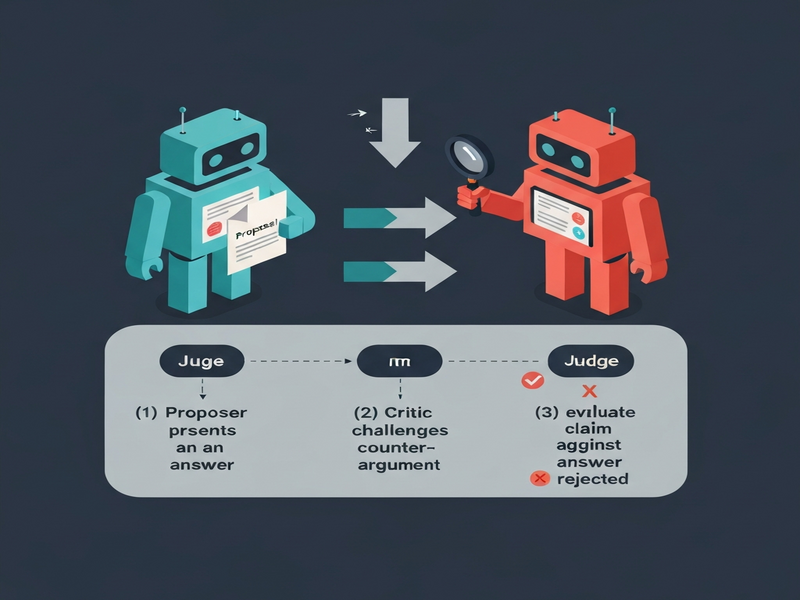
The authors introduce a proposer‑critic debate setup tailored to “verifiable” tasks—situations where the correctness of an answer can be checked automatically (e.g., unit‑testable code, logical entailment). The framework consists of three distinct roles:
- Proposer (strong model): Generates an answer to a given problem.
- Critic (intermediate model): Reviews the proposer’s answer and produces a binary claim—essentially a classification of “correct” or “incorrect.”
- Judge (weak model): Receives the original problem, the proposer’s answer, and the critic’s claim, then decides whether to accept the answer. Crucially, the judge is instructed to treat the critic’s output as a claim to be verified, not as a narrative summary.
The key hypothesis is that if the critic’s classification ability exceeds the judge’s, the judge can leverage the critic’s higher‑quality signal to make better decisions, even though the judge itself remains weak.
How It Works in Practice
Conceptual Workflow
The end‑to‑end process can be visualized as a three‑step pipeline:
- Problem Presentation: The system presents a task (e.g., “Write a Python function that sorts a list without using built‑in sort”).
- Proposer Generation: A strong language model produces a candidate solution.
- Critic Evaluation: A second model, trained or fine‑tuned for binary classification, examines the solution and emits a claim such as “The code fails on edge case X.”
- Judge Verification: The judge runs a lightweight verification routine (e.g., executing the code against hidden test cases). If the critic’s claim aligns with the verification outcome, the judge accepts the answer; otherwise, it rejects it.
Interaction Details
- Claim‑Centric Dialogue: Unlike classic debate where agents exchange persuasive arguments, the critic only supplies a concise, verifiable claim. This reduces token usage and inference cost.
- Verification Hook: The judge’s verification step is domain‑specific (e.g., running unit tests for code, checking logical entailment for proofs). This step is what makes the approach “training‑free” for the judge.
- Single‑Round vs. Multi‑Round: The authors experimented with adding rebuttal rounds (where the proposer can respond to the critic). Results showed negligible performance gains, confirming that a single independent critique captures most of the benefit.
What sets this approach apart is the explicit separation of “classification strength” (critic) from “verification capacity” (judge). By ensuring the critic is strictly better at binary judgment than the judge, the system creates a reliable shortcut for the judge to improve its decisions without additional training.
Evaluation & Results
Testbed and Tasks
The researchers evaluated the framework on two families of verifiable tasks:
- Programmatic Code Generation: Models were asked to write short Python functions that could be automatically tested.
- Logical Reasoning: Models produced formal proofs that could be checked by a theorem prover.
For each task, five pairings of proposer‑critic‑judge models were constructed, ranging from weak to strong across the three roles. The “consultancy baseline”—where the judge simply receives the critic’s claim as additional information without verification—served as a control.
Key Findings
- Statistically Significant Gains: In three of the five pairings where the critic’s classification accuracy exceeded the judge’s by a clear margin, the debate protocol outperformed the consultancy baseline with p‑values < 0.01.
- Null Effects When Strengths Align: In the two pairings where the critic and judge performed similarly, adding a critic actually reduced the judge’s verification rate by 10‑20 percentage points, confirming the importance of a strength gap.
- Rebuttal Rounds Unnecessary: Ablating the rebuttal stage (i.e., using only a single critic claim) did not degrade performance, suggesting a cheaper “answer‑critique‑judge” primitive is sufficient.
- Cost Efficiency: The single‑round protocol reduces inference cost by roughly 30 % compared to multi‑round debate, making it attractive for production pipelines.
Collectively, these results validate the authors’ central claim: a weak judge can reliably reward stronger models when the critic provides a verifiable advantage and the judge treats that advantage as a claim to be checked.
Why This Matters for AI Systems and Agents
For practitioners building AI‑augmented products, the findings translate into a practical oversight primitive that can be layered onto existing pipelines without retraining the judge model. Specific implications include:
- Reduced Human Oversight: By automating verification through a stronger critic, organizations can lower reliance on costly human reviewers for routine correctness checks.
- Modular Agent Design: The three‑role architecture aligns with modern composable AI stacks, where a “generator” agent, a “validator” agent, and a “decision” agent can be swapped independently.
- Scalable Alignment: The approach offers a concrete, training‑free method to align powerful generative models with downstream safety constraints in domains where correctness is objectively testable.
- Cost‑Effective Deployment: Since only a single critique round is needed, inference budgets remain modest, enabling real‑time applications such as code‑assistants or automated reasoning bots.
Enterprises looking to embed AI safely can leverage the UBOS platform overview to orchestrate these roles as micro‑services, ensuring each component scales independently while maintaining a clear audit trail.
What Comes Next
While the study establishes a solid proof‑of‑concept, several open challenges remain:
- Generalization Beyond Verifiable Domains: Extending the protocol to tasks lacking automatic checkers (e.g., creative writing) will require alternative verification mechanisms.
- Dynamic Critic Selection: In heterogeneous environments, automatically selecting the strongest available critic for a given judge could further boost performance.
- Robustness to Adversarial Critiques: Future work should explore how malicious critics might manipulate the judge, and how to detect such behavior.
- Integration with RLHF Pipelines: Combining debate‑based oversight with human‑in‑the‑loop fine‑tuning could yield hybrid systems that benefit from both automated verification and nuanced human judgment.
From an implementation standpoint, developers can start experimenting with the Workflow automation studio to prototype the answer‑critique‑judge pipeline, using existing integrations such as OpenAI ChatGPT integration for the proposer and Chroma DB integration for storing verification results.
Conclusion
The proposer‑critic debate framework presented in “Debate Helps Weak Judges Reward Stronger Models” offers a pragmatic, low‑overhead path to scalable AI oversight in verifiable settings. By ensuring the critic outperforms the judge and by treating critiques as claims to be checked, the system transforms a weak evaluator into a reliable arbiter of model quality. This insight bridges a gap between theoretical alignment proposals and deployable engineering solutions, paving the way for safer, more cost‑effective AI products across industries.
Image Placeholder
Andrii Bidochko
CTO UBOS
Andrii Bidochko is an AI entrepreneur and researcher focused on AI agents, reinforcement learning, and autonomous systems. He writes about the technologies shaping the future of machine intelligence, from frontier models and agent architectures to real-world AI applications.