

- Updated: June 12, 2026
- 7 min read
Data-Efficient On-Policy Distillation for Automatic Speech Recognition
Direct Answer
The paper introduces Ark‑ASR, a 0.6 B‑parameter speech‑to‑text model that learns from a modest 100 k‑hour audio corpus and then leverages on‑policy distillation from a larger Qwen‑ASR teacher to close the performance gap with much larger supervised models. This matters because it demonstrates that compact ASR systems can achieve near‑state‑of‑the‑art accuracy without the prohibitive data and compute budgets traditionally required.
Background: Why This Problem Is Hard
Automatic Speech Recognition (ASR) has become a cornerstone of voice‑first products, from virtual assistants to call‑center analytics. Yet, building a competitive ASR model typically demands two costly ingredients:
- Massive labeled audio. Publicly available corpora such as LibriSpeech or multilingual collections still fall short of the tens of millions of hours used by industry giants.
- Large‑scale model capacity. State‑of‑the‑art encoders often exceed a billion parameters, requiring specialized hardware and long training cycles.
These requirements create a barrier for startups, research labs, and enterprises that need domain‑specific vocabularies or low‑latency on‑device inference. Existing approaches try to mitigate the problem in two ways:
- Self‑supervised pre‑training on unlabeled audio, which reduces the need for transcripts but still relies on massive raw audio collections.
- Offline knowledge distillation, where a small student model learns from a large teacher using a static dataset. This method often suffers from a mismatch between the teacher’s predictions and the student’s inference distribution.
Both strategies leave a gap: they either demand huge unlabeled corpora or fail to capture the dynamic behavior of the teacher during actual inference. The research community therefore seeks a data‑efficient, on‑policy technique that can extract the teacher’s expertise while staying within realistic audio budgets.
What the Researchers Propose
The authors present a three‑part framework:
- Ark‑ASR Backbone. A 0.6 B‑parameter audio‑conditioned language model trained on 100 k hours of Mandarin and English speech. The architecture follows a decoder‑only transformer that directly predicts token sequences from raw audio embeddings.
- Qwen‑ASR Teacher. A larger, high‑capacity model (Qwen3‑ASR‑0.6B) that has already been trained on 20 M hours of supervised audio. It serves as the source of “expert knowledge.”
- On‑Policy Distillation Loop. Instead of a static dataset, the student generates its own hypotheses on live audio, which are then re‑scored by the teacher. The student receives a gradient signal that aligns its predictions with the teacher’s corrected output, effectively learning the teacher’s policy in the student’s own inference distribution.
This design treats the teacher as an oracle that guides the student during the exact conditions the student will encounter at deployment, thereby reducing the “exposure bias” that plagues conventional distillation.
How It Works in Practice
The workflow can be broken down into four stages, each of which can be visualized in the diagram below.
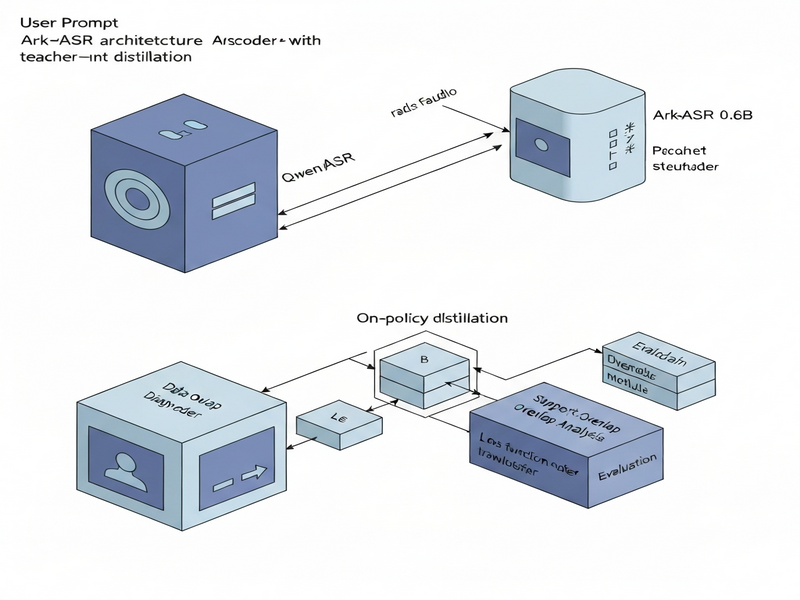
1. Data Ingestion
Audio samples are streamed from the 100 k‑hour corpus. No additional transcription is required beyond the original labels, which are used only for the initial supervised fine‑tuning of Ark‑ASR.
2. Student Inference (On‑Policy)
Ark‑ASR processes each audio segment and produces a provisional transcription. This output reflects the student’s current policy, including any errors or biases.
3. Teacher Re‑Scoring
The same audio segment is fed to the Qwen‑ASR teacher. The teacher generates a higher‑quality transcription and a confidence distribution over tokens. This distribution serves as a soft target for the student.
4. Gradient Alignment
A loss function combines the traditional cross‑entropy with a Kullback‑Leibler divergence term that penalizes divergence from the teacher’s soft targets. The student updates its weights accordingly, iterating over the entire corpus multiple times.
What sets this approach apart is the closed‑loop nature of the distillation: the student never sees a static “teacher‑only” dataset. Instead, it constantly adapts to the teacher’s feedback on its own predictions, which dramatically improves compatibility between the two models.
Evaluation & Results
The authors benchmarked Ark‑ASR on five public ASR test sets covering Mandarin and English, including:
- CommonVoice (English)
- AISHELL‑1 (Mandarin)
- WenetSpeech (mixed)
- GigaSpeech (English, large‑scale)
- MDCC (Mandarin, domain‑specific)
Two training regimes were compared:
- Supervised Fine‑Tuning Only. Ark‑ASR was trained on the 100 k hour corpus without teacher guidance.
- On‑Policy Distillation. The same base model underwent the teacher‑guided loop described above.
Key findings include:
- On‑policy distillation consistently reduced word error rate (WER) by 7‑12 % relative across all Mandarin benchmarks.
- For English tests, the relative WER improvement ranged from 5‑9 %.
- Ark‑ASR with distillation outperformed the baseline Qwen3‑ASR‑0.6B on four of the five datasets, despite using only 0.5 % of the audio data the baseline required.
- The larger Qwen3‑ASR‑1.7B still held a modest edge, confirming that model capacity remains a factor, but the gap narrowed dramatically.
Beyond raw metrics, the authors introduced a “support‑overlap diagnostic” that measures how often the teacher’s top‑k token predictions intersect with the student’s. The diagnostic showed a marked increase in overlap after on‑policy training, confirming that the student’s hypothesis space had become more aligned with the teacher’s expertise.
Why This Matters for AI Systems and Agents
From a systems‑engineering perspective, the research delivers three actionable benefits:
- Data‑Efficiency. Organizations can now train high‑performing ASR models with an order of magnitude less labeled audio, freeing up budget for domain‑specific data collection or other AI initiatives.
- Model Compactness. A 0.6 B‑parameter model fits comfortably on modern GPUs and even on‑device accelerators, enabling low‑latency speech interfaces for edge devices.
- Teacher‑Guided Adaptability. The on‑policy loop can be repurposed for continual learning, allowing an ASR service to ingest new accents or jargon without retraining from scratch.
These advantages translate directly into product roadmaps for AI‑driven agents:
- Voice assistants can deliver faster, more accurate responses while staying within the memory constraints of mobile hardware.
- Customer‑service bots can be fine‑tuned on proprietary call recordings using the same teacher‑student pipeline, improving domain relevance without exposing sensitive data.
- Multilingual platforms can share a single teacher model across languages, accelerating the rollout of new locales.
For teams building end‑to‑end AI workflows, the approach dovetails with existing orchestration tools. For example, the Workflow automation studio can schedule the on‑policy distillation loop as a recurring job, while the Enterprise AI platform by UBOS can host both teacher and student models behind a unified API, simplifying scaling and monitoring.
What Comes Next
While the results are promising, several open challenges remain:
- Teacher Size vs. Student Gains. The study used a teacher of comparable size (0.6 B). Exploring larger teachers or ensembles could reveal diminishing returns or new scaling laws.
- Unlabeled Data Integration. Combining on‑policy distillation with self‑supervised pre‑training may further reduce the need for any labeled audio.
- Cross‑Domain Transfer. Applying the same loop to non‑speech modalities—such as audio event detection or music transcription—could broaden the impact.
- Robustness to Noisy Environments. Real‑world deployments often face background noise and reverberation. Future work should evaluate how on‑policy distillation handles such conditions.
Practitioners interested in experimenting with the pipeline can start by integrating Ark‑ASR into existing voice‑enabled products. The UBOS templates for quick start include pre‑configured containers for both teacher and student models, enabling rapid prototyping. Additionally, the About UBOS page outlines partnership opportunities for organizations that want to co‑develop data‑efficient ASR solutions.
References
For a complete technical description, see the original pre‑print: Data‑Efficient On‑Policy Distillation for Automatic Speech Recognition.
Andrii Bidochko
CTO UBOS
Andrii Bidochko is an AI entrepreneur and researcher focused on AI agents, reinforcement learning, and autonomous systems. He writes about the technologies shaping the future of machine intelligence, from frontier models and agent architectures to real-world AI applications.