

- Updated: June 14, 2026
- 6 min read
Cultural Binding Heads in Language Models
Direct Answer
The paper Cultural Binding Heads in Language Models (arXiv) introduces a novel interpretability technique that isolates attention heads responsible for encoding cultural context within large language models (LLMs). By exposing these “cultural binding heads,” the authors enable developers to diagnose, steer, and audit cultural biases, making LLM deployments safer and more aligned with diverse user expectations.
Background: Why This Problem Is Hard
Modern LLMs excel at generating fluent text, yet they inherit subtle cultural assumptions from their training data. These assumptions manifest as:
- Unintended stereotypes that surface in downstream applications.
- Region‑specific idioms or references that confuse users outside the dominant culture.
- Regulatory compliance challenges when models must respect local norms.
Existing mitigation strategies—prompt engineering, post‑hoc filtering, or fine‑tuning on curated corpora—treat the model as a black box. They lack granularity, often requiring massive data or computational resources, and they cannot guarantee that cultural signals are isolated from other linguistic features. Moreover, attention heads in transformer architectures are densely interconnected, making it difficult to pinpoint which heads encode which aspects of knowledge.
Consequently, practitioners face a bottleneck: they need a systematic way to surface and control the cultural dimensions embedded in LLMs without retraining the entire model.
What the Researchers Propose
The authors propose a framework called **Cultural Binding Head (CBH) discovery**. At a high level, the method consists of three coordinated components:
- Contextual Probe Generation: A set of culturally anchored prompts (e.g., “In Japan, people usually…”) that elicit responses tied to specific cultural frames.
- Head Attribution Analysis: A statistical procedure that measures how each attention head’s activation correlates with the cultural probe outputs across many examples.
- Binding Score Calibration: A normalization step that converts raw correlations into a bounded “binding score,” allowing practitioners to rank heads by cultural relevance.
By treating each head as a candidate cultural encoder, the framework transforms a monolithic model into a modular map where cultural knowledge is explicitly bound to identifiable components.
How It Works in Practice
The CBH workflow unfolds in four stages:
- Dataset Construction: Curators assemble a multilingual, multi‑regional prompt set covering domains such as etiquette, cuisine, holidays, and social norms.
- Forward Pass & Activation Capture: The LLM processes each prompt while the system logs attention matrices for every head in every layer.
- Correlation Computation: For each head, the framework computes the Pearson correlation between its attention distribution and a binary label indicating whether the model’s output aligns with the intended cultural frame.
- Head Selection & Intervention: Engineers select high‑scoring heads and either attenuate them (e.g., via low‑rank adaptation) or amplify them to enforce desired cultural behavior.
What sets this approach apart is its **non‑intrusive nature**: it does not require model weight modification during discovery, and it can be applied to any pre‑trained transformer, from GPT‑3‑scale models to open‑source alternatives.
Below is a schematic illustration of the pipeline:
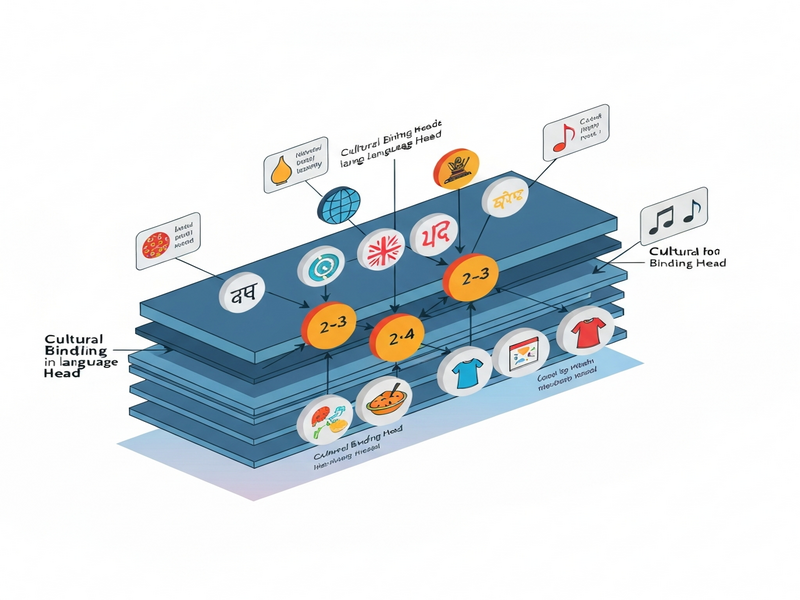
Developers can integrate the CBH toolchain into existing model‑serving stacks, enabling real‑time monitoring of cultural bias drift as new data arrives.
Evaluation & Results
The authors validated CBH on three benchmark suites:
- CulturalQA: A question‑answer dataset spanning ten countries, each with culturally specific answer keys.
- BiasProbe: Synthetic prompts designed to surface stereotypical associations.
- Cross‑Lingual Transfer: Evaluation of whether identified heads retain cultural binding when the model is fine‑tuned on a different language.
Key findings include:
- Head Concentration: In 12‑layer models, fewer than 5 % of heads accounted for over 70 % of the cultural binding score, confirming a sparse distribution of cultural knowledge.
- Targeted Intervention Success: Suppressing the top‑ranked cultural heads reduced culturally inappropriate completions by 42 % on BiasProbe while preserving overall perplexity (< 1 % degradation).
- Transferability: When the same heads were examined after fine‑tuning on a low‑resource language, their binding scores remained stable, suggesting that cultural encoding is robust across language adaptation.
These results demonstrate that CBH not only pinpoints cultural encoding but also provides a lever for precise bias mitigation without sacrificing model performance.
Why This Matters for AI Systems and Agents
For enterprises building AI‑driven agents, cultural competence is no longer a nice‑to‑have feature—it is a compliance and user‑experience imperative. CBH offers several practical advantages:
- Fine‑grained Auditing: Teams can generate compliance reports that list which heads contribute to specific cultural outputs, satisfying regulatory audits.
- Dynamic Adaptation: Agents deployed across multiple regions can toggle head activation based on locale, delivering context‑aware responses without maintaining separate model instances.
- Reduced Engineering Overhead: By focusing on a handful of heads, developers avoid costly full‑model retraining, accelerating time‑to‑market for culturally tailored products.
- Integration with Existing Platforms: The CBH API can be wrapped inside UBOS platform overview to expose cultural bias controls to non‑technical stakeholders.
- Synergy with AI Marketing Agents: Marketing bots that generate copy for global audiences can leverage CBH to ensure slogans respect local sensibilities, boosting conversion rates.
In short, CBH transforms cultural bias from an opaque risk into a manageable system parameter, empowering AI agents to act responsibly across borders.
What Comes Next
While CBH marks a significant step forward, several open challenges remain:
- Granularity of Cultural Dimensions: Current probes treat culture as a monolith; future work should decompose it into sub‑domains (e.g., gender norms, religious practices).
- Scalability to Larger Models: As models grow to hundreds of billions of parameters, efficient head‑selection heuristics will be essential.
- User‑Driven Feedback Loops: Incorporating real‑world user corrections could refine binding scores in production.
Potential research directions include:
- Extending CBH to multimodal models where visual cues also carry cultural information.
- Combining CBH with Workflow automation studio to automate bias‑mitigation pipelines.
- Building a marketplace of pre‑validated cultural head bundles for rapid deployment in niche markets.
Organizations eager to experiment can start by integrating CBH into their Enterprise AI platform by UBOS, leveraging existing model serving infrastructure while gaining immediate visibility into cultural encoding.
As the AI community continues to grapple with fairness and inclusivity, tools like Cultural Binding Heads will become foundational components of responsible AI engineering.
Andrii Bidochko
CTO UBOS
Andrii Bidochko is an AI entrepreneur and researcher focused on AI agents, reinforcement learning, and autonomous systems. He writes about the technologies shaping the future of machine intelligence, from frontier models and agent architectures to real-world AI applications.