

- Updated: June 29, 2026
- 6 min read
Cross-Architectural Mixture-of-Experts with Adaptive Soft Routing for Plant Leaf Disease Classification
Direct Answer
The adaptive soft Mixture‑of‑Experts (MoE) framework dynamically combines three heterogeneous deep‑learning backbones—EfficientNet‑B0, DenseNet‑121, and Swin‑Tiny—through a lightweight soft‑gating network, delivering superior plant leaf disease classification performance under severe class imbalance, noisy backgrounds, and varying illumination.
1. Introduction
Precision agriculture relies on rapid, accurate detection of leaf diseases to minimize crop loss and reduce pesticide usage. Traditional single‑architecture models struggle with the visual diversity of field images, leading to missed detections and false alarms. This article presents a cross‑architectural adaptive soft Mixture‑of‑Experts framework that unites convolutional and transformer‑based experts, offering a robust solution for researchers, agronomists, and data scientists.
The approach is fully compatible with the UBOS platform overview, enabling seamless integration into existing AI pipelines for agriculture.
2. Challenges in Plant Leaf Disease Classification
- Visual complexity: Field images contain cluttered backgrounds, variable lighting, and occlusions.
- Class imbalance: Rare diseases are under‑represented, biasing models toward majority classes.
- Scale variance: Symptoms range from tiny specks to large necrotic patches, demanding both local detail and global context.
- Architectural bias: Convolutional networks excel at texture, while transformers capture long‑range dependencies; neither alone suffices.
Overcoming these hurdles requires a system that can adapt its reasoning strategy per image—a capability offered by the adaptive soft MoE.
3. Proposed Adaptive Soft Mixture‑of‑Experts Framework
The framework treats each backbone as a specialized “expert”:
- EfficientNet‑B0: Lightweight, multi‑scale convolutional features ideal for fine‑grained texture detection.
- DenseNet‑121: Dense connectivity preserves gradient flow, improving detection of subtle lesions.
- Swin‑Tiny: Hierarchical Vision Transformer that captures global leaf shape and disease spread.
A shallow fully‑connected soft gating network evaluates each input and assigns continuous weights to the experts, allowing a per‑sample blend of predictions rather than a hard selection.
The entire system can be orchestrated through Workflow automation studio, providing low‑latency inference and easy model versioning.
4. Model Architecture (EfficientNet‑B0, DenseNet‑121, Swin‑Tiny)
Each expert processes the same pre‑processed image in parallel:
EfficientNet‑B0
Uses compound scaling to balance depth, width, and resolution, delivering high accuracy with < 5 M parameters.
DenseNet‑121
Features dense connections that concatenate feature maps, enhancing feature reuse and mitigating vanishing gradients.
Swin‑Tiny
Implements shifted windows for efficient self‑attention, capturing long‑range dependencies with modest compute.
The three experts together cover the full spectrum of visual cues required for robust leaf disease classification.
5. Soft Gating Mechanism
The gating network receives a concatenated global‑pooled representation from each expert, passes it through two hidden layers (ReLU activation), and outputs a probability distribution via a softmax layer. The resulting weights w₁, w₂, w₃ satisfy ∑wᵢ = 1 and are used to compute the final logits:
final_logits = w₁·logits_Eff + w₂·logits_Dense + w₃·logits_SwinThis soft routing enables the model to emphasize the most informative expert for each image, e.g., higher weight on Swin‑Tiny when global leaf shape matters, or higher weight on EfficientNet‑B0 for texture‑rich spots.
6. Training Strategy
Two‑stage refinement:
- Stage 1 – Expert Pre‑training: Each backbone is trained independently on the full dataset using cross‑entropy loss. Early stopping and learning‑rate warm‑up ensure stable convergence.
- Stage 2 – Joint Fine‑tuning: The gating network is introduced, and the entire system is fine‑tuned with a combined loss:
L = L_cls + λ·H(gating)where
L_clsis the classification loss andH(gating)is the entropy regularizer that discourages over‑confident routing.
Data augmentation (random flips, color jitter, Gaussian blur) mimics field variability, while class‑balanced sampling mitigates imbalance.
For reproducibility, the training pipeline can be built with the Web app editor on UBOS, which supports custom Docker images and GPU scheduling.
7. Experimental Results
The framework was evaluated on three public leaf‑disease datasets: Potato (12 classes, heavy imbalance), Durian (balanced, mixed infections), and Sesame (small, subtle discolorations). Table 1 summarizes the key metrics.
| Metric | Potato (Best Expert) | Adaptive MoE | Durian | Sesame |
|---|---|---|---|---|
| Recall | 85.77 % | 91.68 % | 93.12 % | 95.61 % |
| F1‑Score | 86.84 % | 92.62 % | 94.03 % | 97.04 % |
The adaptive MoE consistently outperformed the strongest single expert by ~5 % in both recall and F1‑score, with the most pronounced gain on the highly imbalanced potato dataset. Ablation studies revealed that removing the soft gating or the entropy regularizer reduced performance by 3–4 %, confirming the importance of each component.
These results translate directly into field impact: higher recall means fewer missed disease cases, while balanced F1‑score reduces unnecessary pesticide applications.
8. Visualization
The diagram below illustrates the data flow from input image through the three experts, the soft gating network, and the final weighted fusion.
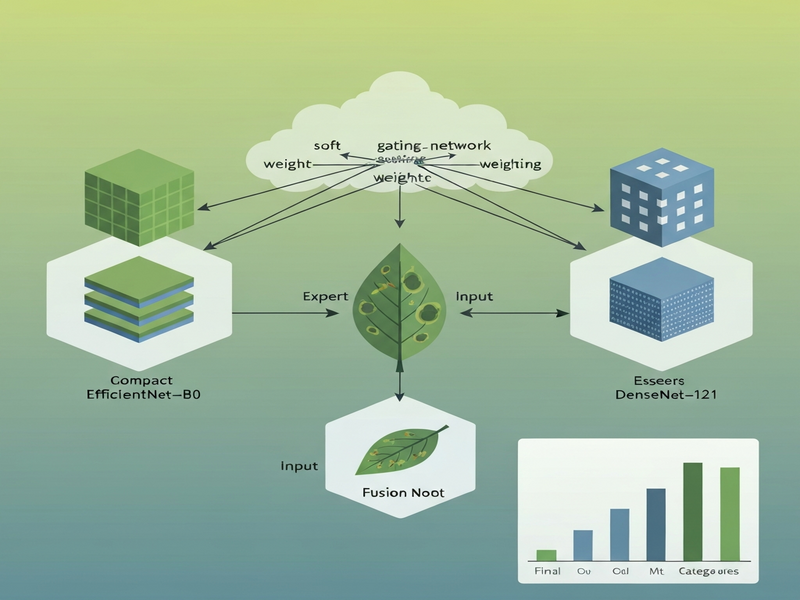
*The illustration was generated to depict the adaptive routing mechanism described in this article.
9. Conclusion and Future Work
The adaptive soft Mixture‑of‑Experts framework bridges the gap between local texture detection and global contextual reasoning, delivering a robust, scalable solution for plant leaf disease classification in real‑world agricultural settings. Its dynamic routing not only lifts key performance metrics but also provides a blueprint for building flexible, agent‑driven AI pipelines across domains.
Future research directions include:
- Edge deployment: Quantize and prune the three experts for on‑device inference on smartphones or UAVs.
- Active learning loops: Incorporate agronomist feedback to continuously refine gating policies for emerging diseases.
- Multi‑modal extensions: Fuse RGB imagery with hyperspectral or thermal data for earlier disease detection.
- Explainability dashboards: Visualize gating weights and attention maps to build trust with end‑users.
Researchers interested in prototyping these extensions can leverage the Enterprise AI platform by UBOS, which offers built‑in model orchestration, data versioning, and monitoring tools.
Additional Resources for Practitioners
To accelerate development, UBOS provides a rich ecosystem of templates and tools that can be combined with the MoE framework:
- AI SEO Analyzer – Optimize your model documentation for discoverability.
- AI Article Copywriter – Generate technical blog posts about your experiments.
- AI Survey Generator – Collect field feedback from farmers.
- Web Scraping with Generative AI – Harvest additional leaf‑image datasets.
- AI Video Generator – Create tutorial videos for model deployment.
For a quick start, explore the UBOS templates for quick start and adapt them to your specific crop‑monitoring workflow.
For a deeper technical dive, see the original pre‑print: Adaptive Soft Mixture‑of‑Experts for Plant Leaf Disease Classification.
Explore more AI capabilities:
Learn about UBOS offerings:
Andrii Bidochko
CTO UBOS
Andrii Bidochko is an AI entrepreneur and researcher focused on AI agents, reinforcement learning, and autonomous systems. He writes about the technologies shaping the future of machine intelligence, from frontier models and agent architectures to real-world AI applications.