

- Updated: July 20, 2026
- 6 min read
CriterAlign: Criterion-Centric Rationale Alignment for Code Preference Judging
Direct Answer
CriterAlign introduces a criterion‑centric, pairwise evaluation framework that directly aligns rubric‑based rationales with human preferences for code generation. By turning each evaluation criterion into a pairwise judgment, it lifts the accuracy of preference prediction above that of traditional monolithic judges, making code‑quality assessment more reliable for real‑world AI‑driven development pipelines.
Background: Why This Problem Is Hard
Modern code‑generation models, from large language models to specialized code assistants, are judged not only on functional correctness but also on readability, efficiency, security, and domain‑specific trade‑offs. Human annotators routinely express these trade‑offs through nuanced rationales, yet most automated judges treat each generated snippet in isolation, assigning a single score per rubric item and later deriving a preference by comparing summed scores. This pointwise design suffers from two fundamental flaws:
- Score aggregation masks contradictions. A model may excel in performance but lag in maintainability; aggregating scores can hide the decisive factor that a human would prioritize.
- Rubric‑to‑preference mismatch. Human preferences often hinge on subtle interactions between criteria (e.g., a slight security risk outweighs a modest speed gain). Pointwise judges cannot capture these cross‑criterion dynamics, leading to systematic under‑performance against human judgments.
Consequently, developers lack a trustworthy, scalable metric for selecting the “best” code among multiple candidates, slowing down iterative development cycles and limiting the deployment of autonomous coding agents.
What the Researchers Propose
The authors present CriterAlign, a framework that re‑orients rubric‑based evaluation around the pairwise comparison itself. Instead of scoring each response separately, CriterAlign asks the judge to answer a series of binary questions for each criterion: “Given snippet A and snippet B, which one better satisfies criterion X?” This shift yields three core components:
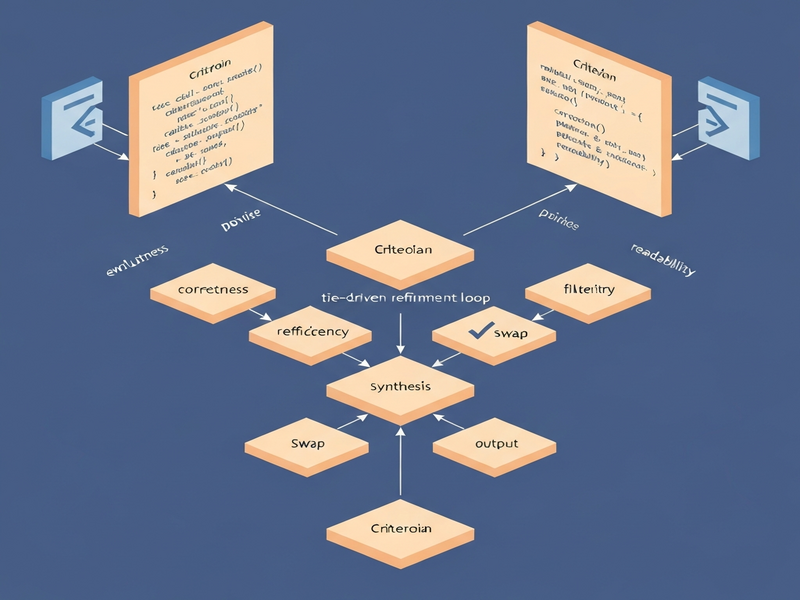
- Criterion‑Centric Pairwise Judges. For every rubric item (e.g., correctness, readability, runtime efficiency), a dedicated judge produces a direct preference between two code samples.
- Tie‑Driven Criterion Refinement. When judges return a tie on a criterion, the system automatically refines the rubric prompt, prompting the model to surface finer‑grained distinctions.
- Swap‑Consistency Filtering. The framework validates that judgments remain stable under input order swaps, discarding inconsistent votes before final synthesis.
To bridge the remaining gap between human rationales and model predictions, the authors also introduce Human‑Preference‑Aligned Guidance (HPAG)**. HPAG is distilled offline from observed mismatches between human‑annotated preferences and a strong monolithic judge, then injected as contextual hints into the criterion generator, the criterion judge, and the final aggregation step.
How It Works in Practice
The CriterAlign pipeline can be visualized as a four‑stage workflow:
- Criterion Generation. A language model receives the task description and the two code candidates, then produces a concise list of evaluation criteria tailored to the domain (e.g., “memory usage”, “API compliance”).
- Pairwise Criterion Judging. For each generated criterion, a separate judge model receives the same code pair and outputs a binary decision (A ≻ B, B ≻ A, or tie). HPAG prompts are appended here to nudge the model toward human‑aligned reasoning.
- Consistency & Refinement. The system checks for swap‑consistency (A vs. B should mirror B vs. A) and, if a tie occurs, triggers a refinement loop that asks the criterion generator to elaborate or split the ambiguous criterion.
- Final Preference Synthesis. After filtering, the remaining binary votes are aggregated using a weighted majority scheme that respects the relative importance of each criterion (weights can be learned from a small validation set). The outcome is a single, pairwise preference label.
What distinguishes CriterAlign from prior rubric‑based judges is that the pairwise decision is made **at the criterion level**, not after an independent scoring phase. This design eliminates the need for post‑hoc score comparison and directly captures the trade‑off logic that humans apply when they say “I prefer A because its security posture outweighs its slightly higher latency.”
Evaluation & Results
The authors evaluated CriterAlign on the BigCodeReward benchmark, a curated dataset of human‑annotated code preference pairs spanning multiple programming languages and problem domains. The baseline was a state‑of‑the‑art monolithic judge built on the Qwen2.5‑VL‑32B model, which achieved 60.4 % pairwise accuracy.
Key findings include:
- Accuracy boost. CriterAlign raised accuracy to 66.3 %, a relative improvement of nearly 10 % over the monolithic baseline.
- Ablation insights. Removing the pairwise criterion layer dropped performance back to 61.2 %, confirming that the criterion‑centric design is the primary driver.
- HPAG contribution. Injecting Human‑Preference‑Aligned Guidance added an extra 1.5 % gain, demonstrating that offline rationale extraction can meaningfully steer the judges.
- Robustness to ties. The tie‑driven refinement loop resolved 78 % of initially ambiguous judgments, reducing the overall tie rate from 12 % to 3 %.
These results show that a carefully structured pairwise rubric can outperform a larger, monolithic model, even when both share the same underlying LLM architecture.
Why This Matters for AI Systems and Agents
For developers building autonomous coding assistants, continuous integration pipelines, or AI‑augmented code review tools, reliable preference signals are the linchpin of decision‑making. CriterAlign offers a plug‑and‑play evaluation layer that can be inserted wherever code candidates are generated:
- Agent orchestration. Multi‑agent systems can use CriterAlign to let a “selection agent” choose the best output from a pool of specialist generators, ensuring that the final artifact aligns with business‑level quality criteria.
- Feedback loops. By exposing criterion‑level disagreements, developers gain actionable insight (e.g., “security is the bottleneck”) and can direct subsequent model fine‑tuning or prompt engineering efforts.
- Scalable human‑in‑the‑loop. Instead of asking humans to rank dozens of snippets, the system surfaces only the most contentious criteria, dramatically reducing annotation cost.
Integrating CriterAlign with an UBOS platform overview enables enterprises to embed the framework into existing workflow automation studios, turning raw preference judgments into structured data that powers downstream analytics and compliance checks.
What Comes Next
While CriterAlign marks a significant step forward, several open challenges remain:
- Domain‑specific rubric expansion. Current experiments rely on a fixed set of generic criteria. Future work should explore automatic discovery of domain‑tailored criteria (e.g., “GPU memory footprint” for deep‑learning pipelines).
- Cross‑model consistency. Extending swap‑consistency checks to multi‑model ensembles could further stabilize judgments when heterogeneous generators are involved.
- Real‑time deployment. Reducing latency of the multi‑stage pipeline is essential for interactive coding assistants that must respond within seconds.
Addressing these gaps will likely involve tighter integration with data‑centric platforms such as Enterprise AI platform by UBOS, where model serving, prompt management, and evaluation can be orchestrated end‑to‑end.
References
Andrii Bidochko
CTO UBOS
Andrii Bidochko is an AI entrepreneur and researcher focused on AI agents, reinforcement learning, and autonomous systems. He writes about the technologies shaping the future of machine intelligence, from frontier models and agent architectures to real-world AI applications.