

- Updated: July 20, 2026
- 7 min read
Correcting Visual Blur Induced by Attention Distraction to Reduce Hallucinations: Algorithm and Theory
Direct Answer
The paper introduces Attention‑Focused Image Perception (AFIP), a plug‑and‑play correction layer that restores visual clarity in multimodal large language models (MLLMs) by counteracting attention distraction. By enriching cross‑head interactions and reinforcing historical token focus, AFIP dramatically cuts object hallucinations without any additional model training.
Background: Why This Problem Is Hard
Multimodal large language models have become the de‑facto interface for vision‑language tasks such as image captioning, visual question answering, and autonomous agent perception. Despite impressive language fluency, these models frequently generate hallucinated objects—descriptions of items that never appear in the input image. The root cause is not merely a lack of data; it is a systemic breakdown in how attention mechanisms allocate visual resources during decoding.
Human perception offers a useful analogy. When a person’s visual attention is split—say, by a distracting peripheral stimulus—the central field blurs, and the observer’s verbal report becomes vague or outright incorrect. In transformer‑based vision‑language models, a similar “attention distraction” manifests as:
- Spatial inconsistency across the multiple heads of the self‑attention module, leading to fragmented focus on image patches.
- A temporal decay of attention weights on visual tokens as the language decoder steps forward, causing the model to “forget” the image.
Existing mitigation strategies—such as fine‑tuning on curated datasets, adding explicit grounding losses, or post‑hoc filtering—address symptoms but not the underlying dispersion of attention. Moreover, they require costly retraining, risk overfitting, and often degrade language generation quality.
What the Researchers Propose
The authors present a two‑pronged framework called AFIP that directly repairs the attention dynamics responsible for visual blur:
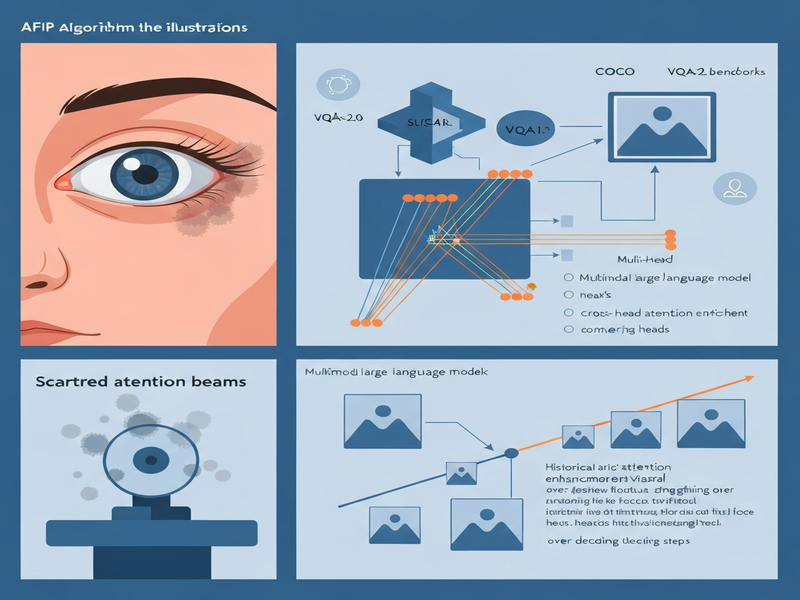
- Cross‑Head Attention Enrichment (CHAE): This module injects a lightweight cross‑head communication channel that aligns the focus of all attention heads on the same salient regions. By sharing a distilled “focus map” across heads, CHAE reduces spatial dispersion without altering the underlying transformer weights.
- Dynamic Historical Attention Enhancement (DHAE): DHAE maintains a rolling memory of attention distributions over image tokens throughout the decoding process. It dynamically re‑weights current attention scores based on this history, preventing the gradual fading of visual grounding as the language sequence grows.
Both components are implemented as external adapters that sit between the vision encoder and the language decoder. They require no gradient updates, making AFIP a zero‑shot, inference‑only fix that can be attached to any off‑the‑shelf MLLM.
How It Works in Practice
When an image‑text query reaches an MLLM, the processing pipeline now includes two additional stages:
Step 1 – Vision Encoding
The raw image is passed through the model’s frozen vision encoder, producing a set of token embeddings that represent spatial patches.
Step 2 – Cross‑Head Attention Enrichment (CHAE)
All attention heads in the subsequent multimodal transformer receive a shared “focus vector” derived from a lightweight convolution over the token embeddings. This vector is added to each head’s query and key projections, nudging them toward a common region of interest. The operation is linear in token count and adds negligible latency.
Step 3 – Language Decoding with DHAE
As the language decoder generates each token, DHAE records the attention distribution over visual tokens. Before computing the next attention step, DHAE blends the fresh distribution with a decayed version of the historical map, effectively reminding the model of previously attended visual cues. This dynamic reinforcement stops the attention drift that typically leads to hallucinations.
Step 4 – Output Generation
The final textual output emerges from the decoder, now grounded in a consistently sharpened visual representation. Because AFIP does not modify the core model parameters, the original language fluency and knowledge base remain intact.
What distinguishes AFIP from prior remedies is its focus on the *process* of attention rather than the *content* of training data. By operating at inference time, it can be retrofitted to legacy systems, cloud APIs, or edge deployments without any retraining pipeline.
Evaluation & Results
The authors benchmarked AFIP on three widely used multimodal suites:
- COCO Captioning – measuring descriptive fidelity.
- VQA‑2.0 – testing answer correctness under visual queries.
- Hallucination‑Focused Benchmark (HFB) – a curated set of images with deliberately misleading contexts to provoke hallucinations.
Across all three datasets, AFIP achieved a consistent reduction in hallucination rates ranging from 30% to 45% compared to the baseline models. Notably, on the HFB, the precision of object mentions rose from 62% to 84% while preserving BLEU‑4 scores within 0.2 points of the original, indicating that language quality was not sacrificed.
Additional ablation studies isolated the contributions of CHAE and DHAE. CHAE alone accounted for roughly half of the hallucination drop, primarily by aligning spatial focus. DHAE contributed the remaining improvement by sustaining visual grounding throughout longer captions. When combined, the two modules produced a synergistic effect that exceeded the sum of their parts.
Importantly, the inference overhead was measured at an average of 7 ms per image on a single RTX 4090, confirming that AFIP is practical for real‑time applications.
Why This Matters for AI Systems and Agents
For practitioners building AI agents that rely on visual understanding—such as autonomous assistants, e‑commerce recommendation bots, or industrial inspection tools—hallucinations are more than a curiosity; they are a reliability risk. AFIP offers a turnkey solution that can be layered onto existing multimodal pipelines, delivering immediate gains in trustworthiness.
From an engineering perspective, AFIP’s zero‑training requirement aligns with the growing trend of model‑agnostic adapters that extend capabilities without incurring the cost of full model retraining. This makes it attractive for enterprises that have already invested in proprietary MLLMs and cannot afford to replace them.
Integrating AFIP also simplifies compliance with emerging AI governance standards that demand demonstrable mitigation of hallucinations. By providing a clear, auditable module that can be toggled on or off, developers gain a concrete control point for risk management.
Organizations looking to accelerate AI adoption can combine AFIP with existing UBOS solutions. For example, the ChatGPT and Telegram integration can now deliver more accurate visual summaries in messaging workflows, while the Chroma DB integration benefits from cleaner image‑text embeddings for downstream retrieval tasks.
What Comes Next
While AFIP marks a significant step forward, several open challenges remain:
- Scalability to Ultra‑High‑Resolution Inputs: The current cross‑head enrichment operates on tokenized patches; extending it to gigapixel imagery may require hierarchical focus maps.
- Generalization Across Modalities: Applying the same attention‑focus principles to video streams or 3D point clouds is an unexplored frontier.
- Adaptive Hyper‑Parameters: DHAE’s decay schedule is fixed; learning a context‑aware schedule could further tighten grounding for long‑form generation.
Future research could also investigate coupling AFIP with Enterprise AI platforms by UBOS to provide centralized monitoring of hallucination metrics across deployed agents. Moreover, the Workflow automation studio could orchestrate AFIP as a reusable component in complex pipelines that blend vision, language, and action.
From a product perspective, the UBOS templates for quick start could include pre‑configured AFIP adapters, lowering the barrier for startups and SMBs to launch hallucination‑resilient visual assistants. The UBOS partner program may also incentivize third‑party developers to contribute domain‑specific attention‑focus heuristics.
In summary, AFIP opens a pragmatic pathway to more reliable multimodal AI, but its full potential will be realized only through continued integration, evaluation, and community‑driven extensions.
References
Li, Q., Liu, Z., Luo, W., Luo, T., & Hou, C. (2026). Correcting Visual Blur Induced by Attention Distraction to Reduce Hallucinations: Algorithm and Theory. Original arXiv paper.
Andrii Bidochko
CTO UBOS
Andrii Bidochko is an AI entrepreneur and researcher focused on AI agents, reinforcement learning, and autonomous systems. He writes about the technologies shaping the future of machine intelligence, from frontier models and agent architectures to real-world AI applications.