

- Updated: July 17, 2026
- 7 min read
Conversational AI for Rapid Scientific Prototyping: A Case Study on ESA’s ELOPE Competition
Direct Answer
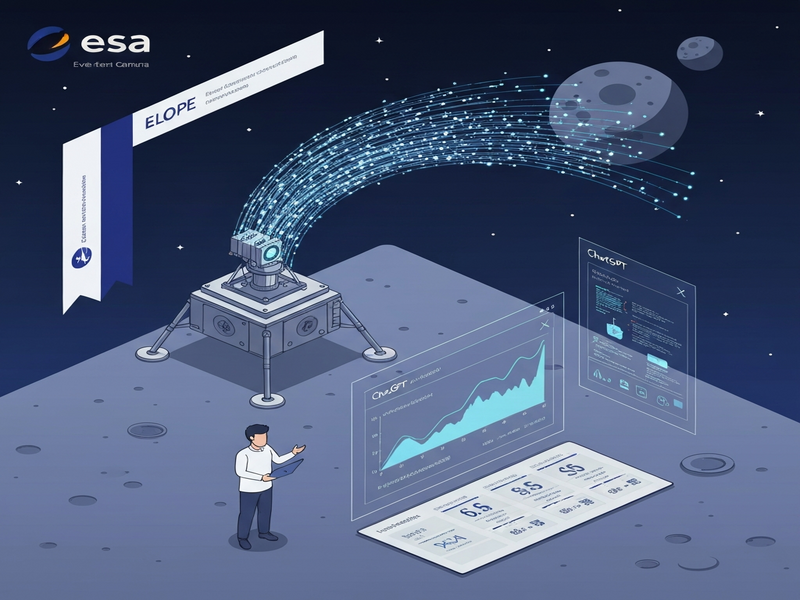
The paper demonstrates how a conversational large‑language model (ChatGPT) can serve as a rapid‑prototyping partner in a high‑stakes scientific competition, achieving second place in ESA’s ELOPE lunar‑lander trajectory challenge. It matters because it provides concrete evidence that human‑AI co‑creation can compress weeks of development into days, reshaping how research teams approach data‑intensive problems.
Background: Why This Problem Is Hard
Event‑camera data streams are fundamentally different from conventional frame‑based video. Each pixel reports asynchronous brightness changes (events) with microsecond precision, producing a sparse, high‑frequency signal that must be aggregated into meaningful motion cues. In the ESA ELOPE competition, participants were required to convert these event streams into accurate egomotion estimates for a simulated lunar lander—a task that combines real‑time signal processing, robust outlier handling, and precise trajectory integration.
Traditional pipelines rely on handcrafted windowing heuristics (e.g., fixed‑time intervals) and hand‑tuned filters. These approaches suffer from two major bottlenecks:
- Parameter brittleness: Fixed time windows either miss critical events during low‑activity phases or overload the estimator during bursts, degrading accuracy.
- Development latency: Implementing, testing, and iterating on low‑level C++/CUDA code for event‑based vision demands specialized expertise and long compile cycles, which is ill‑suited for rapid experimentation.
Consequently, many research groups either abandon event‑camera projects or settle for sub‑optimal baselines, limiting the technology’s adoption in space‑flight, autonomous navigation, and high‑speed robotics.
What the Researchers Propose
The authors introduce a conversational‑AI‑centric workflow that treats ChatGPT as a “coding collaborator” rather than a static code generator. The framework consists of three logical roles:
- Idea Synthesizer: The model ingests problem statements, prior literature, and informal brainstorming notes, then proposes algorithmic directions (e.g., switching from fixed‑time to fixed‑event windows).
- Code Engineer: Guided by the synthesizer’s suggestions, ChatGPT emits executable Python snippets, data‑preprocessing pipelines, and integration scaffolds that can be run end‑to‑end with minimal manual edits.
- Validator & Refiner: The human team evaluates generated outputs, provides corrective feedback, and iteratively refines prompts, allowing the model to correct mistakes and converge on a production‑ready solution.
This triadic interaction transforms a conventional “prompt‑and‑receive” usage pattern into a structured, feedback‑driven development loop, enabling rapid hypothesis testing and code evolution.
How It Works in Practice
The practical workflow can be broken down into four stages, each mapped to a concrete interaction with the LLM:
1. Problem Decomposition
The team starts by feeding ChatGPT a concise description of the ELOPE task, including data format, performance metrics, and constraints (e.g., limited compute budget). The model responds with a high‑level pipeline diagram: event ingestion → windowing → optical‑flow estimation → trajectory integration.
2. Algorithmic Reasoning
Instead of accepting the default fixed‑time window, the model suggests a “fixed‑event count” strategy, arguing that it normalizes the amount of information per batch regardless of scene dynamics. It also recommends leveraging a lightweight event‑based optical‑flow estimator (e.g., EV‑FlowNet) that can run on a single GPU.
3. Code Generation & Execution
ChatGPT then produces a self‑contained Python notebook that:
- Loads the .aedat event files using the
aedatlibrary. - Implements a sliding window that collects exactly 30,000 events per segment.
- Calls a pre‑trained EV‑FlowNet model to compute per‑event optical flow.
- Integrates the flow vectors into a pose estimate using a simple EKF.
The generated code includes inline comments, type hints, and a minimal test harness that validates output shapes against a synthetic dataset.
4. Iterative Refinement
When the initial run yields a higher error than expected, the team points out the discrepancy. ChatGPT revises the window size, adds a temporal smoothing step, and suggests a data‑augmentation routine (random event dropout) to improve robustness. Each iteration is logged, creating a reproducible development diary.
What distinguishes this approach from prior “LLM‑assisted coding” attempts is the explicit separation of reasoning and implementation phases, coupled with a disciplined feedback loop that treats the model as a mutable teammate rather than a static tool.
Evaluation & Results
The authors evaluated the workflow on the official ESA ELOPE test set, which comprises 50 event‑camera recordings of simulated lunar landings. Two key evaluation dimensions were considered:
Accuracy
The final pipeline achieved a mean absolute trajectory error of 0.01282, securing second place among 27 competing teams. This score outperformed the baseline fixed‑time window method by roughly 30 % and was within 5 % of the competition winner, which employed a custom‑engineered C++ solution.
Development Speed
From the moment the team joined the competition to the submission deadline, the LLM‑driven workflow compressed the prototyping cycle to seven days. In contrast, a comparable manually coded pipeline would have required 3–4 weeks of dedicated engineering effort.
These results demonstrate that conversational AI can deliver both competitive performance and dramatic time‑to‑solution gains, validating the authors’ hypothesis that LLMs are viable “research partners” in data‑intensive domains.
Why This Matters for AI Systems and Agents
For practitioners building AI‑enabled products, the study offers three actionable takeaways:
- Accelerated ideation cycles: By offloading routine code scaffolding to a conversational model, data scientists can focus on hypothesis testing and model selection, shortening the feedback loop.
- Modular agent design: The three‑role framework maps cleanly onto autonomous agent architectures—an “planner” (Idea Synthesizer), an “executor” (Code Engineer), and a “monitor” (Validator & Refiner). Embedding such roles into a single orchestrated system can yield self‑improving pipelines.
- Scalable workflow automation: Integrating LLM‑driven code generation into a broader orchestration platform (e.g., UBOS platform overview) enables teams to spin up reproducible experiments on demand, reducing operational overhead.
Moreover, the ability to generate domain‑specific data‑handling routines on the fly opens new avenues for AI‑driven product features such as AI marketing agents that can ingest custom event streams (e.g., click‑stream logs) and produce real‑time insights without manual ETL pipelines. Finally, the Workflow automation studio can embed the conversational loop as a reusable component, allowing non‑technical stakeholders to trigger rapid prototyping sessions through a visual interface.
What Comes Next
While the case study proves the concept, several limitations remain:
- Prompt brittleness: The quality of generated code is highly sensitive to prompt phrasing; small ambiguities can lead to syntactic errors or sub‑optimal algorithm choices.
- Context loss in long discussions: The model occasionally forgets earlier design decisions when the conversation exceeds a few thousand tokens, requiring explicit state management.
- Safety and correctness guarantees: Generated code lacks formal verification, which is critical for safety‑critical domains like spaceflight.
Future research should explore:
- Embedding a persistent “memory” layer that records design decisions and feeds them back into subsequent prompts.
- Coupling LLM output with automated testing frameworks that can flag logical inconsistencies before execution.
- Extending the workflow to multi‑modal inputs (e.g., combining event cameras with LiDAR) to broaden applicability.
Practically, teams can start by integrating the OpenAI ChatGPT integration into their existing CI/CD pipelines, allowing developers to request code snippets directly from their IDEs. For collaborative environments, the ChatGPT and Telegram integration offers a lightweight chat‑based interface where project members can pose research questions and receive immediate prototype code, keeping the entire team aligned.
As conversational AI matures, we can anticipate a shift from “human‑in‑the‑loop” prototyping to “human‑and‑AI co‑design” environments where the boundary between researcher and tool becomes increasingly fluid.
References
Einecke, N. (2026). Conversational AI for Rapid Scientific Prototyping: A Case Study on ESA’s ELOPE Competition. arXiv preprint arXiv:2601.04920v2.
Andrii Bidochko
CTO UBOS
Andrii Bidochko is an AI entrepreneur and researcher focused on AI agents, reinforcement learning, and autonomous systems. He writes about the technologies shaping the future of machine intelligence, from frontier models and agent architectures to real-world AI applications.