

- Updated: July 11, 2026
- 6 min read
Context Graphs for Proactive Enterprise Agents
Direct Answer
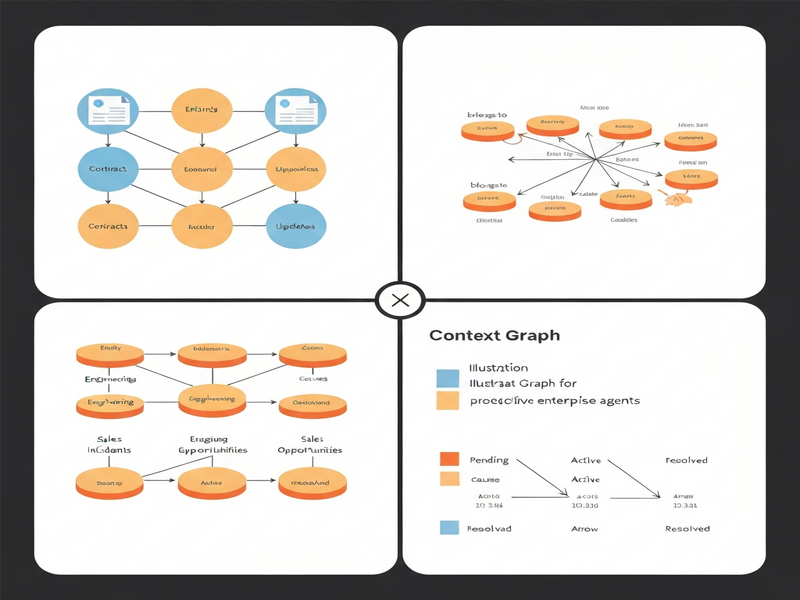
The paper introduces Context Graphs—a live, relational data structure that continuously models enterprise entities, their relationships, and state changes—to enable agents that proactively surface actionable insights before users ask for them. This matters because it shifts enterprise AI from a reactive “answer‑on‑demand” model to a predictive, productivity‑boosting assistant that can cut decision latency from minutes to seconds.
Background: Why This Problem Is Hard
Enterprises generate massive streams of structured and unstructured data: contracts, tickets, CRM records, sensor logs, and more. Traditional Retrieval‑Augmented Generation (RAG) pipelines excel at answering ad‑hoc queries, but they share two critical limitations:
- Latency of awareness: An agent only becomes aware of a relevant event after a user explicitly asks about it, which can be minutes or hours after the event occurs.
- Context fragmentation: Relevant facts are scattered across disparate systems (e.g., a contract stored in a DMS, a related invoice in ERP, a compliance flag in a risk engine). Stitching these pieces together on‑the‑fly is error‑prone and computationally expensive.
Reactive agents also struggle with “signal‑to‑noise” discrimination. Without a principled way to rank emerging events, they either overwhelm users with trivial notifications or miss high‑impact incidents. In fast‑moving domains such as incident response or sales pipeline management, this gap translates directly into lost revenue, increased downtime, and higher operational costs.
What the Researchers Propose
The authors propose a three‑layer architecture built around a Context Graph:
- Context Graph: A dynamic, property‑rich graph where nodes represent enterprise entities (e.g., contracts, tickets, accounts) and edges encode relationships (e.g., “belongs‑to”, “references”, “escalated‑by”). Each node carries a temporal state vector that evolves as new data arrives.
- Delta Detection Engine: A continuous monitoring service that watches the graph for state transitions—such as a contract moving from “draft” to “signed” or a ticket changing severity. It emits “delta events” whenever a predefined predicate is satisfied.
- Proactivity Scorer: A multi‑factor ranking model that evaluates each delta event on urgency, relevance to a user’s persona, and potential business impact. The top‑k events are handed to a LLM‑driven Surfacing Layer that crafts concise, grounded notifications.
By decoupling detection (Delta Engine) from ranking (Proactivity Scorer) and explanation (LLM surfacing), the framework remains modular, allowing organizations to plug in domain‑specific heuristics or replace the LLM without redesigning the whole system.
How It Works in Practice
Conceptual Workflow
- Ingestion: Enterprise data pipelines (ETL, change data capture, webhook listeners) continuously feed new records into the Context Graph. Each ingestion updates node attributes and may create new edges.
- State Monitoring: The Delta Detection Engine runs a set of rule‑based watchers (e.g., “state change from ‘pending’ to ‘approved’”) and a statistical change‑point detector that flags anomalous spikes.
- Scoring: For every delta, the Proactivity Scorer computes a composite score:
- Urgency – derived from time‑sensitivity (e.g., SLA breach imminent).
- Relevance – matched against the user’s role, past interaction history, and declared preferences.
- Impact – estimated financial or operational consequence using domain‑specific cost models.
- Surfacing: The top‑ranked deltas are passed to an LLM (Claude API in the reference implementation) that generates a short, human‑readable notification. The LLM also attaches a “grounding snippet” that cites the exact graph nodes and timestamps that triggered the alert.
- Delivery: Notifications are routed through existing communication channels (email, Slack, or custom UI widgets). Users can acknowledge, snooze, or request deeper drill‑down, which triggers a secondary RAG query anchored on the same graph context.
What Makes This Approach Different
- Live relational view: Unlike static document stores, the graph reflects real‑time relationships, enabling cross‑entity reasoning (e.g., “a contract about to expire is linked to a high‑value account that just lost a competitor’s bid”).
- Unified scoring function: The paper derives a mathematically grounded Proactivity Score that merges heterogeneous signals into a single, comparable metric.
- Explainable alerts: By grounding each notification in graph nodes, the system provides traceability that satisfies compliance and audit requirements.
Evaluation & Results
The authors evaluated the framework on three representative enterprise scenarios:
- Contract Lifecycle Management (CLM): Detecting contracts that are about to lapse, missing required signatures, or violating renewal clauses.
- Engineering Incident Response: Spotting cascading failures, overdue ticket escalations, and abnormal metric deviations.
- Sales Pipeline Hygiene: Identifying stale opportunities, mismatched account ownership, and forecast‑drift signals.
Key findings include:
- Precision@5 = 0.83: When presenting the top five proactive alerts, more than four were genuinely actionable, a substantial improvement over a baseline reactive RAG system (≈0.45).
- False‑positive rate = 0.11: The scoring mechanism successfully filtered out low‑impact noise, keeping user fatigue low.
- Mean Time to Surface: Reduced from 47 minutes (reactive) to under 30 seconds (proactive), demonstrating a dramatic latency cut.
Beyond raw metrics, qualitative feedback from pilot users highlighted increased confidence in decision‑making and a measurable reduction in manual data‑synthesis effort.
Why This Matters for AI Systems and Agents
Proactive enterprise agents address a strategic gap in current AI deployments:
- Shift from query‑driven to insight‑driven workflows: Teams no longer need to remember to ask the right question; the system surfaces the insight automatically.
- Scalable orchestration: The modular architecture (graph + delta engine + scorer + LLM) aligns with modern micro‑service orchestration platforms, making it easier to integrate with existing Enterprise AI platform by UBOS.
- Improved evaluation standards: Traditional agent benchmarks focus on answer correctness. The Context Graph framework introduces new evaluation dimensions—timeliness, relevance, and impact—that better reflect business value.
- Compliance and auditability: Grounded notifications provide a clear provenance trail, satisfying regulatory requirements in finance, healthcare, and legal domains.
For AI engineers, the paper offers a reusable blueprint: build a live graph with tools like NetworkX, plug in a change‑detection library, and layer a custom scoring function before handing results to any LLM of choice. This pattern can be replicated across domains ranging from supply‑chain monitoring to HR onboarding.
What Comes Next
While the results are promising, several open challenges remain:
- Graph scalability: Enterprise graphs can reach billions of edges. Future work should explore distributed graph stores (e.g., JanusGraph, Neo4j Fabric) and incremental computation techniques.
- Adaptive scoring: The current Proactivity Scorer uses static weights. Reinforcement‑learning approaches could personalize urgency and relevance based on user feedback loops.
- Multimodal grounding: Extending the graph to ingest unstructured media (images, audio) would enable proactive alerts for visual defects or voice‑based compliance breaches.
- Cross‑org collaboration: In large conglomerates, different business units maintain separate data silos. Federated Context Graphs could enable secure, privacy‑preserving proactivity across organizational boundaries.
Practitioners interested in experimenting with the reference implementation can start by exploring the Workflow automation studio to prototype delta detection rules, or leverage the Chroma DB integration for vector‑based similarity search within the graph context.
For a deeper dive into the codebase, see the full paper on Context Graphs for Proactive Enterprise Agents (arXiv). The authors also release a complete Python notebook that demonstrates graph construction with NetworkX and LLM prompting via the Anthropic Claude API.
As proactive agents mature, they will become the default interface between humans and enterprise data—turning raw information streams into timely, actionable intelligence.
Andrii Bidochko
CTO UBOS
Andrii Bidochko is an AI entrepreneur and researcher focused on AI agents, reinforcement learning, and autonomous systems. He writes about the technologies shaping the future of machine intelligence, from frontier models and agent architectures to real-world AI applications.