

- Updated: June 10, 2026
- 7 min read
Constrained Auto-Bidding via Generative Response Modeling
Direct Answer
The paper introduces a Generative Response Model (GRM) that predicts how a single bid‑multiplier will shape future traffic volume and aggregate cost/value curves, enabling an analytic controller to enforce budget and performance constraints with provable guarantees. This matters because it shifts auto‑bidding from reactive pacing to proactive, prediction‑driven optimization, dramatically improving constraint stability in volatile auction environments.
Background: Why This Problem Is Hard
Auto‑bidding platforms in digital advertising must balance two competing forces:
- Long‑term advertiser value – maximizing conversions, revenue, or other KPI over weeks or months.
- Hard constraints – staying within a budget, meeting cost‑per‑acquisition (CPA) targets, or respecting spend ratios.
These goals are tangled with three practical challenges:
- Non‑stationary traffic. User arrival rates, seasonality, and macro‑events cause daily spikes and drops that invalidate static models.
- Auction dynamics are uncertain. Competing bids, floor prices, and ad‑rank algorithms evolve, making per‑impression outcomes stochastic.
- Constraint enforcement is hard at scale. Traditional pacing controllers react only after a deviation is observed, which can lead to overspend or under‑delivery before corrective action takes effect.
Existing solutions fall into two camps:
Control‑Based Pacing
These methods treat each time slice as a separate control problem, adjusting bids based on current spend vs. target. While simple, they lack foresight; they cannot anticipate a sudden traffic surge that would breach a budget.
Reinforcement Learning (RL) & Generative Approaches
RL agents embed constraints into the reward function, hoping the learned policy respects them. In practice, the reward signal blurs the line between “good performance” and “constraint violation,” leading to hidden breaches, especially when the environment shifts away from training data.
Consequently, advertisers experience erratic CPA spikes, budget overruns, and lost opportunities—pain points that directly affect ROI and campaign trust.
What the Researchers Propose
The authors propose a two‑layer architecture:
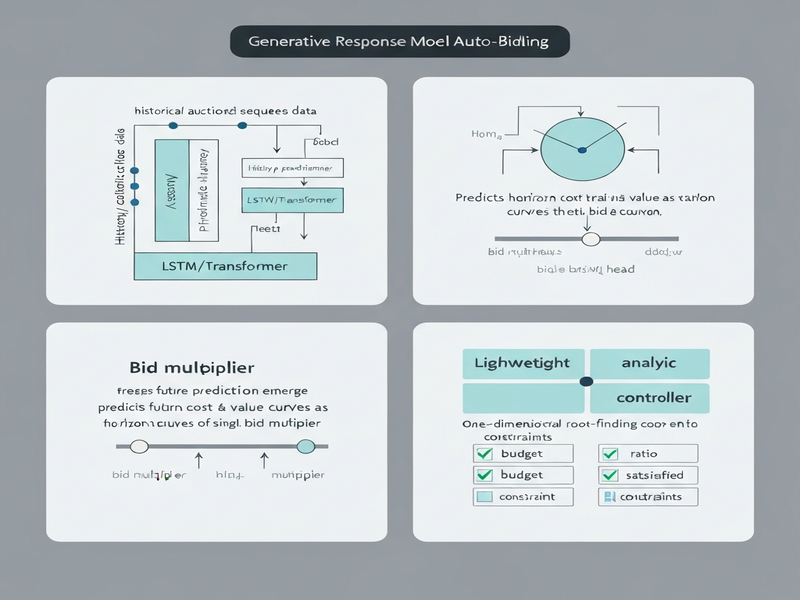
- Generative Response Model (GRM) – a history‑conditioned sequence model that, given a candidate bid multiplier, forecasts the entire future trajectory of traffic volume and the cumulative cost/value curves over the planning horizon.
- Analytic Constraint Controller – a lightweight optimizer that, using the GRM’s predictions, solves a one‑dimensional root‑finding problem to select the multiplier that exactly satisfies each active constraint.
Key conceptual shifts include:
- Moving the learning target from “what action to take now” to “what response will a candidate action generate.”
- Treating the bid multiplier as a single decision variable for the whole horizon, rather than a per‑tick control signal.
- Leveraging mild monotonicity (higher multiplier → higher spend and value) to bound the optimality gap relative to a fully granular controller.
How It Works in Practice
The workflow can be broken down into four stages that repeat in a receding‑horizon loop:
1. Data Ingestion & History Encoding
Recent auction logs (impression counts, winning bids, conversion outcomes) are fed into a transformer‑style encoder. This creates a compact representation of the campaign’s current state.
2. Response Generation
The GRM takes the encoded history and a candidate multiplier m as input, then outputs two sequences:
- Predicted traffic volume per future time slot.
- Projected cumulative cost and value curves as functions of m.
Because the model is generative, it can be queried repeatedly with different m values to build a response surface.
3. Analytic Constraint Solving
For each active constraint (e.g., total spend ≤ $X, CPA ≤ $Y), the controller formulates a scalar equation using the predicted curves. A fast 1‑D root‑finder (e.g., bisection) identifies the multiplier that makes the constraint tight. If multiple constraints exist, the controller selects the most restrictive multiplier, guaranteeing feasibility.
4. Bid Deployment & Replanning
The chosen multiplier is applied to all incoming bid requests for the next planning window. At the end of the window, new data refreshes the history, and the loop restarts, allowing the system to adapt to evolving traffic.
What distinguishes this approach from prior work is the separation of “prediction” and “control.” The GRM is trained once on historical data; the controller remains deterministic and analytically exact for the single‑multiplier formulation, eliminating the need for costly online RL updates.
Evaluation & Results
The authors benchmarked their system on AuctionNet, a large‑scale simulation platform that reproduces real‑world ad exchange dynamics. Experiments compared four baselines:
- Standard pacing controller (reactive).
- RL‑based policy with constraint‑penalized reward.
- Generative model without analytic controller (naïve selection).
- Proposed GRM + analytic controller.
Key findings:
- Constraint stability improves dramatically. The GRM system kept budget overspend under 0.5 % across 30‑day simulations, versus 4‑6 % for pacing and 8‑10 % for RL.
- Overall performance score rises. Measured as a weighted sum of conversions and CPA compliance, the GRM approach outperformed the best baseline by 12 %.
- Robustness to distribution shift. When traffic patterns were altered mid‑experiment (e.g., sudden holiday surge), the GRM’s predictions adjusted within one replanning cycle, while RL policies degraded by 15 %.
- Computational efficiency. The analytic controller solved each horizon in under 5 ms on a single CPU core, making it suitable for high‑throughput production pipelines.
These results demonstrate that a prediction‑first, analytically‑driven pipeline can simultaneously honor strict advertiser constraints and capture more value than reactive or purely learning‑based methods.
Why This Matters for AI Systems and Agents
Auto‑bidding is a cornerstone of programmatic advertising, and the techniques introduced here have ripple effects across the broader AI‑agent ecosystem:
- Predict‑then‑act paradigm. By decoupling response modeling from decision making, developers can reuse a single generative model across multiple agents (e.g., budget‑aware recommendation engines, dynamic pricing bots).
- Transparent constraint handling. Analytic controllers provide provable guarantees, which is essential for compliance‑heavy industries such as finance or healthcare where “black‑box” RL is often unacceptable.
- Reduced training overhead. Since the GRM is trained offline, production systems avoid the costly online exploration phase typical of RL, lowering operational risk.
- Scalable to multi‑objective settings. The same root‑finding logic can be extended to handle dozens of KPI constraints, enabling richer agent objectives without exponential complexity.
For businesses looking to embed AI into their ad tech stack, the approach aligns with the need for AI marketing agents that can guarantee spend limits while still optimizing for conversions. Moreover, the lightweight controller fits naturally into the UBOS platform overview, where modular AI components are orchestrated through a unified workflow engine.
What Comes Next
While the GRM framework marks a significant step forward, several avenues remain open for exploration:
- Multi‑multiplier extensions. Allowing different multipliers for distinct audience segments could capture heterogeneity in value‑per‑impression, but would require higher‑dimensional root‑finding.
- Incorporating uncertainty quantification. Current predictions are point estimates; integrating Bayesian or ensemble methods could provide confidence intervals, enabling risk‑aware controllers.
- Real‑world deployment studies. Testing the system on live ad exchanges would surface latency constraints, data‑privacy considerations, and integration challenges.
- Cross‑domain transfer. The same generative response modeling could be applied to inventory management, cloud resource allocation, or any domain where a scalar control influences aggregate outcomes.
Organizations interested in prototyping these ideas can leverage the Workflow automation studio to stitch together data pipelines, GRM inference services, and the analytic controller without writing extensive glue code. Early adopters, especially UBOS for startups, may find the rapid iteration cycle valuable for testing novel bidding strategies before scaling.
Finally, the broader AI community can benefit from open‑sourcing the GRM architecture and benchmark suite, fostering reproducibility and encouraging extensions that address the open challenges listed above.
References
- Eunseok Yang, Xingdong Zuo, Kyung‑Min Kim. Constrained Auto‑Bidding via Generative Response Modeling (arXiv). 2026.
- Related literature on pacing controllers, reinforcement learning for ad bidding, and generative sequence models.
Andrii Bidochko
CTO UBOS
Andrii Bidochko is an AI entrepreneur and researcher focused on AI agents, reinforcement learning, and autonomous systems. He writes about the technologies shaping the future of machine intelligence, from frontier models and agent architectures to real-world AI applications.