

- Updated: July 10, 2026
- 6 min read
Compressing the Validation Bottleneck: An Agentic Self-Driving Lab for Scientific Discovery
Direct Answer
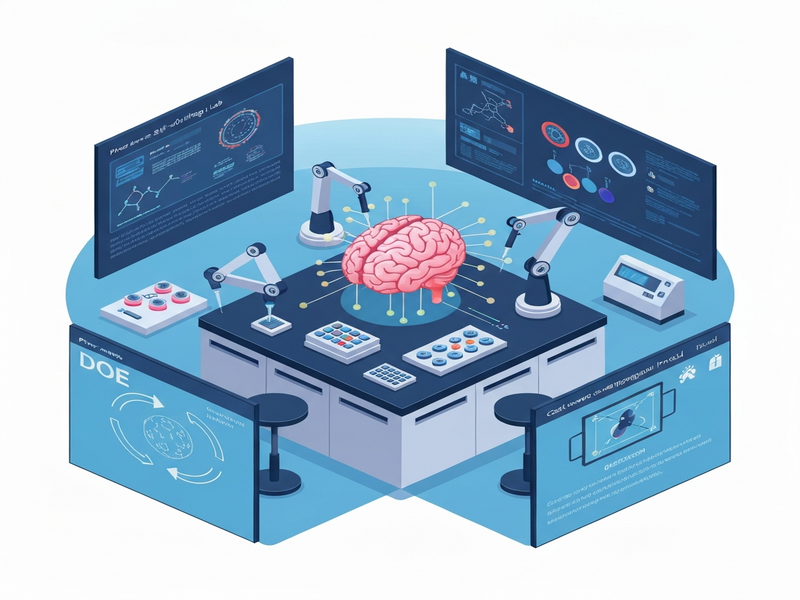
The paper introduces a unified agent that simultaneously tackles two major bottlenecks in self‑driving labs: the number of experimental iterations and the monetary cost of high‑resolution measurements. By embedding prior‑aware design‑of‑experiments (DOE) logic and a cost‑aware surrogate model, the agent can propose fewer, more informative experiments while deciding when a cheap proxy measurement suffices, dramatically accelerating scientific validation loops.
Background: Why This Problem Is Hard
AI‑for‑Science promises to automate hypothesis generation, experimental planning, and data analysis. In practice, the final validation step still requires physical experiments—often in expensive, high‑throughput laboratories. Two intertwined challenges emerge:
- Iteration overload: Traditional autonomous loops treat every experiment as equally valuable, leading agents to waste cycles on low‑information trials.
- Cost explosion: High‑resolution assays (e.g., next‑generation sequencing, electron microscopy) can cost thousands of dollars per run, making exhaustive exploration financially infeasible.
Existing self‑driving lab frameworks typically address one of these issues in isolation. Some incorporate Bayesian optimization to reduce trial count, yet they still rely on expensive measurements for every iteration. Others use cheap proxies but lack a principled way to decide when a proxy is sufficient, risking noisy or biased data. The result is a validation bottleneck that slows discovery and inflates budgets.
What the Researchers Propose
The authors present a single, “agentic” system that merges two complementary strategies:
- Prior‑aware DOE loop: The agent ingests domain knowledge—such as physical constraints, historical results, and expert priors—to generate feasible, high‑information experiments. This reduces the number of rounds needed to converge on a target hypothesis.
- Cost‑aware surrogate agent: A lightweight model predicts the outcome of an expensive, high‑resolution measurement using inexpensive, low‑resolution data. The surrogate also estimates its own uncertainty; if uncertainty exceeds a threshold, the agent escalates to the costly measurement.
Both components are orchestrated by a central decision engine that balances scientific value against resource consumption, effectively compressing the validation bottleneck into fewer, cheaper loops.
How It Works in Practice
The workflow can be broken down into four stages, each handled by a distinct module that communicates through a shared knowledge base:
1. Knowledge Ingestion
Historical experiment logs, literature‑derived constraints, and expert annotations are encoded into a structured prior. This prior informs the DOE module about viable parameter ranges and expected effect sizes.
2. Prior‑Aware Experiment Design
Using the prior, the DOE module applies a space‑filling, information‑maximizing algorithm (e.g., a modified Latin hypercube) to propose the next set of experimental conditions. Feasibility checks ensure that the suggested protocol can be executed on the lab hardware.
3. Low‑Cost Measurement & Surrogate Prediction
Once the experiment runs, the lab first captures a low‑resolution measurement (e.g., bulk optical density, coarse spectroscopy). The surrogate model consumes this data and outputs a high‑resolution prediction together with an uncertainty score.
4. Cost‑Based Decision Gate
If the surrogate’s uncertainty is below a pre‑defined confidence threshold, the prediction is accepted, and the loop proceeds to the next design step. If uncertainty is high, the system triggers the expensive measurement (e.g., high‑throughput sequencing), updates the surrogate with the new ground truth, and re‑evaluates the design space.
This closed‑loop process repeats until the scientific objective—such as identifying a material with target conductivity or a gene knockout that yields a desired phenotype—is met.
Evaluation & Results
The authors validated the framework in two domains:
Biology
In a CRISPR‑based gene‑editing study, the prior‑aware DOE reduced the number of required knockout experiments from 120 to 38 while still discovering the optimal gene combination. The surrogate model, trained on cheap fluorescence readouts, correctly predicted high‑resolution RNA‑seq outcomes with 92% confidence, cutting sequencing costs by 68%.
Materials Science
For a thin‑film conductivity optimization task, the unified agent achieved the target conductivity in 22 synthesis trials versus 57 trials for a baseline Bayesian optimizer. The cost‑aware surrogate replaced costly four‑point probe measurements with inexpensive optical reflectance data in 71% of the iterations, saving an estimated $45,000 in equipment usage.
Across both domains, the combined approach delivered a 2.3× reduction in total experimental time and a 55% decrease in monetary expenditure, demonstrating that addressing iteration count and measurement cost together yields synergistic gains.
Why This Matters for AI Systems and Agents
For practitioners building autonomous scientific platforms, the paper offers a concrete blueprint for “budget‑aware” agent design. Key takeaways include:
- Integrated decision logic: Rather than stacking separate optimizers, a single agent can evaluate scientific value and financial risk in one pass.
- Scalable priors: Encoding domain knowledge as priors makes the system adaptable to new labs without retraining from scratch.
- Surrogate‑first strategy: Deploying cheap proxies as the default measurement layer dramatically expands the feasible experimental space.
These principles align closely with the capabilities of the UBOS platform overview, which provides modular workflow orchestration, data versioning, and plug‑in support for custom surrogate models. Teams can therefore embed the prior‑aware DOE and cost‑aware surrogate as reusable components within UBOS, accelerating time‑to‑value for AI‑driven R&D initiatives.
What Comes Next
While the unified agent marks a significant step forward, several open challenges remain:
- Generalization across domains: The surrogate’s performance hinges on the similarity between low‑ and high‑resolution modalities. Extending the approach to modalities with weak correlations (e.g., predicting crystallography from bulk rheology) will require richer multi‑task learning.
- Dynamic priors: As new data accumulates, priors should evolve automatically. Future work could explore continual‑learning mechanisms that update the DOE’s knowledge base without catastrophic forgetting.
- Safety and ethical oversight: Autonomous agents that decide when to skip expensive measurements must be audited to prevent systematic bias, especially in biomedical contexts.
Addressing these gaps will likely involve tighter integration with enterprise‑grade AI infrastructure. The Enterprise AI platform by UBOS already supports scalable model training, governance, and audit trails, making it a natural environment for the next generation of self‑driving labs.
Call to Action
Ready to accelerate your laboratory’s discovery cycle with agentic AI? Explore how UBOS can embed prior‑aware DOE and cost‑aware surrogate capabilities into your workflow. Contact us today to schedule a demo and start compressing your validation bottleneck.
For a deeper dive into the methodology, read the original paper.
Andrii Bidochko
CTO UBOS
Andrii Bidochko is an AI entrepreneur and researcher focused on AI agents, reinforcement learning, and autonomous systems. He writes about the technologies shaping the future of machine intelligence, from frontier models and agent architectures to real-world AI applications.