

- Updated: June 26, 2026
- 6 min read
Composing Verifiable Conceptual Models via Building Blocks: Towards Design-Time Verification of Agentic AI Workflows
Direct Answer
The paper introduces a design‑time verification framework that treats agentic AI workflows as compositions of reusable “building‑block” models, checking their compatibility with twelve structural rules before deployment. This matters because it lets developers catch coordination flaws early, reducing costly runtime failures in complex LLM‑orchestrated systems.
Background: Why This Problem Is Hard
Agentic AI systems—networks of large language model (LLM) agents that invoke tools, exchange data, and trigger external actions—are becoming the backbone of modern automation platforms. While runtime monitoring (e.g., sandboxing, policy enforcement) can block overtly unsafe actions, it does not guarantee that the underlying workflow logic is coherent. Designers often assemble workflows by stitching together prompts, APIs, and tool calls, but they lack a systematic way to verify that the pieces will interoperate as intended.
Current orchestration platforms focus on execution‑time safeguards such as token limits, rate‑limiting, or heuristic safety filters. These mechanisms assume the workflow graph is already correct, which is rarely true in practice. A mis‑aligned input schema, a missing dependency, or an ambiguous decision node can cause silent failures, dead‑ends, or unintended side effects—issues that only surface after costly production runs.
From a modeling perspective, this mirrors the classic challenge of composing conceptual models without guaranteeing structural consistency. Without formal checks, developers must rely on ad‑hoc testing, which is both time‑consuming and incomplete. The gap is especially acute for enterprises that need repeatable, auditable pipelines for compliance and AI safety.
What the Researchers Propose
The authors present a modular verification methodology that abstracts an agentic workflow into a set of building blocks. Each block encapsulates a single logical capability—such as “retrieve user profile,” “select tool,” or “make a decision”—and declares its inputs, outputs, and behavioral contracts. The framework then applies twelve structural rules that capture essential compatibility constraints, including:
- Input‑output type matching
- Uniqueness of decision points
- Absence of circular tool dependencies
- Proper termination of external actions
- Consistency of state‑transition semantics
When a workflow is assembled, the verifier traverses the graph, checks each rule, and reports violations before any code is executed. By treating verification as a design‑time activity, the approach shifts error detection left in the development lifecycle.
How It Works in Practice
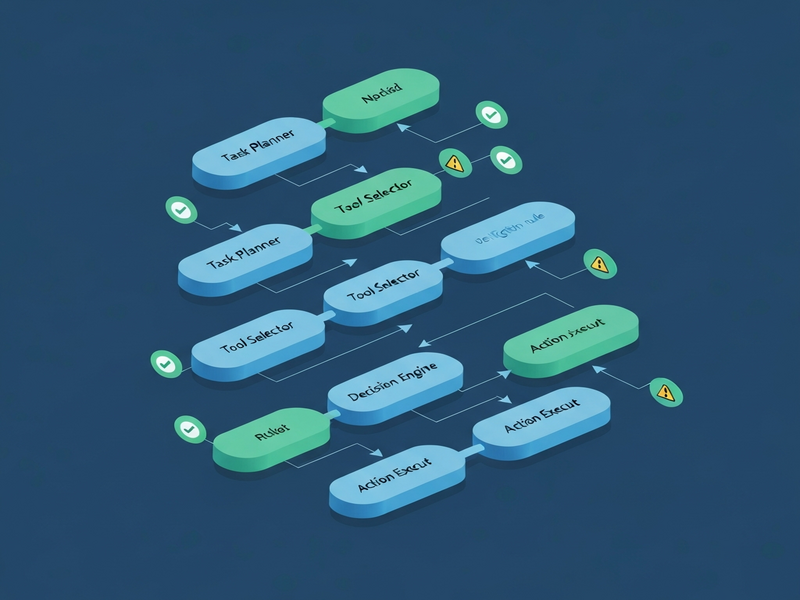
At a high level, the verification pipeline consists of three stages:
- Block Library Construction: Engineers create a repository of reusable building blocks, each annotated with formal metadata (input schema, output schema, side‑effects, required tools).
- Workflow Composition: Using a visual editor or DSL, designers connect blocks to form a directed acyclic graph (DAG) that represents the intended agentic flow.
- Design‑Time Verification: The verifier ingests the DAG, instantiates the twelve structural rules, and evaluates them in a single pass. Violations are surfaced as actionable diagnostics (e.g., “Block B expects a
stringbut receivesintegerfrom Block A”).
The system differs from existing runtime‑only solutions in two key ways:
- Static Guarantees: By checking type and control‑flow constraints ahead of time, the framework prevents a class of bugs that would otherwise require extensive integration testing.
- Reusability: Because blocks are self‑describing, they can be shared across projects or even across organizations, fostering a community‑driven ecosystem of vetted components.
Below is a conceptual diagram illustrating the three‑stage pipeline:
In practice, a developer might start with a Workflow automation studio to drag‑and‑drop blocks, run the verifier, and iterate until the graph passes all twelve rules.
Evaluation & Results
The authors validated their prototype on two publicly available datasets:
- Dataset A: 48 agentic workflows deliberately injected with design flaws (e.g., mismatched schemas, missing termination nodes).
- Dataset B: 168 variants of the same logical workflows where the graph structure was transformed (e.g., task splitting, parallelization) to test robustness against superficial changes.
Key findings include:
- The verifier identified 100 % of the known violations in Dataset A, confirming that the twelve rules cover the most common design errors.
- In Dataset B, the verifier still flagged the underlying incompatibilities despite structural transformations, demonstrating that the approach is resilient to graph refactoring.
- False‑positive rates remained below 2 %, indicating that the rules are precise enough not to over‑constrain legitimate designs.
These results suggest that design‑time verification can reliably surface hidden flaws, even when developers attempt to “hide” problems by re‑architecting the workflow layout.
Why This Matters for AI Systems and Agents
For enterprises building large‑scale agentic pipelines, the ability to certify a workflow before it touches production data is a game‑changer. The benefits are threefold:
- Reduced Downtime: Early detection of incompatibilities prevents runtime crashes that could interrupt critical business processes.
- Compliance & Auditing: A verifiable design artifact satisfies regulatory demands for traceability, especially in sectors like finance or healthcare where AI decisions must be explainable.
- Accelerated Innovation: Teams can safely experiment with new blocks, knowing that the verifier will catch integration errors automatically.
Practically, the framework aligns with the growing demand for AI safety tooling that moves beyond post‑hoc monitoring. By embedding verification into the development workflow, organizations can adopt a “shift‑left” safety posture, similar to static analysis in traditional software engineering.
Developers using the UBOS platform overview can integrate these verification rules directly into their CI/CD pipelines, ensuring that every commit that modifies a workflow is automatically checked for structural soundness.
What Comes Next
While the prototype demonstrates strong detection capabilities, several open challenges remain:
- Scalability to Massive Graphs: As workflows grow to thousands of nodes, verification performance must be optimized, possibly through incremental checking.
- Dynamic Contexts: Current rules assume static schemas; extending them to handle runtime‑generated data (e.g., user‑specific prompts) will broaden applicability.
- Community‑Driven Block Repositories: Establishing standards for block metadata and encouraging open‑source contributions could create a marketplace of vetted components.
- Integration with Runtime Monitors: Combining design‑time guarantees with runtime safety nets would provide end‑to‑end assurance.
Future research may explore automated synthesis of verification rules from formal specifications, or the use of model‑checking techniques to prove properties like dead‑lock freedom. For organizations eager to adopt a verification‑first mindset, the Enterprise AI platform by UBOS already offers extensible hooks for custom rule sets, making it straightforward to pilot these ideas in production.
References
- Flandre, N. Y., Nwala, A. C., & Giabbanelli, P. J. (2026). Composing Verifiable Conceptual Models via Building Blocks: Towards Design‑Time Verification of Agentic AI Workflows. arXiv preprint arXiv:2606.21565.
Andrii Bidochko
CTO UBOS
Andrii Bidochko is an AI entrepreneur and researcher focused on AI agents, reinforcement learning, and autonomous systems. He writes about the technologies shaping the future of machine intelligence, from frontier models and agent architectures to real-world AI applications.