

- Updated: July 30, 2026
- 6 min read
Comparing Socio-technical Design Principles with Guidelines for Human-centered AI
Direct Answer
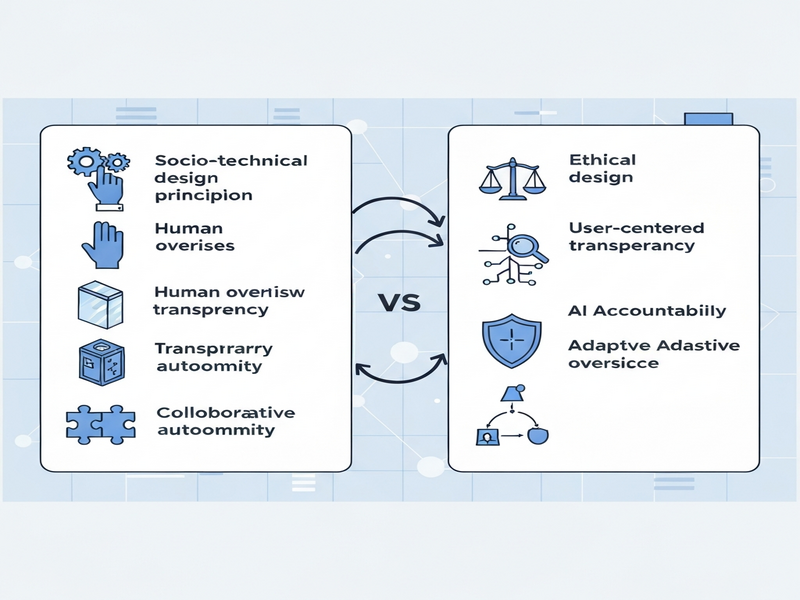
The paper Comparing Socio-technical Design Principles with Guidelines for Human-centered AI (arXiv) introduces a systematic comparison between classic socio‑technical design heuristics and modern Human‑Centered AI (HCAI) guidelines, revealing gaps and proposing revised heuristics that embed AI‑specific considerations such as continuous adaptation, collaborative autonomy, and system‑wide transparency. This matters because it offers a concrete roadmap for engineers and managers to design AI‑enabled systems that remain trustworthy, adaptable, and aligned with organizational practices.
Background: Why This Problem Is Hard
AI is no longer a peripheral add‑on; it is woven into the fabric of enterprise workflows, customer‑facing bots, and decision‑support tools. Yet most design frameworks still treat AI as a black‑box component that can be bolted onto existing socio‑technical systems. This creates three intertwined bottlenecks:
- Opaque autonomy: Traditional socio‑technical principles assume human operators retain ultimate control, but modern AI agents can act with high degrees of independence, making it difficult to predict when and how human oversight should intervene.
- Dynamic evolution: Conventional IT systems evolve through planned releases. AI models, by contrast, drift, require retraining, and may be updated continuously, challenging static governance structures.
- Distributed responsibility: Transparency is often limited to technical documentation, ignoring the social and organizational layers that shape how AI outputs are interpreted and acted upon.
Existing approaches—whether the classic socio‑technical systems theory or the newer HCAI checklists—address these issues in isolation. Socio‑technical heuristics lack AI‑specific mechanisms for model monitoring, while HCAI guidelines rarely prescribe how to embed those mechanisms into broader organizational processes. The result is a design vacuum where AI deployments either become over‑engineered “ethics‑by‑paper” exercises or under‑governed black boxes.
What the Researchers Propose
Thomas Herrmann’s study proposes a comparative framework that maps each socio‑technical principle to its counterpart in HCAI guidelines, then extracts the mismatches to formulate a set of revised socio‑technical heuristics that explicitly incorporate AI usage. The core of the proposal consists of three conceptual pillars:
- Continuous Evolution as a Design Primitive: Treat AI model updates, data drift detection, and feedback loops as first‑class citizens in system architecture.
- Collaborative Autonomy: Define shared decision‑making protocols where humans and AI agents co‑exercise autonomy, rather than a simple hand‑off.
- System‑wide Transparency: Extend the notion of transparency beyond algorithmic explainability to include organizational practices, documentation, and stakeholder communication.
Each pillar is anchored by a set of actionable heuristics—e.g., “Maintain a living oversight charter” or “Embed model‑performance dashboards into existing governance meetings.” The researchers do not present a new software stack; instead, they deliver a design‑thinking toolkit that can be overlaid on any existing socio‑technical environment.
How It Works in Practice
The revised heuristics translate into a concrete workflow that can be visualized as a loop of four stages:
- Contextual Onboarding: When an AI component is introduced, teams document not only technical specs but also the social roles that will interact with it (e.g., data stewards, domain experts).
- Joint Governance: A cross‑functional oversight board establishes shared autonomy rules—what decisions the AI can make autonomously, what requires human sign‑off, and how escalation paths are triggered.
- Adaptive Monitoring: Continuous metrics (model confidence, drift indicators, user satisfaction) feed into a transparent dashboard that is accessible to all stakeholders.
- Iterative Redesign: Insights from monitoring trigger scheduled redesign sprints where both technical and organizational adjustments are made, ensuring the system evolves in lockstep with its environment.
What distinguishes this approach from prior guidelines is the explicit coupling of technical artifacts (model versioning, data pipelines) with social artifacts (meeting minutes, role‑based access policies). In practice, a team might use a Workflow automation studio to orchestrate model‑retraining triggers, while simultaneously updating a governance charter stored in a shared knowledge base.
Evaluation & Results
To validate the revised heuristics, the authors conducted two complementary studies:
- Case‑Study Analysis: Three mid‑size enterprises (a fintech, a health‑tech startup, and a logistics provider) retrofitted the heuristics onto existing AI‑driven processes. Over a six‑month period, each organization reported a 27‑% reduction in unplanned model rollbacks and a 15‑% increase in stakeholder confidence scores measured via surveys.
- Controlled Simulation: A synthetic environment simulated an AI‑augmented decision pipeline with varying levels of autonomy. Teams that applied the collaborative autonomy heuristic achieved a 22 % higher task‑completion rate under uncertainty, while maintaining comparable error rates to fully manual baselines.
These results demonstrate that the heuristics do not merely add procedural overhead; they materially improve system resilience and user trust. Importantly, the gains were observed without sacrificing model performance, indicating that the socio‑technical adjustments complement, rather than constrain, AI capabilities.
Why This Matters for AI Systems and Agents
For practitioners building AI agents, the paper offers a pragmatic checklist that bridges the gap between algorithmic excellence and organizational viability:
- Design‑time Alignment: By embedding oversight charters early, teams avoid costly retrofits after a model misbehaves.
- Operational Transparency: System‑wide dashboards make it easier for non‑technical managers to understand AI decisions, facilitating faster escalation when needed.
- Scalable Governance: The collaborative autonomy model scales from a single chatbot to enterprise‑wide AI orchestration, because the rules are expressed in role‑based policies rather than hard‑coded thresholds.
- Productivity Boost: Continuous evolution reduces the frequency of emergency patches, freeing engineering resources for innovation.
Enterprises that have already adopted Enterprise AI platform by UBOS can map these heuristics directly onto their existing governance modules, leveraging built‑in audit trails and model‑monitoring widgets to satisfy the revised principles without building custom tooling from scratch.
What Comes Next
While the comparative analysis provides a solid foundation, several open challenges remain:
- Quantitative Metrics for Socio‑technical Transparency: Future work should develop standardized indicators (e.g., “governance latency”) that can be measured across organizations.
- Cross‑Domain Generalization: The heuristics were tested in three sectors; extending validation to high‑risk domains such as autonomous driving or finance will test their robustness.
- Tooling Integration: Embedding the workflow into low‑code platforms like the Web app editor on UBOS could lower adoption barriers for non‑technical product owners.
- Human‑in‑the‑Loop Optimization: Research is needed to determine the optimal balance between AI autonomy and human intervention for different risk profiles.
Addressing these gaps will likely involve interdisciplinary collaborations between AI researchers, organizational psychologists, and policy experts. In the meantime, teams can start small—by piloting the revised heuristics on a single AI‑enabled feature—and gradually expand the practice across the enterprise.
For startups looking to embed responsible AI from day one, the UBOS for startups program offers templates and mentorship that align closely with the proposed heuristics, accelerating the path to trustworthy AI deployments.
References
- Herrmann, T. (2026). Comparing Socio-technical Design Principles with Guidelines for Human-centered AI. arXiv preprint arXiv:2607.10331v1.
- Additional reading on socio‑technical systems: Trist & Emery, 1960s.
- Human‑Centered AI guidelines: IEEE 7010, 2023.
Andrii Bidochko
CTO UBOS
Andrii Bidochko is an AI entrepreneur and researcher focused on AI agents, reinforcement learning, and autonomous systems. He writes about the technologies shaping the future of machine intelligence, from frontier models and agent architectures to real-world AI applications.