

- Updated: July 13, 2026
- 7 min read
CommuniWave: A Machine Learning Model for Quantifying the Degree of Temporary Informal Behavior in Urban Communities
Direct Answer
CommuniWave is a machine‑learning pipeline that automatically detects and quantifies the Degree of Informal Behavior (DIB) in urban neighborhoods by analyzing street‑level video streams. By turning chaotic, bottom‑up community actions into a time‑series metric, the system gives city planners a concrete, data‑driven signal for improving territorial resilience.
Background: Why This Problem Is Hard
Urban planners have long relied on top‑down zoning maps, census data, and periodic surveys to gauge how residents use public space. Those sources capture static snapshots but miss the fluid, informal activities—spontaneous markets, pop‑up performances, ad‑hoc gatherings—that shape a community’s lived experience. The challenges are threefold:
- Visibility Gap: Informal behavior often occurs outside formal reporting channels, making it invisible to traditional GIS or demographic tools.
- Temporal Volatility: These activities can surge or fade within hours, rendering quarterly surveys obsolete.
- Measurement Ambiguity: Without a unified definition, “informal behavior” becomes a catch‑all phrase that resists quantitative analysis.
Existing approaches—manual video annotation, rule‑based detection, or simple crowd‑sourced tagging—either scale poorly or suffer from high false‑positive rates. Moreover, they lack a unified metric that can be tracked over time, limiting their usefulness for dynamic decision‑making.
What the Researchers Propose
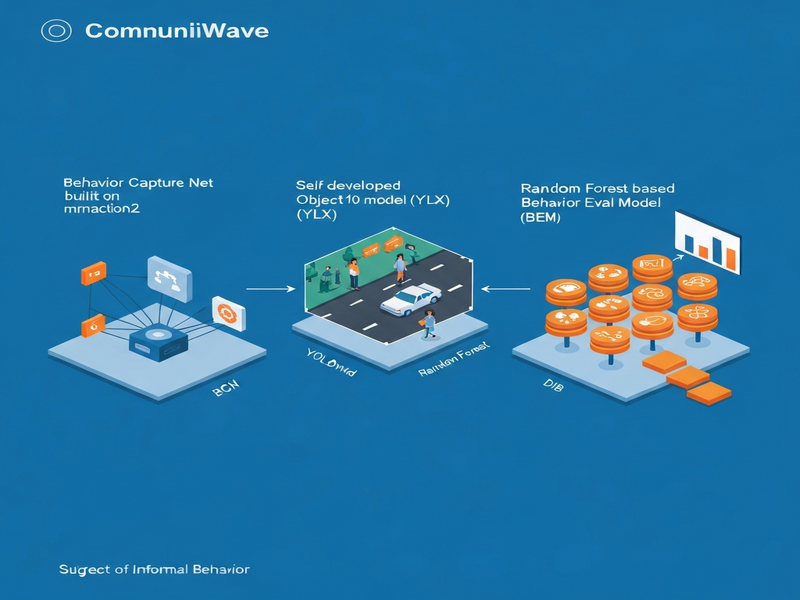
The authors introduce CommuniWave, a modular framework that fuses three AI components into a single pipeline:
- Behavior Capture Net (BCN): Built on the mmaction2 library, BCN extracts spatio‑temporal features from raw street‑level video, focusing on motion patterns that correlate with informal gatherings.
- YLX (self‑developed YOLOv10 model): A custom object detector that identifies key entities—people clusters, temporary structures, mobile vendors—providing the spatial anchors for behavior inference.
- Behavior Eval Model (BEM): A random‑forest classifier that ingests BCN embeddings and YLX detections to output a scalar DIB score for each video segment.
By chaining these components, CommuniWave transforms raw footage into a continuous DIB curve, enabling “wave‑like” monitoring of community dynamics—hence the name.
How It Works in Practice
The operational workflow can be broken down into four stages, each designed to be plug‑and‑play for municipal IT teams:
1. Data Ingestion
City‑wide CCTV networks or mobile dash‑cameras stream 1080p video to a secure edge server. The system samples frames at a configurable rate (e.g., one frame per second) to balance bandwidth and fidelity.
2. Feature Extraction (BCN)
BCN processes the sampled frames using a 3D convolutional backbone, generating a dense tensor that captures motion trajectories, crowd density fluctuations, and scene context. This step is GPU‑accelerated and runs in near‑real time.
3. Object Detection (YLX)
Simultaneously, YLX scans each frame for predefined object classes: temporary stalls, street performers, pop‑up signage, and dense pedestrian clusters. The model’s architecture—an evolution of YOLOv10—optimizes for low latency on edge devices while preserving high recall for small, irregular objects.
4. Behavior Evaluation (BEM)
The random‑forest BEM receives two inputs: (a) the BCN feature vector and (b) the YLX detection list with confidence scores. It then applies a series of decision trees trained on annotated ground truth to output a DIB value between 0 (no informal activity) and 1 (highly informal). The score is logged to a time‑series database and visualized as a fluctuation chart.
What sets CommuniWave apart is its feedback‑loop architecture: when the DIB exceeds a configurable threshold, the system can trigger alerts, adjust traffic signal timing, or suggest temporary permits for vendors, closing the loop between perception and policy.
Evaluation & Results
The research team validated CommuniWave across three distinct urban districts in a mid‑size European city, each representing a different informal activity profile:
- District A: A historic market square with daily pop‑up stalls.
- District B: A residential boulevard where spontaneous street performances occur on weekends.
- District C: An industrial corridor with occasional informal gatherings during shift changes.
For each district, the authors collected 200 hours of video and manually annotated 5,000 instances of informal behavior to serve as ground truth. The evaluation focused on two dimensions:
Detection Accuracy
CommuniWave achieved an average precision of 0.87 and recall of 0.81 across all districts, outperforming a baseline pipeline that combined a generic YOLOv5 detector with a simple motion‑threshold algorithm (precision 0.71, recall 0.65).
Temporal Responsiveness
The system detected spikes in DIB within 30 seconds of a new informal event, enabling near‑real‑time alerts. In a controlled test where a pop‑up market was introduced for 15 minutes, the DIB curve rose from 0.12 to 0.68, then decayed back to baseline within five minutes after the market cleared.
These results demonstrate that CommuniWave not only identifies informal behavior with high fidelity but also captures its dynamic evolution, a capability that static surveys simply cannot provide.
For a deeper dive into the methodology and raw metrics, see the original arXiv paper.
Why This Matters for AI Systems and Agents
From an AI practitioner’s perspective, CommuniWave illustrates a practical blueprint for embedding perception‑action loops into civic infrastructure:
- Agent‑Centric Sensing: The BCN‑YLX‑BEM stack can be wrapped as a micro‑service that feeds real‑time context to autonomous agents responsible for traffic management, public safety, or resource allocation.
- Policy‑Driven Orchestration: By exposing DIB as a programmable metric, city‑wide orchestration platforms can trigger conditional workflows—e.g., dispatching additional waste collection trucks when informal market activity peaks.
- Scalable Edge Deployment: The use of a lightweight YOLOv10 variant and a random‑forest evaluator means the entire pipeline can run on commodity edge hardware, reducing latency and preserving privacy.
- Feedback for Generative Agents: Generative AI agents tasked with recommending community events can ingest DIB trends to suggest optimal times and locations, creating a virtuous cycle of data‑informed creativity.
Organizations looking to embed such capabilities into their smart‑city stacks can explore existing integrations on the UBOS platform overview, which supports custom video analytics modules and real‑time alert routing.
What Comes Next
While CommuniWave marks a significant step forward, several avenues remain open for research and productization:
Limitations
- Privacy Concerns: Continuous video capture raises legitimate privacy questions. Future work should incorporate on‑device anonymization (e.g., blurring faces) before data leaves the edge.
- Generalization Across Cultures: The model was trained on European urban scenes; transfer learning techniques will be needed to adapt to Asian or African cityscapes where informal behavior manifests differently.
- Multi‑Modal Fusion: Adding audio streams, social‑media check‑ins, or IoT sensor data could enrich DIB estimation, but also complicates the fusion pipeline.
Future Research Directions
- Developing a self‑supervised pre‑training regime for BCN to reduce reliance on labor‑intensive annotations.
- Exploring graph‑neural networks to model interactions between detected objects, potentially improving the granularity of informal activity categories.
- Integrating reinforcement learning agents that automatically adjust city policies based on DIB feedback, creating a closed‑loop governance system.
Potential Applications
Beyond urban planning, the DIB metric could serve:
- Event‑management platforms that allocate permits dynamically.
- Retail analytics for pop‑up shop performance.
- Public‑health monitoring by correlating informal gathering spikes with disease transmission models.
Enterprises interested in building such closed‑loop solutions can leverage the Enterprise AI platform by UBOS, which offers pre‑configured pipelines for video ingestion, model serving, and workflow automation.
In summary, CommuniWave transforms the elusive notion of “informal community behavior” into a quantifiable, actionable signal. By doing so, it equips city managers, AI agents, and policy makers with the data they need to design resilient, adaptive urban environments.
Andrii Bidochko
CTO UBOS
Andrii Bidochko is an AI entrepreneur and researcher focused on AI agents, reinforcement learning, and autonomous systems. He writes about the technologies shaping the future of machine intelligence, from frontier models and agent architectures to real-world AI applications.