

- Updated: July 19, 2026
- 7 min read
CoCo‑Fed: A Unified Framework for Memory- and Communication-Efficient Federated Learning at the Wireless Edge
Direct Answer
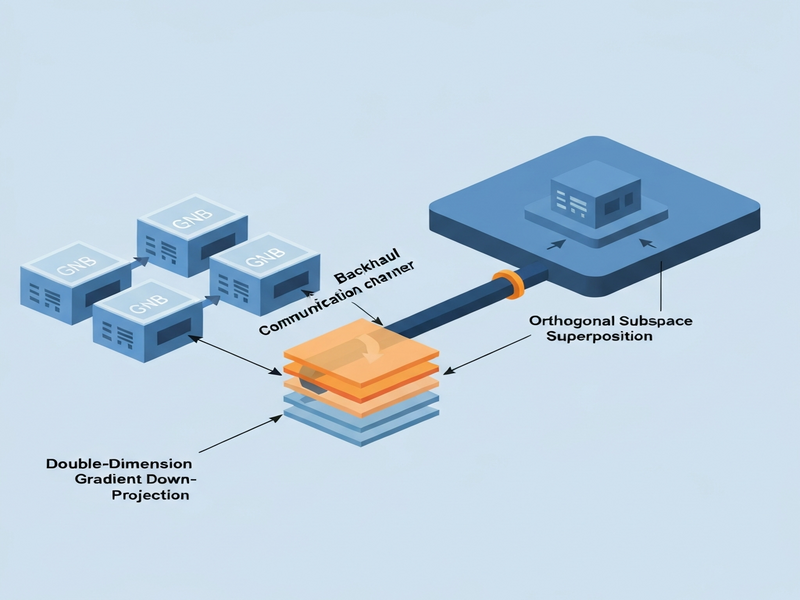
CoCo‑Fed is a new federated‑learning framework that simultaneously cuts the memory required for local training and the bandwidth needed for global model aggregation on O‑RAN base stations. By projecting gradients onto low‑rank subspaces and superimposing layer updates into a single orthogonal matrix, it makes large‑scale edge AI feasible on resource‑constrained gNBs.
Background: Why This Problem Is Hard
Deploying deep neural networks at the wireless edge—especially within the Open Radio Access Network (O‑RAN) ecosystem—faces two intertwined bottlenecks:
- Memory wall: Modern models can require hundreds of megabytes of RAM for a single training step, far exceeding the limited memory of distributed gNBs.
- Backhaul congestion: Federated learning traditionally sends full‑precision model updates (often tens of megabytes per round) over bandwidth‑limited fronthaul/backhaul links, quickly saturating the network.
Current mitigation strategies—such as gradient sparsification, quantization, or model pruning—address one side of the problem but rarely both. Sparsification reduces traffic but leaves the local memory footprint untouched; pruning shrinks the model but often requires additional inference latency or a redesign of the on‑device optimizer. Moreover, many techniques assume IID data and stable connectivity, conditions that rarely hold in wireless sensing or massive MIMO scenarios.
What the Researchers Propose
The authors introduce CoCo‑Fed (Compression and Combination‑based Federated learning), a two‑pronged framework that unifies memory efficiency and communication reduction:
- Local memory efficiency through a double‑dimension down‑projection of gradients, turning high‑dimensional updates into compact low‑rank representations without adding inference parameters.
- Global communication reduction via an orthogonal subspace superposition protocol that merges layer‑wise updates from each gNB into a single consolidated matrix before transmission.
Key agents in the system are the edge gNB trainer, which performs the low‑rank optimization, and the central orchestrator, which decodes the superimposed matrices and reconstructs the global model.
How It Works in Practice
Conceptual Workflow
- Initialization: The central orchestrator distributes a seed model and a shared projection basis to all participating gNBs.
- Local Gradient Down‑Projection: Each gNB computes raw gradients on its local data, then projects them first across the channel dimension and second across the filter dimension, yielding a low‑rank gradient tensor.
- Low‑Rank Optimizer Step: The projected gradients feed a modified optimizer (e.g., low‑rank Adam) that updates the local model without ever materializing the full‑size gradient.
- Orthogonal Subspace Superposition: Before sending updates, each gNB multiplies its low‑rank tensors by a unique orthogonal matrix and adds them together, producing a single consolidated matrix per communication round.
- Global Aggregation: The orchestrator receives the superimposed matrices, applies the inverse orthogonal transforms, and aggregates the recovered low‑rank updates into the global model.
- Broadcast: The updated global model is broadcast back to the gNBs, completing the round.
Interaction Between Components
The edge trainer and central orchestrator remain loosely coupled; the only shared state is the projection basis and orthogonal matrices, which can be refreshed periodically to improve privacy. Because the superposition step collapses all layers into one matrix, the backhaul traffic per round drops from O(L·P) to O(P), where L is the number of layers and P the projection size.
What Makes This Approach Different
- Dual‑dimensional compression: Instead of a single flattening step, CoCo‑Fed compresses along both input and output dimensions, preserving more expressive power.
- Zero‑overhead inference: The low‑rank representation is used only during training; inference runs on the original full‑size model, avoiding latency penalties.
- Theoretical guarantees: The authors prove convergence even under non‑IID data distributions and unsupervised loss functions, a rare property for compressed federated schemes.
Evaluation & Results
Testbed and Task
The framework was evaluated on a simulated O‑RAN testbed using an angle‑of‑arrival (AoA) estimation task—a canonical wireless sensing problem that demands high‑precision model updates under strict latency constraints.
Key Findings
- Memory reduction: Local memory consumption dropped by up to 78 % compared with vanilla federated learning, enabling training of 12‑layer CNNs on gNBs with 2 GB RAM.
- Communication savings: The orthogonal superposition protocol cut backhaul traffic by roughly 85 % per round, keeping link utilization below 10 % of the baseline.
- Convergence speed: Despite aggressive compression, CoCo‑Fed reached target AoA error within 1.2× the number of rounds required by uncompressed FL, and outperformed state‑of‑the‑art sparsification and quantization baselines.
- Robustness to non‑IID data: Experiments with heterogeneous sensor placements showed negligible degradation, confirming the theoretical convergence claims.
Why the Findings Matter
These results demonstrate that edge AI deployments can now scale to larger models without over‑provisioning hardware or saturating the backhaul—two constraints that have historically limited the commercial rollout of O‑RAN‑based intelligence.
Why This Matters for AI Systems and Agents
For telecom operators, AI researchers, and edge‑computing product teams, CoCo‑Fed offers a practical pathway to embed sophisticated learning loops directly into the radio access network:
- Reduced CAPEX/OPEX: Smaller memory footprints mean existing gNB hardware can be repurposed for AI workloads, delaying costly upgrades.
- Faster model refresh cycles: Lower bandwidth usage frees up backhaul capacity for other services, allowing more frequent global aggregation and quicker adaptation to changing radio conditions.
- Improved privacy: Since raw data never leaves the gNB and updates are heavily compressed, the attack surface for data leakage shrinks.
- Seamless integration with existing pipelines: CoCo‑Fed’s optimizer plug‑in can be dropped into popular federated‑learning libraries, and the orthogonal protocol maps cleanly onto standard 5G transport slices.
Enterprises looking to build AI‑driven network services can therefore accelerate time‑to‑value while staying within the strict resource budgets of O‑RAN deployments.
Explore how a unified AI platform can orchestrate such edge workflows on the UBOS platform overview, or learn how Enterprise AI platform by UBOS simplifies model distribution across heterogeneous radio nodes.
What Comes Next
While CoCo‑Fed marks a significant step forward, several open challenges remain:
- Dynamic projection adaptation: Current experiments use a static projection basis; future work could learn basis matrices on‑the‑fly to further tighten compression.
- Hardware acceleration: Implementing the double‑dimension projection on ASICs or FPGA‑based gNBs could push memory savings even deeper.
- Cross‑domain generalization: Extending the framework to multimodal edge tasks (e.g., video analytics, IoT anomaly detection) will test its scalability.
- Security hardening: Orthogonal superposition is resilient to simple eavesdropping, but formal privacy guarantees (e.g., differential privacy) need integration.
Potential applications span beyond wireless sensing. Any scenario that couples constrained edge devices with a central learner—such as autonomous vehicle fleets, smart‑grid monitoring, or distributed robotics—could benefit from CoCo‑Fed’s memory‑and‑communication efficiency.
Developers interested in rapid prototyping can leverage the Workflow automation studio to stitch together data ingestion, low‑rank training, and backhaul orchestration without writing low‑level networking code. Startups may find the UBOS for startups program a convenient launchpad for edge‑AI services that need to stay lean on both memory and bandwidth.
For a deeper dive into the original research, consult the CoCo‑Fed paper on arXiv.
References & Further Reading
- Guo, Z., Liu, Z., Cen, Z., et al. “CoCo‑Fed: A Unified Framework for Memory- and Communication-Efficient Federated Learning at the Wireless Edge.” arXiv:2601.00549v2, 2026.
- Open Radio Access Network (O‑RAN) Alliance – Architecture Overview.
- Federated Learning: Challenges, Methods, and Future Directions – IEEE Communications Surveys.
Andrii Bidochko
CTO UBOS
Andrii Bidochko is an AI entrepreneur and researcher focused on AI agents, reinforcement learning, and autonomous systems. He writes about the technologies shaping the future of machine intelligence, from frontier models and agent architectures to real-world AI applications.