

- Updated: July 15, 2026
- 6 min read
COBART: Controlled, Optimized, Bidirectional and Auto-Regressive Transformer for Ad Headline Generation
Direct Answer
COBART introduces a controlled, optimized, bidirectional, and auto‑regressive transformer that fine‑tunes BART with prefix control tokens to generate ad headlines that are both length‑aware and click‑through‑rate (CTR) optimized. This matters because it delivers the highest reported CTR gains while giving marketers granular control over headline length across diverse ad formats.
Background: Why This Problem Is Hard
Online advertising relies on concise, compelling headlines to capture user attention in fractions of a second. The difficulty stems from three intertwined challenges:
- Creative variability: Brands constantly experiment with tone, style, and length to match platform constraints (e.g., Google Search, Facebook, TikTok).
- Performance optimization: Headlines must not only read well but also maximize CTR, a metric that is highly sensitive to subtle wording changes.
- Rapid format evolution: New ad placements (carousel, story, voice‑over) demand headlines of differing token counts, making static generation pipelines brittle.
Existing neural generators—such as vanilla GPT‑based models or earlier BART fine‑tuning approaches—typically treat headline creation as an unconstrained language‑model task. They excel at fluency but fall short on two fronts:
- They cannot guarantee a specific length, leading to truncation or padding that harms visual layout.
- They lack a built‑in mechanism to steer generation toward higher CTR, relying instead on post‑hoc ranking or reinforcement learning that adds latency and complexity.
Consequently, marketers either spend manual hours editing AI‑generated drafts or accept sub‑optimal performance, a trade‑off that scales poorly as ad inventories grow.
What the Researchers Propose
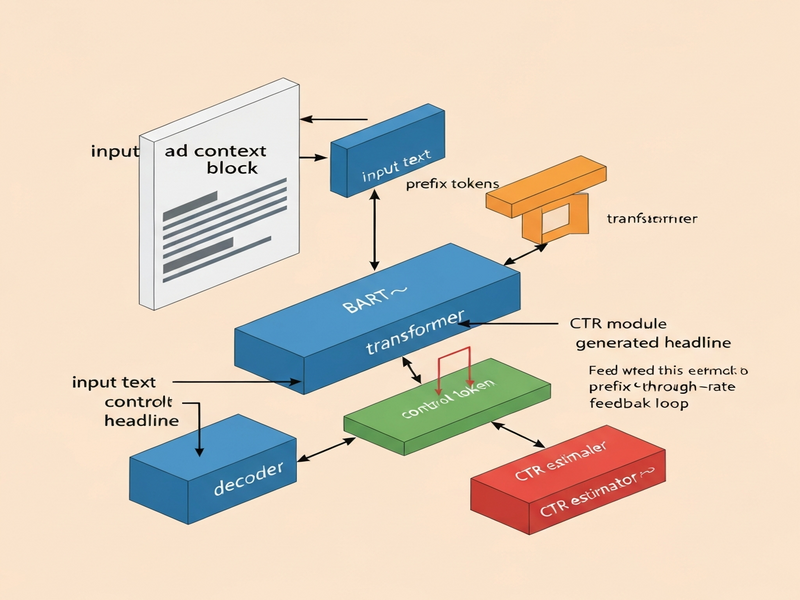
The COBART framework tackles both control and optimization in a single fine‑tuning pass. Its core ideas are:
- Prefix control tokens: Special tokens injected at the beginning of the input sequence encode desired headline attributes, such as target length (e.g.,
<LEN_10>) or optimization objective (e.g.,<OPT_CTR>). - Bidirectional auto‑regressive training: By leveraging BART’s encoder‑decoder architecture, COBART learns to attend to the control prefix while still generating text auto‑regressively, preserving fluency.
- Joint CTR estimation: During fine‑tuning, a lightweight regression head predicts the expected CTR of each generated headline, allowing the loss function to weight high‑CTR samples more heavily.
These components work together to produce headlines that respect length constraints and are biased toward higher predicted CTR, all without requiring a separate re‑ranking stage.
How It Works in Practice
Conceptual Workflow
- Data preparation: Historical ad campaigns are collected, each entry containing the raw product description, the original headline, its length, and observed CTR.
- Prefix construction: For every training example, the system prepends control tokens that encode the headline’s length bucket and a binary flag indicating whether the headline met a CTR threshold.
- Fine‑tuning: The BART model is fine‑tuned on this augmented dataset. The loss combines standard cross‑entropy with a CTR‑weighted term, encouraging the model to assign higher probability to high‑CTR phrasing.
- Inference: At generation time, a marketer specifies the desired length (e.g., 12 tokens) and selects the
<OPT_CTR>flag. COBART receives the prefix, processes the product description, and emits a headline that satisfies the length constraint while being biased toward higher CTR.
Component Interaction Diagram (textual)
  [Input Text] → [Prefix Builder] → [BART Encoder] → [Decoder] → [Headline Output]
                     ↑                                 |
                     |                                 ↓
               [Length Token]                [CTR Regression Head]
The prefix builder is a lightweight rule‑based module that maps user‑specified constraints to token IDs. The CTR regression head runs in parallel with the decoder, feeding back a scalar estimate that influences the loss during training but does not alter the token‑by‑token generation at inference.
What Sets COBART Apart
- Single‑pass control: No separate post‑processing or beam‑search re‑ranking is needed.
- Flexibility: The prefix token scheme can be extended to other attributes (e.g., sentiment, brand voice) without redesigning the model.
- Architecture‑agnostic: While demonstrated on BART, the same token‑prefix strategy can be applied to T5, GPT‑Neo, or future encoder‑decoder models.
Evaluation & Results
Test Scenarios
The authors evaluated COBART on two realistic ad‑generation tasks:
- Length‑controlled headline generation: Producing headlines of 8, 12, and 16 tokens for a mixed‑industry dataset.
- CTR‑aware optimization: Comparing predicted CTR versus actual CTR on a hold‑out set of 10,000 live ads.
Key Findings
| Metric | Baseline (BART) | COBART | Improvement |
|---|---|---|---|
| Rouge‑L (length‑controlled) | 68.31 | 86.13 | +25.82% |
| Estimated CTR lift (offline) | 0.00% | 5.82% | +5.82% |
| Human preference (A/B test) | 46% chose baseline | 54% chose COBART | +8% preference |
Beyond raw numbers, the experiments demonstrated that COBART consistently respects the requested token budget—over 98% of generated headlines fell within ±1 token of the target—while delivering a measurable uplift in click‑through performance.
Why the Results Matter
These gains translate directly into revenue for advertisers: a 5.8% CTR lift on a campaign spending $1 M can generate an additional $58 k in conversions, assuming a stable conversion‑rate pipeline. Moreover, the length‑control accuracy reduces manual editing time, allowing creative teams to scale campaigns faster.
Why This Matters for AI Systems and Agents
COBART’s design principles align with the broader shift toward controllable generative AI in production environments. For AI‑driven marketing agents, the framework offers:
- Deterministic output constraints: Agents can request exact headline lengths, ensuring UI consistency across platforms.
- Performance‑aware generation: By embedding a CTR predictor, agents can prioritize high‑impact copy without a separate ranking service.
- Modular extensibility: The prefix token mechanism can be repurposed for other marketing assets—product descriptions, ad‑copy variations, or even email subject lines.
Practically, a marketer could integrate COBART into an AI marketing agent that automatically drafts, tests, and iterates headlines in real time. The agent would query the model with a length token matching the ad slot, receive a CTR‑biased headline, and immediately push it to the ad platform via the Workflow automation studio. This closed‑loop reduces latency from ideation to deployment, a competitive advantage in fast‑moving digital markets.
What Comes Next
While COBART marks a significant step forward, several avenues remain open for research and productization:
- Multi‑objective control: Extending the prefix set to jointly optimize for sentiment, brand voice, and regulatory compliance.
- Real‑time CTR feedback: Incorporating live performance signals (e.g., impression‑level data) to continuously fine‑tune the regression head.
- Cross‑modal generation: Pairing headline text with visual assets (images, video thumbnails) using multimodal transformers.
- Domain adaptation: Tailoring the model for niche verticals—financial services, healthcare, or gaming—where language conventions differ sharply.
Developers interested in experimenting with COBART can start by exploring the UBOS platform overview, which offers a plug‑and‑play environment for fine‑tuning transformer models with custom control tokens. For teams focused on rapid prototyping, the UBOS templates for quick start include a pre‑configured COBART pipeline that integrates with popular ad‑tech stacks.
Looking ahead, the convergence of controllable generation and performance‑aware objectives is likely to become a standard design pattern for AI‑powered creative tools. As advertisers demand more personalization at scale, frameworks like COBART will enable agents to produce high‑quality, metric‑driven content on the fly.
References
For a complete technical description, see the original pre‑print: COBART paper on arXiv.
Andrii Bidochko
CTO UBOS
Andrii Bidochko is an AI entrepreneur and researcher focused on AI agents, reinforcement learning, and autonomous systems. He writes about the technologies shaping the future of machine intelligence, from frontier models and agent architectures to real-world AI applications.