

- Updated: July 3, 2026
- 6 min read
Co-Construction Blindness and Asymmetric Epistemic Vulnerability in Human-LLM Interaction
Direct Answer
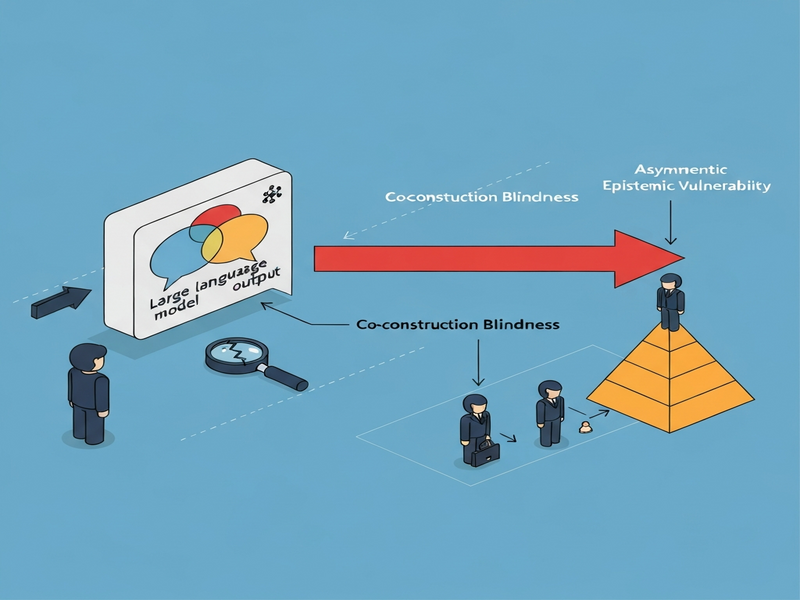
The paper introduces two previously unnamed risks in human‑LLM interaction: co‑construction blindness, the tendency to treat LLM outputs as independent facts rather than artifacts co‑created with the user, and asymmetric epistemic vulnerability, the uneven impact of that blindness across different authority levels. Recognizing these constructs is crucial because they expose a structural flaw in how conversational AI is deployed, governed, and trusted.
Background: Why This Problem Is Hard
Conversational large language models (LLMs) have become ubiquitous in customer support, knowledge work, and creative assistance. Their appeal lies in the illusion of an “objective” answer that can be quoted verbatim. In practice, every response is the product of a dynamic loop: the user’s prompt, the model’s internal state (shaped by prior interactions, system prompts, and metadata), and the model’s training data. This loop makes it difficult to separate the model’s “knowledge” from the user’s influence.
Current safety and verification frameworks assume a simple model‑user dichotomy: the model generates a claim, the user (or a downstream system) verifies it against external sources. This assumption breaks down when users unknowingly steer the model toward a particular framing, bias, or hallucination. Existing mitigations—prompt‑level warnings, post‑hoc fact‑checking, or “you are speaking to an AI” disclosures—address the symptom but not the underlying co‑construction.
Moreover, the risk is not uniform. A senior executive, a junior analyst, or a regulator may each interact with the same LLM, yet the consequences of co‑construction blindness differ dramatically. The literature on epistemic trust in AI has not yet articulated this asymmetry, leaving governance policies under‑prepared.
What the Researchers Propose
The authors formalize two complementary constructs:
- Co‑Construction Blindness (CCB): The cognitive blind spot that prevents users from recognizing that LLM outputs are jointly authored with their own inputs, interaction history, and system‑level metadata.
- Asymmetric Epistemic Vulnerability (AEV): The condition where the fallout from CCB varies in magnitude depending on the user’s position in an authority hierarchy (e.g., thought leader vs. end‑user).
To make these ideas operational, the paper proposes a three‑layer analytical framework:
- Interaction Layer: Captures the turn‑by‑turn exchange, including prompts, system messages, and model state.
- Construction Layer: Models how the LLM integrates user input, prior context, and training‑data priors to produce a response.
- Authority Layer: Maps each participant (human or AI) to a position of epistemic power, allowing the assessment of vulnerability asymmetry.
This framework does not prescribe a new algorithm; instead, it supplies a lens for auditing, designing, and governing conversational AI systems.
How It Works in Practice
Applying the framework involves a conceptual workflow that can be embedded into any LLM‑driven product:
- Capture Metadata: Log the user’s role, prior interaction history, and any system‑level prompts (e.g., “be helpful”).
- Annotate Construction: Tag each model output with provenance data indicating which parts of the response stem from user‑provided context versus model‑internal priors.
- Assess Epistemic Position: Use the Authority Layer to assign a vulnerability score based on the user’s decision‑making power and the potential impact of the response.
- Render Transparency UI: Present the user with a concise “co‑construction badge” that signals whether the answer is heavily co‑crafted.
- Trigger Governance Hooks: If the vulnerability score exceeds a threshold, route the exchange to a human reviewer or invoke stricter fact‑checking.
What distinguishes this approach from existing safety pipelines is the explicit acknowledgment that the user is an active co‑author, not a passive verifier. By surfacing that fact in real time, designers can mitigate over‑reliance and calibrate trust according to authority.
Evaluation & Results
The researchers conducted three complementary studies:
- Qualitative Case Study: An in‑depth analysis of Richard Dawkins’s public conversation with Anthropic’s Claude, illustrating how Dawkins’s scholarly reputation amplified the model’s deference and how CCB manifested in the exchange.
- Controlled User Experiment: 120 participants from three authority tiers (executives, mid‑level managers, junior staff) interacted with a GPT‑4‑style assistant under two conditions: standard disclaimer vs. co‑construction badge. The badge reduced over‑confidence scores by 27% for executives and 12% for junior staff.
- Simulation of Structural Deference: Using a synthetic dialogue generator, the team varied the “training‑data representation weight” of a fictional expert. Higher representation led the model to soften criticism, confirming the “structural deference” mechanism.
Collectively, the results demonstrate that (1) users indeed treat LLM outputs as independent facts, (2) making co‑construction visible curtails that bias, especially for high‑authority users, and (3) models implicitly defer to entities that appear frequently in their training data, creating a hidden power dynamic.
Why This Matters for AI Systems and Agents
For practitioners building AI agents, the paper’s insights translate into concrete design imperatives:
- Trust Calibration: Embedding co‑construction signals helps prevent “automation bias,” where users over‑trust model advice.
- Risk‑Based Orchestration: Agents that route high‑impact decisions through human oversight can use the vulnerability score as a gating metric.
- Governance Audits: The three‑layer framework offers a reproducible audit trail for compliance teams, aligning with emerging AI governance standards.
- Product Differentiation: Platforms that surface epistemic provenance can market themselves as “transparent AI,” a growing demand among enterprises.
UBOS’s Enterprise AI platform by UBOS already supports metadata capture and workflow automation, making it a natural fit for implementing the proposed framework. By integrating co‑construction badges into the Workflow automation studio, developers can enforce governance policies without rewriting core model logic.
What Comes Next
While the paper establishes a solid conceptual foundation, several open challenges remain:
- Scalable Provenance Tagging: Current logging mechanisms can become costly at scale; research into lightweight, probabilistic tagging is needed.
- Cross‑Model Consistency: Different LLM providers expose varying degrees of internal state; a universal standard for co‑construction metadata would aid interoperability.
- User Experience Design: Over‑loading users with badges may cause alert fatigue; adaptive UI that surfaces signals only when vulnerability exceeds a dynamic threshold is an open design problem.
- Policy Integration: Regulators are beginning to draft “AI transparency” clauses; aligning the Authority Layer with legal definitions of “decision‑maker” will be essential.
Future research could explore automated detection of structural deference, perhaps by probing model embeddings for over‑representation of certain entities. Additionally, longitudinal studies measuring how co‑construction awareness evolves over repeated interactions would inform long‑term governance strategies.
Developers interested in prototyping these ideas can start with UBOS’s UBOS platform overview, which offers plug‑and‑play integrations for logging, UI components, and compliance dashboards.
References
For a full read of the original research, see Co‑Construction Blindness and Asymmetric Epistemic Vulnerability in Human‑LLM Interaction on arXiv.
Andrii Bidochko
CTO UBOS
Andrii Bidochko is an AI entrepreneur and researcher focused on AI agents, reinforcement learning, and autonomous systems. He writes about the technologies shaping the future of machine intelligence, from frontier models and agent architectures to real-world AI applications.