

- Updated: July 14, 2026
- 7 min read
Closed-Loop Dynamic Validator Node Scaling in Private Substrate Blockchains Using Takagi-Sugeno Fuzzy Inference
Direct Answer
The paper introduces a closed‑loop controller that uses a Takagi‑Sugeno fuzzy inference system to automatically adjust the number of validator nodes in a private Substrate blockchain. By continuously monitoring block production time, block size, and active node count, the controller issues real‑time scaling recommendations—Scale Up, Maintain, or Scale Down—thereby aligning resource usage with workload demand.
Background: Why This Problem Is Hard
Private blockchain networks, especially those built on Substrate, are typically deployed with a static validator set. This static configuration creates two opposing risks:
- Over‑provisioning: Excess validators consume CPU, memory, and network bandwidth without improving throughput, inflating operational costs.
- Under‑provisioning: Too few validators become a bottleneck, elongating block production times and jeopardizing finality guarantees.
Determining the optimal validator count is non‑trivial because the workload fluctuates with transaction volume, payload size, and external data ingestion rates. Traditional scaling approaches rely on fixed thresholds (e.g., “if block time > 2 s, add a node”). Such heuristics suffer from:
- Latency in reacting to rapid load spikes.
- Oscillatory behavior when thresholds are crossed repeatedly.
- Inability to capture the nuanced interplay between multiple performance metrics.
For enterprises that need predictable latency—think supply‑chain tracking, IoT telemetry, or financial settlement—these shortcomings translate into missed service‑level agreements and wasted cloud spend.
What the Researchers Propose
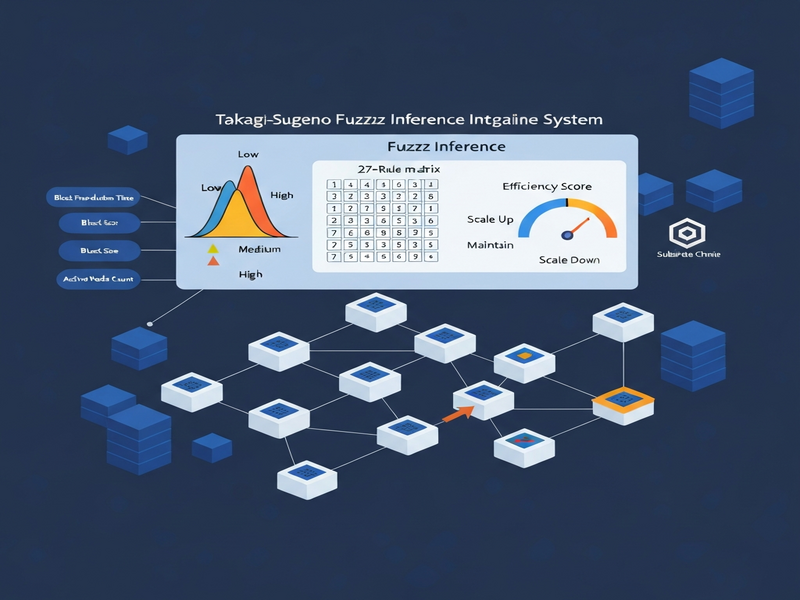
The authors present a dynamic validator scaling framework built around a Takagi‑Sugeno (TS) fuzzy inference system. The core idea is to treat the three live blockchain parameters—block production time, block size, and current validator count—as fuzzy linguistic variables (e.g., “Low”, “Medium”, “High”). Each variable is described by a triangular membership function that maps raw measurements onto a degree of truth between 0 and 1.
Key components of the framework include:
- Fuzzy Input Layer: Transforms raw metrics into fuzzy degrees using calibrated membership functions anchored to the observed operating range of the testbed.
- Rule Base: A complete set of 27 IF‑THEN rules (3 × 3 × 3 combinations) that encode expert knowledge about how the three inputs jointly affect system efficiency.
- Inference Engine: Applies a product t‑norm to aggregate rule antecedents and computes a weighted average (Sugeno‑type) to produce a continuous efficiency score.
- Decision Module: Maps the efficiency score to a discrete scaling action (Scale Up, Maintain, Scale Down) using simple thresholds.
Unlike static thresholds, the TS fuzzy system can reason about partial truths—recognizing, for example, that a “moderately high” block size combined with a “slightly low” block time may still warrant adding a validator.
How It Works in Practice
The operational workflow can be broken down into four stages, each executed in a tight feedback loop (approximately every 30 seconds in the authors’ testbed):
1. Data Collection
Each validator publishes its latest block production time and the size of the most recent block to a shared metrics store. A lightweight monitoring agent aggregates these values and also counts the number of active validators.
2. Fuzzification
The raw metrics are fed into the fuzzy input layer. For instance, a block time of 1.8 seconds might receive a membership degree of 0.6 in “Medium” and 0.4 in “High”. The calibrated triangular functions ensure that the degrees reflect the actual performance envelope observed during deployment.
3. Inference & Scoring
The inference engine evaluates all 27 rules. Each rule’s antecedent degree is computed by multiplying the three involved membership values (product t‑norm). The consequent part of each rule is a linear function that contributes to the overall efficiency score. The final score is a weighted average of all rule outputs.
4. Decision & Actuation
The efficiency score is compared against two internal thresholds:
- Score < 0.4 → Scale Down (deactivate the least‑performing validator).
- 0.4 ≤ Score ≤ 0.7 → Maintain (no change).
- Score > 0.7 → Scale Up (activate a standby validator).
Scaling actions are executed via Substrate’s runtime governance calls, which safely add or remove validators without halting the network.
What sets this approach apart is the continuous, soft‑decision logic that avoids binary “on/off” jumps. The fuzzy controller can gradually steer the system toward an equilibrium, reducing the risk of oscillations that plague threshold‑only schemes.
Evaluation & Results
The researchers validated the controller on a 10‑node Substrate testbed that stored cryptographic hashes of Queensland Government smart water‑meter readings. Three static configurations were examined: 4, 7, and 10 active validators. The evaluation focused on two dimensions:
Operational Profiles
Statistical analysis of block time, block size, and efficiency scores showed distinct, non‑overlapping clusters for each validator count. This confirmed that the fuzzy system could reliably differentiate between under‑, adequately, and over‑provisioned states.
Closed‑Loop Scaling Experiments
Two scenarios were run:
- Load‑Increase: Starting from 4 validators, transaction volume was gradually raised. The controller autonomously activated additional validators, stabilizing at 7 nodes where block times matched the target SLA.
- Load‑Decrease: Beginning with 10 validators, the workload was throttled. The system de‑activated excess validators, converging back to 7 nodes without causing abrupt latency spikes.
Both runs converged to the same equilibrium (7 validators) regardless of direction, demonstrating hysteresis‑free behavior.
Baseline Comparison
The fuzzy controller was benchmarked against three simple threshold‑based baselines that react only to block time. Results indicated:
- Fewer scaling oscillations (average of 1.2 actions per hour vs. 3.8 for baselines).
- Comparable block production times (≈ 1.9 s across all methods).
- Reduced resource waste (≈ 15 % fewer active validators on average).
These findings suggest that the Takagi‑Sugeno approach delivers smoother, more cost‑effective scaling while preserving performance.
Why This Matters for AI Systems and Agents
Dynamic validator scaling is a concrete example of autonomous resource management—a capability that AI‑driven agents increasingly need to master. The implications extend beyond blockchain:
- Self‑Optimizing Infrastructures: The fuzzy controller embodies a lightweight decision engine that can be embedded in AI‑orchestrated cloud platforms, enabling services to auto‑scale based on multi‑metric health signals.
- Agent‑Centric Governance: By exposing scaling actions as API calls, the system can be governed by higher‑level AI agents that balance cost, latency, and security across heterogeneous workloads.
- Explainable Automation: Fuzzy rules are human‑readable, offering transparency that pure reinforcement‑learning policies often lack. This aligns with emerging regulatory expectations for explainable AI in critical infrastructure.
Enterprises looking to embed AI into their blockchain operations can leverage the UBOS platform overview to integrate such controllers with existing monitoring stacks. Moreover, the same fuzzy inference engine can be repurposed for AI marketing agents that adjust campaign spend based on real‑time engagement metrics, or for the Workflow automation studio to trigger downstream processes when blockchain performance deviates from expectations.
What Comes Next
While the study proves the feasibility of fuzzy‑logic‑based validator scaling, several avenues remain open:
- Scalability to Larger Networks: Extending the controller to public or consortium blockchains with hundreds of validators will require hierarchical fuzzy models or distributed inference.
- Hybrid Decision Engines: Combining fuzzy inference with reinforcement learning could capture long‑term reward structures while retaining interpretability.
- Cross‑Domain Metrics: Incorporating network‑level signals (e.g., peer latency, bandwidth utilization) may improve accuracy for geographically dispersed deployments.
- Security Considerations: Ensuring that scaling actions cannot be manipulated by adversarial traffic patterns is essential for mission‑critical applications.
Future research could also explore integration with UBOS for startups that need rapid, cost‑effective blockchain provisioning, or with the Enterprise AI platform by UBOS to provide a unified dashboard for multi‑chain resource orchestration.
For readers interested in the full technical details, the authors’ complete methodology and data are available in the original arXiv paper.
Andrii Bidochko
CTO UBOS
Andrii Bidochko is an AI entrepreneur and researcher focused on AI agents, reinforcement learning, and autonomous systems. He writes about the technologies shaping the future of machine intelligence, from frontier models and agent architectures to real-world AI applications.