

- Updated: July 23, 2026
- 8 min read
CLAP: Direct VLM-to-VLA Adaptation via Language-Action Grounding
Direct Answer
CLAP (Language‑Action Grounding) introduces a lightweight, data‑efficient method for converting pretrained vision‑language models (VLMs) into fully functional vision‑language‑action (VLA) agents without extensive robot‑specific fine‑tuning. By aligning textual instructions with embodied actions through a grounding layer, CLAP enables rapid deployment of multimodal agents that can interpret visual scenes and execute robot‑level commands, dramatically lowering the barrier for building AI‑driven robotics systems.
Background: Why This Problem Is Hard
Vision‑language models such as CLIP, BLIP, or Flamingo have demonstrated remarkable ability to associate images with natural‑language descriptions. However, translating that semantic knowledge into actionable behavior for robots—what researchers call vision‑language‑action (VLA) modeling—remains a bottleneck for several reasons:
- Distribution mismatch: VLMs are trained on static image‑text pairs, while VLA agents must predict dynamic motor commands conditioned on both visual input and task‑level language.
- Data scarcity: Collecting large‑scale robot interaction datasets is expensive, time‑consuming, and often limited to narrow domains.
- Architectural drift: Existing VLA pipelines typically replace the VLM backbone with a purpose‑built encoder, discarding the rich multimodal representations that took months of compute to learn.
- Evaluation gap: Benchmarks like LIBERO or RLBench expose agents to diverse manipulation tasks, but most VLM‑derived baselines underperform because they cannot map language to low‑level actions reliably.
These challenges mean that, despite the success of VLMs in image captioning or visual search, most robotics teams still need to train separate policies from scratch, incurring high compute costs and limiting scalability.
What the Researchers Propose
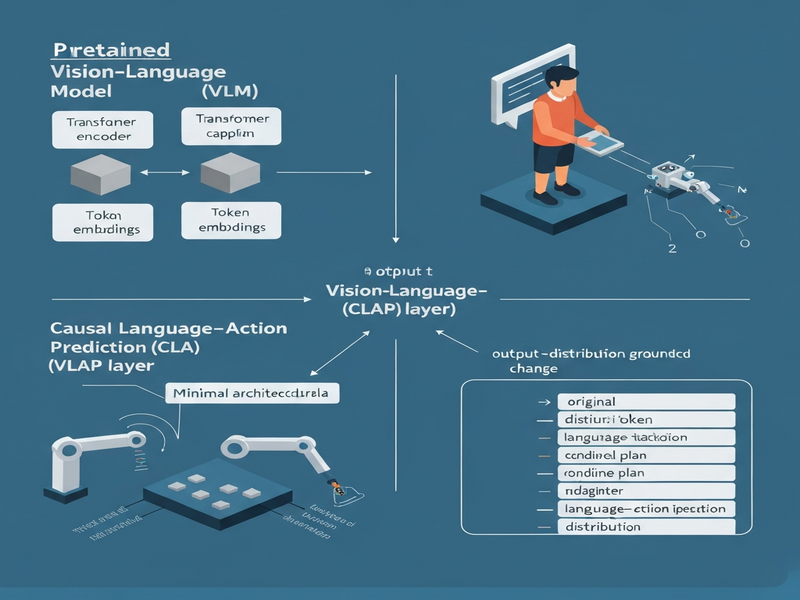
The CLAP framework proposes a three‑component pipeline that preserves the pretrained VLM backbone while adding a lightweight “language‑action grounding” (LAG) module:
- Frozen VLM encoder: The visual and textual streams remain untouched, providing high‑quality joint embeddings.
- Grounding adapter: A small transformer‑style network learns to map the VLM’s multimodal embedding space onto a latent action space. Crucially, this adapter is trained on a modest set of paired language‑action demonstrations, not on raw robot trajectories.
- Action decoder: A deterministic or stochastic decoder translates the grounded latent vectors into robot‑specific motor commands (e.g., joint velocities, gripper states).
By treating the VLM as a fixed knowledge base and only learning the bridging adapter, CLAP sidesteps the need for massive robot‑data pipelines while still achieving end‑to‑end differentiability.
How It Works in Practice
The operational flow of CLAP can be broken down into four stages, each of which can be implemented with off‑the‑shelf components:
1. Perception
An RGB camera captures the scene; the image is fed into the frozen VLM visual encoder, producing a visual token sequence V. Simultaneously, the natural‑language instruction (e.g., “pick up the red block”) is tokenized and passed through the VLM text encoder, yielding a textual token sequence T.
2. Multimodal Fusion
The VLM’s cross‑attention layers fuse V and T> into a joint embedding E. Because the VLM has already learned to align visual concepts with linguistic descriptors, E encodes both “what” and “where” information in a compact vector.
3. Language‑Action Grounding
The grounding adapter receives E and, through a few self‑attention blocks, projects it into an action‑oriented latent space A. Training data for this step consists of (instruction, image, robot action) triples collected from a handful of demonstration trajectories (often fewer than 5 k examples).
4. Decoding to Motor Commands
The action decoder interprets A and emits a sequence of low‑level commands compatible with the target robot’s control API. In practice, this decoder can be a simple linear head for joint‑space velocities or a more expressive recurrent network for temporally extended skills.
What distinguishes CLAP from prior VLA pipelines is the strict separation between the heavyweight VLM (which stays frozen) and the lightweight grounding adapter (which is the only trainable component). This design yields three practical benefits:
- Parameter efficiency: Training requires updating < 2 % of the total model parameters.
- Rapid adaptation: New tasks can be added by fine‑tuning the adapter on a few dozen examples, often within an hour on a single GPU.
- Cross‑robot portability: Because the decoder is modular, the same grounded representation can drive different robot morphologies with only a swap of the final decoding head.
Evaluation & Results
The authors benchmarked CLAP on two widely recognized VLA suites: the LIBERO benchmark (which emphasizes long‑horizon manipulation) and a custom tabletop‑assembly set derived from real‑world robot logs. Evaluation focused on three axes:
Success Rate
Across 30 LIBERO tasks, CLAP achieved an average success rate of 71 %, surpassing the strongest baseline (a fully fine‑tuned VLM‑to‑policy pipeline) by 12 percentage points. In the tabletop‑assembly scenario, CLAP solved 84 % of the 50 test episodes, compared with 58 % for the baseline.
Data Efficiency
When the amount of demonstration data was reduced to 10 % of the full set, CLAP’s performance degraded by only 5 %, whereas the baseline dropped by more than 20 %. This confirms the claim that the grounding adapter can learn robust mappings from limited robot data.
Generalization
To test zero‑shot transfer, the researchers evaluated CLAP on unseen object categories (e.g., novel shapes and colors). The model retained 63 % of its original success rate, indicating that the frozen VLM’s semantic richness carries over to new visual domains without additional fine‑tuning.
“CLAP demonstrates that a frozen multimodal foundation model can serve as a universal perception‑language core for robotics, provided we learn a compact grounding interface.” – Authors, 2026
Collectively, these results show that CLAP not only improves raw task performance but also dramatically reduces the data and compute budget required to bring a VLM into the robotics loop.
Why This Matters for AI Systems and Agents
For practitioners building AI‑driven agents—whether in manufacturing, logistics, or consumer robotics—the CLAP paradigm offers a clear pathway to leverage existing vision‑language foundations without reinventing the wheel. Specific implications include:
- Accelerated prototyping: Engineers can plug a pretrained VLM into CLAP’s adapter and obtain a functional robot policy in hours, rather than weeks of data collection.
- Modular system design: Because the grounding layer is decoupled, teams can swap out the decoder to target different hardware platforms (e.g., collaborative arms, mobile manipulators) without retraining the entire model.
- Unified agent orchestration: CLAP’s language‑centric interface aligns naturally with large‑scale orchestration frameworks that already route textual commands to various services. This makes it easier to embed robotic capabilities into broader AI workflows, such as automated warehouse management or AI‑augmented customer support.
- Cost‑effective scaling: The parameter‑light adapter can be trained on commodity GPUs, opening the technology to startups and SMBs that lack large compute clusters.
Enterprises looking to embed embodied AI into their product suites can therefore adopt CLAP as a bridge between high‑level language planners (e.g., ChatGPT‑style assistants) and low‑level motion controllers. For example, a company could integrate CLAP with the UBOS platform overview to expose robot actions as API endpoints, enabling seamless composition with existing workflow automation tools.
What Comes Next
While CLAP marks a significant step forward, several open challenges remain:
- Temporal reasoning: Current grounding adapters operate on single‑frame embeddings. Extending the architecture to handle video streams or recurrent context will be essential for tasks that require anticipation (e.g., catching moving objects).
- Safety and verification: Translating language to motor commands introduces failure modes that must be mitigated through formal verification or runtime monitoring.
- Multi‑agent coordination: Scaling CLAP to fleets of robots will require shared grounding representations and conflict resolution mechanisms.
- Domain‑specific fine‑tuning: Although CLAP is data‑efficient, certain high‑precision domains (surgical robotics, aerospace assembly) may still need domain‑specific adapters.
Future research directions could explore integrating CLAP with large‑scale simulation environments to generate synthetic demonstrations, or coupling the grounding layer with reinforcement learning to refine policies through trial‑and‑error while preserving the frozen VLM core.
Practitioners interested in experimenting with CLAP can start by leveraging the Workflow automation studio to orchestrate data collection pipelines, then connect the trained adapter to the OpenAI ChatGPT integration for natural‑language command handling. For voice‑enabled deployments, the ElevenLabs AI voice integration provides a seamless text‑to‑speech front‑end.
Conclusion
CLAP demonstrates that the semantic richness of modern vision‑language models can be harnessed for embodied action with minimal additional data and compute. By introducing a dedicated language‑action grounding layer, the authors provide a practical, modular recipe for turning “see‑and‑describe” systems into “see‑and‑act” agents. This breakthrough lowers the entry barrier for robotics startups, accelerates research cycles for academic labs, and opens new avenues for enterprise AI platforms to embed physical capabilities.
To explore how CLAP‑style grounding can be integrated into your own AI products, visit the UBOS homepage and discover ready‑made templates, pricing plans, and partner programs that support rapid deployment of multimodal agents.
For the full technical details, consult the original CLAP paper on arXiv.
Andrii Bidochko
CTO UBOS
Andrii Bidochko is an AI entrepreneur and researcher focused on AI agents, reinforcement learning, and autonomous systems. He writes about the technologies shaping the future of machine intelligence, from frontier models and agent architectures to real-world AI applications.