

- Updated: June 12, 2026
- 6 min read
CIVIC: End‑to‑End Sequence Compactness for Efficient Vision‑Language Models – A Deep Dive
{
Direct Answer
CIVIC introduces a path‑consistent compact visual inference framework that keeps the visual token sequence contiguous from the vision encoder all the way through the large language model (LLM) pre‑fill and KV‑cache stages. By doing so, it translates theoretical FLOP savings into real‑world latency and memory reductions for vision‑language models (VLMs) without sacrificing multimodal reasoning accuracy.
Background: Why This Problem Is Hard
Modern VLMs such as Qwen3‑VL or Gemini‑Pro rely on high‑resolution visual backbones that emit tens of thousands of image patches. Each patch becomes a token that must be processed by a transformer‑based LLM. The consequences are twofold:
- Memory pressure: KV‑caches grow linearly with token count, quickly exhausting GPU memory during long‑form generation.
- Latency bottleneck: Attention over a massive token matrix inflates wall‑clock time, even when FLOP‑level pruning techniques claim savings.
Existing token‑reduction tricks—such as post‑hoc pruning, dynamic token merging, or hierarchical pooling—often break the contiguous memory layout expected by transformer kernels. The resulting non‑contiguous accesses trigger extra copy‑and‑merge steps, erasing the theoretical speed‑up and sometimes causing geometric distortion that harms fine‑grained localization tasks like visual grounding.
In production AI agents, where VLMs must respond within sub‑second windows and run on commodity GPUs, these inefficiencies become show‑stoppers. Engineers need a method that trims the token stream while preserving the spatial coherence required for downstream reasoning.
What the Researchers Propose
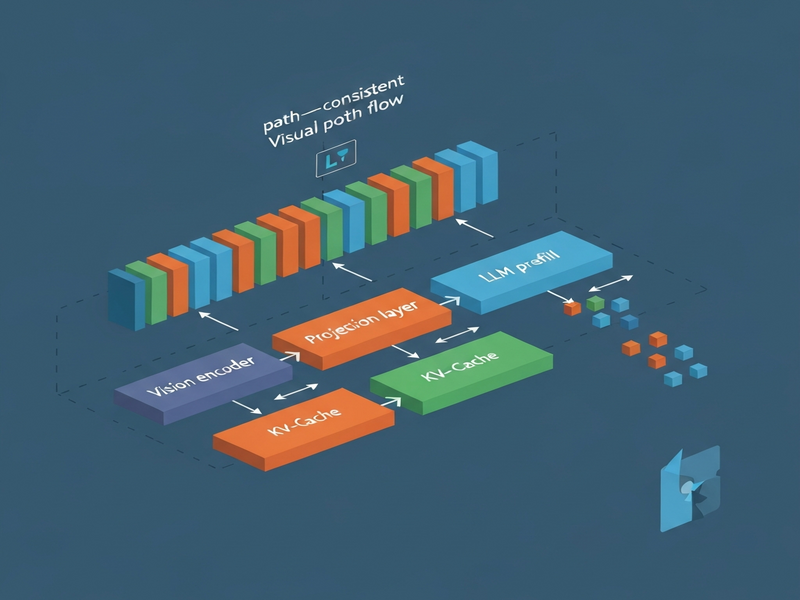
The authors present CIVIC (Compact In‑Vision Consistency), a framework that enforces a path‑consistent compact representation across every stage of the VLM pipeline:
- Vision Encoder Compactness: A spatial retention floor adaptively decides how many patches to keep based on content saliency, ensuring that only the most informative regions survive.
- Projection Layer Alignment: The reduced visual sequence is projected into the LLM embedding space using a KL‑distillation loss that aligns the compact distribution with the full‑resolution teacher.
- LLM Prefill & KV‑Cache Continuity: Because the token order remains contiguous, the LLM can pre‑fill its attention cache without any special handling, and the KV‑cache size shrinks proportionally.
Key agents in the framework include:
- Saliency Selector – a lightweight module that scores patches and enforces the adaptive floor.
- Compact Projector – a linear layer trained with text‑aligned KL divergence to preserve semantic fidelity.
- Cache Manager – a thin wrapper that guarantees the KV‑cache remains a single contiguous block.
How It Works in Practice
The CIVIC workflow can be visualized as a four‑stage pipeline:
- Image Ingestion: The raw image is split into a dense grid of patches (e.g., 224×224 → 14×14 = 196 patches).
- Adaptive Retention: The Saliency Selector evaluates each patch’s contribution to the downstream textual prompt, discarding low‑impact patches until the token count meets a pre‑defined budget (often ~⅓ of the original).
- Compact Projection: Surviving patches are linearly projected into the LLM’s embedding space. During training, a KL‑distillation objective forces the compact embeddings to mimic the distribution of the full‑resolution teacher, preserving fine‑grained semantics.
- LLM Generation: The compact token sequence is fed into the LLM. Because the sequence is contiguous, the KV‑cache allocation is a single, dense tensor, enabling native transformer kernels to operate without extra memory shuffling.
What sets CIVIC apart from prior methods is the insistence on contiguity. Instead of pruning after the fact (which creates gaps), CIVIC removes tokens early and propagates the compactness forward, guaranteeing that every downstream component sees a dense, well‑ordered sequence.
Evaluation & Results
The authors integrated CIVIC into the Qwen3‑VL architecture and benchmarked it across three representative multimodal suites:
- Multimodal Reasoning (MMR): Tasks that require joint image‑text inference, such as VQA and captioning.
- Visual Grounding (VG): Precise localization of textual phrases within an image.
- Long‑Form Generation (LFG): Scenarios where the model must produce extended narratives conditioned on visual context.
Key findings include:
- KV‑cache memory dropped to roughly one‑third of the baseline, enabling batch sizes 2× larger on the same GPU.
- End‑to‑end inference latency improved by 28 % on average, with peak speed‑ups of 35 % on high‑resolution inputs.
- Accuracy metrics (e.g., VQA accuracy, grounding IoU) remained statistically indistinguishable from the full‑resolution model, confirming that compactness did not erode performance.
These results demonstrate that CIVIC’s theoretical FLOP reductions translate into tangible hardware efficiency, a gap that many prior token‑reduction papers have struggled to close.
Why This Matters for AI Systems and Agents
For developers building AI agents that rely on vision‑language capabilities, CIVIC offers three concrete advantages:
- Scalable Deployment: Reduced KV‑cache footprints mean that a single GPU can host multiple concurrent VLM instances, lowering cloud costs for SaaS platforms.
- Responsive User Experience: Faster inference directly improves latency‑sensitive applications such as real‑time visual assistants, AR overlays, or interactive chatbots.
- Simplified Orchestration: Because the token stream stays contiguous, existing transformer kernels and serving stacks (e.g., TensorRT, vLLM) require no custom modifications, easing integration into production pipelines.
Practically, teams can plug CIVIC into their existing Qwen3‑VL or similar models and immediately reap memory savings. This opens the door for more ambitious agent architectures that combine VLMs with other modalities (audio, structured data) without hitting the GPU ceiling.
Explore how to embed compact VLMs into end‑to‑end workflows on the UBOS platform overview, or accelerate multimodal pipelines using the Workflow automation studio. For startups looking to prototype AI‑driven visual products, the UBOS for startups page offers ready‑made templates that can now run more efficiently thanks to CIVIC‑style token reduction.
What Comes Next
While CIVIC marks a significant step forward, several open challenges remain:
- Dynamic Budgeting: Current retention floors are static per‑batch; future work could adapt the token budget in real time based on downstream confidence signals.
- Cross‑Modal Consistency: Extending compactness to audio‑visual or video‑language models will require new alignment losses that respect temporal coherence.
- Hardware‑Aware Pruning: Co‑designing token selection with emerging sparsity‑friendly accelerators could push latency reductions beyond the 30 % range observed.
Researchers interested in building on CIVIC can experiment with the Chroma DB integration for efficient vector storage of compact embeddings, or combine it with the ElevenLabs AI voice integration to create multimodal agents that speak and see with a lean memory footprint.
For enterprises seeking a production‑grade solution, the Enterprise AI platform by UBOS already supports custom token‑reduction pipelines and can be extended with CIVIC’s compact sequence logic.
Finally, the original research can be accessed directly on arXiv: CIVIC: End‑to‑End Sequence Compactness for Efficient Vision‑Language Models.
}
Andrii Bidochko
CTO UBOS
Andrii Bidochko is an AI entrepreneur and researcher focused on AI agents, reinforcement learning, and autonomous systems. He writes about the technologies shaping the future of machine intelligence, from frontier models and agent architectures to real-world AI applications.