

- Updated: July 12, 2026
- 7 min read
CausalDS: Benchmarking Causal Reasoning in Data-Science Agents
Direct Answer
CausalDS is a newly released benchmark that evaluates how well data‑science agents can reason about cause and effect while simultaneously performing realistic data‑analysis tasks. By generating synthetic causal worlds—complete with structural causal models, observational datasets, and natural‑language narratives—CausalDS forces agents to blend symbolic causal inference, coding, uncertainty quantification, and tool use, offering a far more holistic test than existing symbolic‑only or data‑only suites.
Background: Why This Problem Is Hard
Large language models (LLMs) have evolved from pure text generators into agentic systems that can call APIs, write code, and iterate on data‑driven hypotheses. In practice, a data‑science agent must answer questions such as “Will increasing ad spend raise conversion rates?”—a query that demands both statistical prediction and causal justification. Yet the benchmark landscape is split in two:
- Symbolic causal reasoning suites (e.g., cause‑effect logic puzzles) provide clean, abstract graphs but lack any real data, code, or noisy observations.
- Data‑analysis benchmarks (e.g., Kaggle‑style tasks) supply rich datasets but rarely embed a known causal structure, making it impossible to verify whether an agent truly understands causality.
This dichotomy creates a blind spot: an agent could ace a Kaggle competition by exploiting correlations while completely ignoring the underlying causal mechanisms, or it could solve textbook causal diagrams without ever handling messy, missing, or biased data. Moreover, most public causal datasets are curated from a handful of sources, with diversity achieved only through superficial templating rather than systematic generation of novel causal graphs. The result is a “causal parrot” problem—models that appear to reason causally but are merely memorizing patterns from a limited set of examples.
What the Researchers Propose
The authors introduce CausalDS (Causal Data‑Science), a benchmark that synthesizes entire causal worlds from the ground up. Each benchmark instance, called a scene, consists of three tightly coupled components:
- Structural Causal Model (SCM): A directed acyclic graph with functional relationships and noise terms, sampled from a configurable space of causal structures.
- Observational Data: A dataset generated by the SCM, optionally passed through an observation model that injects missing values, measurement error, or selection bias—mirroring real‑world imperfections.
- Natural‑Language Story: A synthetic paragraph that describes the scenario in a domain‑relevant way (e.g., marketing, healthcare), grounding the abstract graph in a narrative that agents can read.
From each scene the benchmark derives tasks that span Judea Pearl’s three “rungs” of causal inference:
- Rung 1 – Association: Predictive questions that can be answered with standard supervised learning (e.g., “What is the expected sales next month?”).
- Rung 2 – Intervention: Counterfactual or do‑calculus queries that require reasoning about the effect of an explicit intervention (e.g., “What happens if we double the advertising budget?”).
- Rung 3 – Counterfactuals (optional): More advanced “what‑if” scenarios that ask about individual outcomes under hypothetical changes.
Crucially, most tasks embed a coding component: the agent must write and execute Python (or R) scripts, call data‑processing tools, and possibly chain multiple utilities to arrive at a final answer. The benchmark also treats “I don’t know” as a legitimate, scored response, encouraging agents to recognize when a question is under‑determined given the available data.
How It Works in Practice
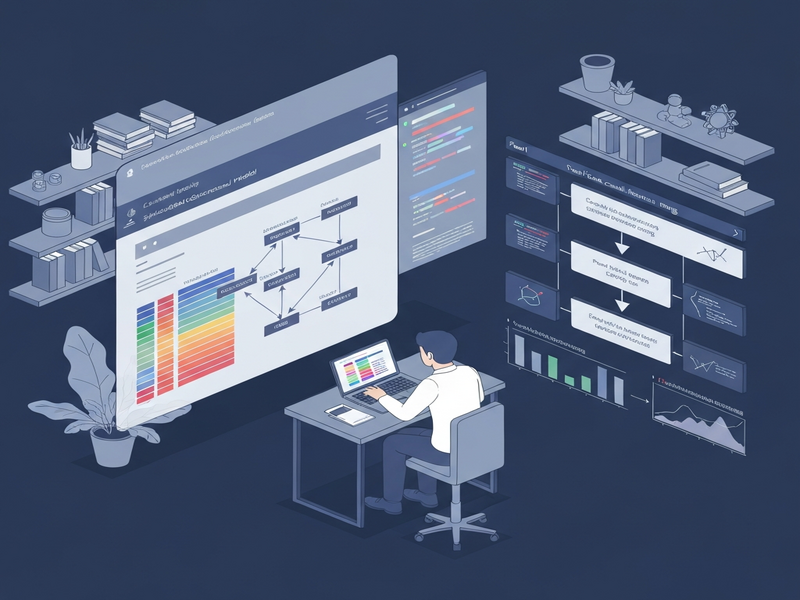
The CausalDS workflow can be visualized as a pipeline of four interacting modules:
- Scene Generator: Randomly samples an SCM from a predefined distribution (e.g., number of variables, edge density). If the researcher opts for empirical grounding, the generator aligns variable marginal distributions with those observed in real datasets, preserving realistic statistical signatures while keeping the causal graph synthetic.
- Data Synthesizer: Executes the SCM to produce a raw observational table. An observation model then corrupts the data—adding missingness, measurement noise, or selection bias—to emulate the imperfections agents encounter in production pipelines.
- Story Composer: Translates the SCM’s semantics into a fluent paragraph, inserting domain‑specific terminology (e.g., “click‑through rate”, “patient recovery time”). This step ensures that the benchmark tests natural‑language understanding alongside causal reasoning.
- Task Engine: Generates a suite of questions per scene, mapping each to a required toolchain (e.g., “load data → fit regression → compute do‑effect”). The engine also defines the scoring rubric, which blends symbolic correctness, code execution success, uncertainty calibration, and abstention penalties.
When an LLM‑based agent tackles a CausalDS instance, it first parses the story, extracts the implied variables, and decides which tools to invoke. For a Rung 2 intervention, the agent might:
- Load the synthetic CSV into a pandas DataFrame.
- Identify the treatment variable (e.g., “advertising spend”).
- Apply a do‑operator by re‑sampling the outcome under a forced treatment value, using the known functional form from the SCM (which the agent must infer from the story and data).
- Report the estimated average treatment effect along with a confidence interval.
This end‑to‑end loop forces the model to blend language comprehension, statistical coding, and causal logic—something no existing benchmark demands in a single package.
Evaluation & Results
The authors evaluated several state‑of‑the‑art LLM agents, including GPT‑4‑Turbo, Claude‑3, and open‑source alternatives fine‑tuned on code. The experiments covered three dimensions:
- Symbolic Reasoning Accuracy: Whether the agent correctly identified causal relationships and applied the appropriate do‑calculus rules.
- Data‑Science Performance: The quality of the generated code, measured by successful execution, statistical validity of the results, and adherence to best practices (e.g., train‑test splits, hyperparameter tuning).
- Uncertainty & Abstention: Calibration of confidence scores and the ability to refuse answering when the observation model rendered the query under‑determined.
Key findings include:
- Even the most capable closed‑source models achieved only ~55 % symbolic correctness on Rung 2 tasks, highlighting a persistent gap in causal inference capabilities.
- Code generation success rates hovered around 70 % for straightforward regression tasks but dropped below 40 % when the observation model introduced missing data, indicating that robust data‑cleaning pipelines are still a weakness.
- Agents that were explicitly trained on causal language (e.g., via a curated “causal prompt library”) showed a 12 % improvement in abstention calibration, suggesting that teaching models to recognize uncertainty is feasible.
Overall, the benchmark demonstrated that current agents excel at surface‑level prediction but struggle when forced to integrate causal reasoning, noisy data handling, and multi‑step tool orchestration. These results are meaningful because they expose concrete failure modes that developers can target for improvement.
Why This Matters for AI Systems and Agents
For practitioners building AI‑driven decision‑support tools, CausalDS offers a realistic stress test that mirrors production constraints:
- End‑to‑end validation: Instead of testing a model’s causal graph in isolation, the benchmark verifies that the entire pipeline—from natural‑language query to executable code—behaves correctly.
- Tool‑use benchmarking: Modern agents rely on external utilities (e.g., pandas, scikit‑learn, SQL engines). CausalDS quantifies how well an agent can orchestrate these tools, a critical factor for enterprise deployments.
- Risk mitigation: By rewarding abstention when data are insufficient, the benchmark encourages the development of safety‑aware agents that avoid overconfident, potentially harmful recommendations.
These capabilities align directly with the needs of Enterprise AI platform by UBOS, where customers demand trustworthy causal insights that can be embedded into automated workflows. Moreover, the benchmark’s synthetic yet empirically grounded generation process makes it easy to extend to domain‑specific scenarios, such as finance or healthcare, without exposing proprietary data.
What Comes Next
While CausalDS marks a significant step forward, several limitations remain:
- Scalability of SCMs: Current scenes involve up to 10 variables; real‑world problems often span hundreds of features.
- Domain richness: The natural‑language stories are generated from templates, which may not capture the nuance of industry‑specific jargon.
- Evaluation breadth: The benchmark focuses on Python‑centric toolchains; extending to other ecosystems (e.g., R, Julia) would broaden its relevance.
Future research directions could include:
- Integrating Workflow automation studio to automatically generate multi‑step pipelines that combine data ingestion, causal discovery, and reporting.
- Leveraging UBOS templates for quick start to create domain‑specific story generators, enabling rapid prototyping for sectors like retail or biotech.
- Exploring reinforcement‑learning agents that learn to select the optimal sequence of tools based on feedback from the CausalDS scoring engine.
By addressing these gaps, the community can move toward benchmarks that not only test “can the model think causally?” but also “can the model act causally in a production environment?”
References
For a complete technical description, see the original CausalDS paper on arXiv.
Andrii Bidochko
CTO UBOS
Andrii Bidochko is an AI entrepreneur and researcher focused on AI agents, reinforcement learning, and autonomous systems. He writes about the technologies shaping the future of machine intelligence, from frontier models and agent architectures to real-world AI applications.