

- Updated: June 17, 2026
- 8 min read
Can Quantum Federated Learning Withstand Circuit-Level Backdoors?
Direct Answer
The paper Can Quantum Federated Learning Withstand Circuit-Level Backdoors? introduces a new threat model called Circuit‑Level Backdoor Threat (CULT), which demonstrates how a single malicious client can embed stealthy backdoors into quantum federated learning (QFL) pipelines by exploiting variational quantum circuits and measurement‑based gradients. The findings matter because they reveal a previously hidden attack surface that can cripple federated quantum AI systems even when state‑of‑the‑art defenses are applied.
Background: Why This Problem Is Hard
Federated learning (FL) has become the de‑facto paradigm for training models across distributed data owners while preserving privacy. At the same time, quantum machine learning (QML) promises exponential speed‑ups for certain linear‑algebraic tasks, leading to the emergence of Quantum Federated Learning (QFL). QFL combines two complex ecosystems:
- Federated optimization: The server aggregates noisy, client‑side gradient updates without ever seeing raw data.
- Variational quantum circuits: Each client runs a parameterized quantum circuit (PQC) and extracts gradients via measurement, a process that is inherently stochastic and hardware‑dependent.
Both layers are vulnerable. Classical FL is known to suffer from poisoning, model‑replacement, and backdoor attacks. Quantum circuits add a new dimension: the circuit topology, gate parameters, and measurement outcomes can be subtly altered to embed malicious behavior that is invisible to standard statistical checks. Existing defenses—Krum, Multi‑Krum, FoolsGold, FLGuardian, Mud‑HoG—were designed for classical gradient vectors and assume that malicious updates will deviate noticeably from the benign norm. In QFL, however, an attacker can manipulate the quantum circuit itself, keeping the resulting gradient vector within expected bounds while still planting a functional backdoor.
Why does this matter now? Quantum hardware is transitioning from laboratory prototypes to cloud‑based services (e.g., IBM Quantum, Rigetti). Enterprises are already experimenting with hybrid quantum‑classical pipelines for finance, drug discovery, and logistics. As these pipelines adopt federated architectures to respect data sovereignty, the security stakes rise dramatically. A hidden backdoor could, for instance, cause a quantum‑enhanced fraud‑detection model to misclassify high‑value transactions, or force a chemistry‑simulation model to output erroneous molecular structures.
What the Researchers Propose
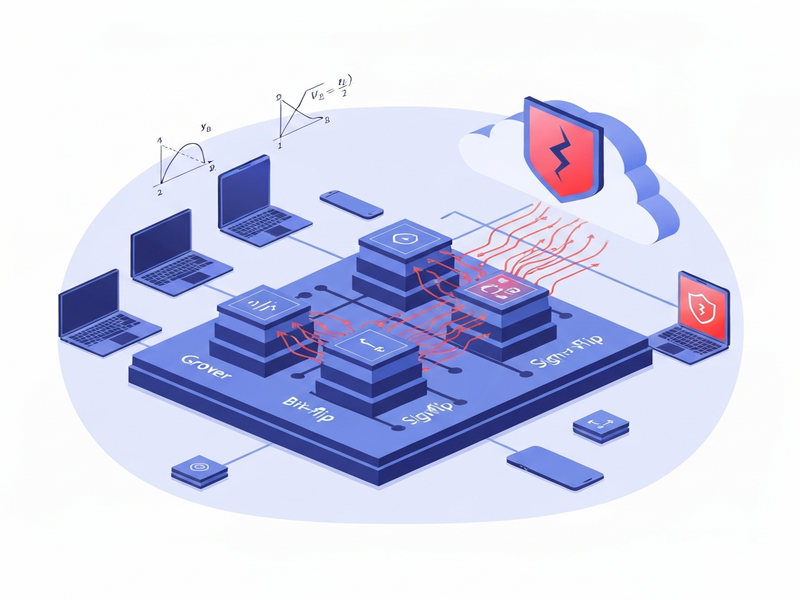
The authors formalize the Circuit‑Level Backdoor Threat (CULT) model, which enumerates four distinct attack primitives that a malicious client can embed into a QFL round:
- Grover‑based backdoor: Uses Grover’s amplitude amplification to bias measurement outcomes toward a target pattern.
- Pauli‑flip backdoor: Inserts Pauli‑X/Y/Z gates that flip qubit states only when a specific input trigger is present.
- Bit‑flip backdoor: Alters classical post‑processing of measurement bits, effectively flipping output bits for trigger inputs.
- Sign‑flip backdoor: Negates the sign of gradient components derived from certain measurement results, steering the global model in a hidden direction.
Each primitive can be deployed either in‑training (during the federated optimization loop) or post‑training (by delivering a poisoned model snapshot). The key insight is that these manipulations keep the Euclidean norm of the client’s gradient update within the statistical envelope of honest participants, thereby evading norm‑based detection.
To evaluate CULT, the researchers built a full‑stack QFL simulator that integrates:
- A parameterized quantum circuit library (supporting hardware‑agnostic gate sets).
- A classical federated optimizer (FedAvg) that aggregates quantum‑derived gradients.
- Attack modules that inject the four CULT primitives into selected client updates.
How It Works in Practice
The practical workflow of a QFL system under the CULT threat can be broken down into three phases:
1. Client‑Side Quantum Computation
Each participating device (or cloud quantum node) receives the current global circuit parameters from the server. It then:
- Prepares an input quantum state encoding its local data batch.
- Executes the variational circuit, possibly augmented with malicious sub‑circuits (e.g., a Grover oracle that activates on a trigger pattern).
- Measures the qubits, producing a stochastic bitstring.
- Computes a gradient estimate using the parameter‑shift rule or stochastic finite differences.
When a client is compromised, the malicious sub‑circuit is activated only for inputs that match the attacker’s trigger (e.g., a specific pixel pattern in an image). The resulting gradient remains statistically similar to benign gradients for all other inputs.
2. Server‑Side Aggregation
The central server collects all gradient vectors, applies the chosen aggregation rule (FedAvg by default), and updates the global circuit parameters. Because the malicious gradient is crafted to stay within the benign norm ball, the server’s robust aggregation methods (Krum, Multi‑Krum, etc.) often treat it as trustworthy.
3. Model Deployment and Trigger Exploitation
After several federated rounds, the global model is deployed for inference. When an end‑user supplies an input that matches the attacker’s trigger, the hidden quantum sub‑circuit fires, causing the model to produce a targeted misprediction (e.g., classifying a “stop” sign as a “speed limit” sign). In post‑training attacks, the attacker simply swaps the final model with a poisoned version that contains the backdoor circuitry.
What distinguishes this approach from classical backdoor attacks is the exploitation of quantum‑specific degrees of freedom—gate placement, amplitude amplification, and measurement basis—while still conforming to the statistical expectations of federated gradient aggregation.
Evaluation & Results
The authors conducted extensive experiments on two benchmark datasets, MNIST and CIFAR‑10, using non‑IID data partitions to reflect realistic federated scenarios. Key experimental dimensions included:
- Fraction of malicious clients (1 % to 20 %).
- Attack timing (early‑round vs. late‑round injection).
- Defense mechanisms applied (FedAvg alone, Krum, Multi‑Krum, FoolsGold, FLGuardian, Mud‑HoG).
Core findings:
- Single‑client potency: Even a lone malicious client (1 % of participants) could degrade global test accuracy by up to 30 % on CIFAR‑10 when using a Grover‑based backdoor.
- Stealthiness confirmed: The L2 norm of poisoned updates differed by less than 2 % from the average benign norm, allowing them to pass through norm‑based filters.
- Partial defense success: Robust aggregators like Krum reduced accuracy loss in low‑malicious‑fraction regimes but failed catastrophically when the attacker timed the backdoor injection in later rounds, where the model had already converged.
- Worst‑case collapse: In scenarios combining a high‑fraction of malicious clients (≥10 %) with post‑training model replacement, overall accuracy dropped by up to 50 % despite all defenses being active.
These results demonstrate that existing federated defenses, originally crafted for classical gradient vectors, are insufficient against quantum‑aware backdoors that manipulate the underlying circuit rather than the gradient magnitude alone.
Why This Matters for AI Systems and Agents
For practitioners building AI agents that rely on federated or hybrid quantum‑classical pipelines, the CULT findings raise several red flags:
- Supply‑chain risk: Quantum cloud providers may host multiple tenants on the same hardware. A compromised tenant could embed a backdoor into shared circuit templates, affecting all downstream agents.
- Model reliability: Agents that depend on QFL for critical decisions (e.g., autonomous navigation, financial forecasting) could be silently coerced into erroneous actions when presented with a trigger.
- Compliance and auditability: Regulatory frameworks increasingly demand provable model integrity. CULT shows that traditional audit logs (gradient snapshots) may not capture malicious quantum sub‑circuits.
- Design of robust orchestration: System architects must consider quantum‑level verification (e.g., circuit tomography, gate‑level anomaly detection) in addition to classical aggregation safeguards.
Integrating these insights early can prevent costly retrofits. For example, teams can leverage the UBOS platform overview to prototype end‑to‑end quantum‑classical workflows with built‑in monitoring hooks, ensuring that any deviation in circuit structure triggers an alert before model aggregation.
What Comes Next
While the paper makes a compelling case for the existence and danger of circuit‑level backdoors, several avenues remain open:
- Quantum‑native defenses: Developing verification techniques that inspect the quantum circuit itself (e.g., randomized benchmarking, gate‑level fingerprinting) could complement gradient‑based defenses.
- Hardware‑level isolation: Cloud quantum providers might enforce tenant‑level sandboxing of circuit templates, preventing cross‑tenant contamination.
- Adaptive aggregation: Future federated algorithms could weigh updates not only by norm but also by circuit similarity metrics, flagging outliers that share structural patterns with known backdoor primitives.
- Benchmark suites: Establishing standardized QFL security benchmarks would help the community evaluate new defenses under realistic attack scenarios.
Addressing these challenges will likely require collaboration across quantum hardware vendors, cryptographers, and AI system integrators. Companies looking to stay ahead can explore the Enterprise AI platform by UBOS, which offers modular components for secure model orchestration, including quantum‑ready monitoring extensions.
Conclusion
The CULT threat model shines a light on a blind spot in the rapidly evolving field of quantum federated learning. By demonstrating that a single malicious client can embed stealthy, circuit‑level backdoors that evade existing robust aggregation methods, the authors underscore the urgent need for quantum‑aware security primitives. As enterprises begin to adopt hybrid quantum‑classical pipelines for high‑stakes applications, integrating circuit‑level verification, hardware isolation, and adaptive aggregation will be essential to safeguard model integrity and maintain trust in AI agents.
Andrii Bidochko
CTO UBOS
Andrii Bidochko is an AI entrepreneur and researcher focused on AI agents, reinforcement learning, and autonomous systems. He writes about the technologies shaping the future of machine intelligence, from frontier models and agent architectures to real-world AI applications.