

- Updated: June 26, 2026
- 7 min read
Calibration Is Not Control: Why LLM-Agent Oversight Needs Intervention
Direct Answer
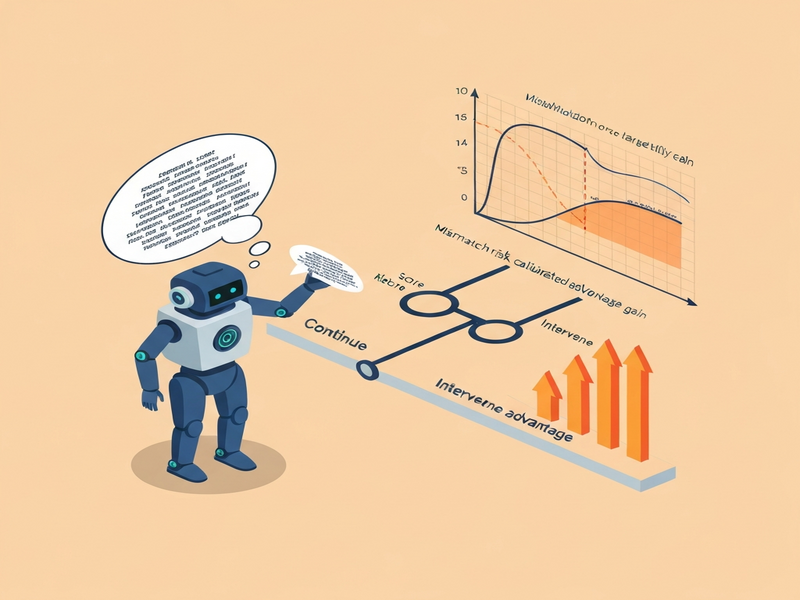
The paper arXiv 2606.21399 demonstrates that simply calibrating a scalar risk score does not give LLM‑agent overseers the control they need; instead, it introduces the concept of intervention advantage—the expected utility gain from stepping in versus letting the agent continue. By measuring this advantage with a counterfactual “prefix branching” protocol, the authors show that action‑conditioned control can dramatically reduce oversight regret across diverse benchmarks.
Background: Why This Problem Is Hard
Large language model (LLM) agents are increasingly deployed in autonomous workflows—customer‑service bots, data‑analysis assistants, and even robotic controllers. In production, a single misstep can cascade into costly errors, privacy breaches, or safety incidents. The prevailing safety net is runtime oversight, which treats the agent’s future behavior as a scalar risk prediction: a confidence, uncertainty, or failure probability that triggers an external halt when it exceeds a threshold.
Two fundamental issues undermine this approach:
- Information loss. A scalar score collapses a high‑dimensional trajectory into a single number, discarding the nuanced context that determines whether an intervention would actually improve outcomes.
- Misaligned decision target. Oversight systems aim to answer “Will the agent fail if we let it run?” but the operational question is “Will intervening now make the final result better?” The two questions diverge whenever the same risk estimate corresponds to both recoverable and irrecoverable states.
Existing calibration techniques—temperature scaling, isotonic regression, or Platt scaling—focus on aligning predicted probabilities with observed frequencies. While they improve statistical metrics, they do not address the core mismatch between risk estimation and control utility. Consequently, even a perfectly calibrated risk score can lead to high “control regret,” the loss incurred by making the wrong intervention decision.
What the Researchers Propose
The authors introduce a new oversight paradigm centered on intervention advantage (IA). IA quantifies the expected increase in utility when an overseer intervenes at a particular trajectory prefix, compared with the expected utility of letting the agent proceed unchecked. In other words, IA directly measures the value of control rather than the likelihood of failure.
To estimate IA, the paper proposes a prefix‑branching protocol:
- Identify a trajectory prefix where the overseer must decide.
- From that exact state, execute multiple candidate actions (including the agent’s original choice and a set of alternative interventions).
- Observe the downstream outcomes of each branch to compute the utility difference.
This counterfactual sampling yields an action‑conditioned value estimate for each possible intervention, allowing the overseer to select the action with the highest IA. The framework replaces the scalar risk score with a small, tractable decision model that directly optimizes for control effectiveness.
How It Works in Practice
The practical workflow can be broken into four interacting components:
1. Trajectory Monitor
A lightweight observer records the agent’s state, actions, and environment observations in real time. When a predefined “decision point” is reached—e.g., a confidence drop, a policy divergence, or a domain‑specific trigger—the monitor flags the prefix for evaluation.
2. Branching Engine
Given the flagged prefix, the branching engine spawns parallel simulations from the identical state. Each simulation runs a distinct candidate action: the agent’s original move, a safe fallback, or a corrective maneuver supplied by a human‑in‑the‑loop or a rule‑based policy.
3. Utility Evaluator
Each simulated branch is rolled out to a horizon (often a few steps to keep computation tractable) and scored with a domain‑specific utility function—task completion, cost, safety margin, or user satisfaction. The evaluator aggregates these scores to compute the expected utility of each action.
4. Intervention Selector
The selector compares the expected utilities and chooses the action with the highest IA. If the IA is negative (i.e., intervening would hurt performance), the system lets the original LLM agent continue.
What distinguishes this approach from traditional calibrated risk routing is that the decision is made on a per‑prefix, per‑action basis, preserving the rich contextual information that scalar scores discard. Moreover, the branching engine can be implemented with modern model‑in‑the‑loop simulators (e.g., lightweight LLMs or environment models), making the overhead manageable for many real‑time applications.
Evaluation & Results
The authors validated their framework on four benchmark suites that span text‑based planning, embodied interaction, and multi‑step reasoning:
- ALFWorld – a simulated household environment where agents must manipulate objects to achieve goals.
- MiniWoB – web‑navigation tasks that require sequential clicks and form filling.
- HotpotQA‑Chain – multi‑hop question answering that tests reasoning depth.
- CodeAct – code‑generation and execution loops where errors can be catastrophic.
Across all domains, the action‑conditioned controller consistently outperformed calibrated scalar routing. The most striking improvement appeared in ALFWorld’s “interactive regime,” where the average control regret dropped from 0.506 (scalar baseline) to 0.110 using prefix‑only IA estimation. In weaker intervention settings—where the overseer’s corrective actions have limited effect—the gap narrowed but remained positive, confirming that the method adapts gracefully to varying levels of control authority.
Importantly, a calibration‑only ablation (re‑scaling the scalar risk score) improved traditional prediction metrics (e.g., Brier score) but left control regret unchanged. This empirical evidence supports the paper’s central claim: calibration fixes probability alignment but does not repair the underlying target error that drives poor oversight decisions.
Why This Matters for AI Systems and Agents
For practitioners building production‑grade LLM agents, the findings reshape how risk management pipelines should be architected:
- Control‑first design. Instead of treating risk prediction as the final gate, developers can embed IA estimators directly into orchestration layers, ensuring that every intervention decision is utility‑aware.
- Reduced false alarms. By focusing on expected outcome improvement, the system avoids unnecessary halts that degrade user experience—a common complaint with over‑cautious safety filters.
- Scalable safety. The prefix‑branching protocol can be parallelized across modern cloud GPU clusters, making it feasible for high‑throughput services such as ChatGPT and Telegram integration or OpenAI ChatGPT integration.
- Better alignment with business KPIs. Since IA is expressed in domain‑specific utility terms (e.g., transaction success rate, customer satisfaction), it aligns safety engineering with measurable business outcomes, a critical factor for enterprises adopting AI.
In short, moving from calibrated risk scores to action‑conditioned value estimation equips AI safety teams with a decision tool that directly answers “Will intervening help?”—the question that truly matters for AI risk management.
What Comes Next
While the intervention‑advantage framework marks a significant step forward, several open challenges remain:
- Long‑horizon branching. Current experiments limit rollouts to a few steps for tractability. Extending IA estimation to deep, multi‑step horizons will require more efficient model‑based simulators or hierarchical branching strategies.
- Human‑in‑the‑loop scalability. In many enterprise settings, human operators must review IA suggestions. Designing intuitive dashboards that surface IA scores without overwhelming users is an active research area.
- Generalization across domains. The utility functions used in benchmarks are handcrafted. Automating utility specification—perhaps via reinforcement learning from human feedback—could broaden applicability to domains like finance or healthcare.
- Integration with existing orchestration platforms. Embedding IA estimators into end‑to‑end pipelines (e.g., Workflow automation studio) will accelerate adoption and provide real‑world feedback loops.
Future research may also explore hybrid models that combine calibrated risk scores with IA estimates, leveraging the strengths of both probabilistic calibration and utility‑driven control. As LLM agents become more autonomous, the ability to predict the *impact* of an intervention—rather than merely the *probability* of failure—will be a decisive factor in building trustworthy AI systems.
Enterprises interested in prototyping IA‑based oversight can start by experimenting with UBOS’s modular AI stack. The UBOS platform overview offers ready‑made components for trajectory monitoring, simulation, and utility evaluation, while the UBOS templates for quick start accelerate integration with existing workflows.
By rethinking oversight through the lens of intervention advantage, the AI community can move beyond calibration’s limits and toward truly controllable, business‑aligned LLM agents.
Andrii Bidochko
CTO UBOS
Andrii Bidochko is an AI entrepreneur and researcher focused on AI agents, reinforcement learning, and autonomous systems. He writes about the technologies shaping the future of machine intelligence, from frontier models and agent architectures to real-world AI applications.