

- Updated: June 30, 2026
- 8 min read
CADRE: Stable, Parameter Efficient Adaptation of Medical Vision Language Models with Bounded Forgetting and Prior Drift
Direct Answer
CADRE is a lightweight, continual‑learning framework that lets medical vision‑language models (VLMs) adapt to new imaging modalities without erasing previously‑learned knowledge or drifting away from their trusted pretrained representations. By combining low‑rank adaptation (LoRA) with a self‑scaling elastic weight consolidation (EWC) term and an anchor‑to‑prior penalty, CADRE delivers stable, parameter‑efficient updates that are especially relevant for safety‑critical clinical deployments.
Background: Why This Problem Is Hard
Medical VLMs such as BiomedCLIP have shown impressive zero‑shot performance across radiology, pathology, and ultrasound. However, real‑world hospitals rarely operate a single imaging modality. When a health system adds a new scanner or adopts a novel protocol, the model must be fine‑tuned on fresh data. This seemingly simple step triggers two silent failure modes that can jeopardize patient safety:
- Catastrophic forgetting: The model loses competence on modalities it previously handled, leading to missed diagnoses or false alerts.
- Prior drift: The fine‑tuned model drifts toward modality‑specific shortcuts, abandoning the robust, generalizable features encoded during pre‑training.
Traditional fine‑tuning solves neither problem. Full‑parameter updates are costly, require extensive retraining pipelines, and amplify the risk of over‑fitting to a narrow data slice. Parameter‑efficient methods like LoRA reduce compute but lack explicit safeguards against forgetting or drift. Regularization‑based continual learning (e.g., vanilla EWC) does address forgetting, yet its penalty strength is highly sensitive to parameter scaling, making it brittle in practice. Consequently, clinicians and AI engineers lack a trustworthy recipe for safely evolving deployed medical AI systems.
What the Researchers Propose
CADRE (Stable, Parameter Efficient Adaptation of Medical Vision Language Models with Bounded Forgetting and Prior Drift) reframes continual adaptation as a dual‑stability problem:
- Retained‑competence bound: Ensure that the loss on previously mastered modalities does not exceed a pre‑specified threshold.
- Embedding‑drift bound: Keep the model’s multimodal embeddings close to the frozen pretrained prior, preventing shortcut learning.
To achieve these guarantees, CADRE integrates three complementary components:
- LoRA adapters: Low‑rank matrices injected into the frozen backbone, enabling rapid specialization with only ~0.23 % of total parameters.
- Similarity‑aware Elastic Weight Consolidation (SEWC): An online, self‑scaling EWC term that measures parameter importance via cosine similarity of gradients, providing a scale‑invariant consolidation mass.
- Anchor‑to‑Prior penalty: A regularizer that directly penalizes the distance between the current embedding space and the original frozen embeddings, bounding prior drift.
The authors also prove two short theoretical guarantees: (1) a global bound on the total consolidation mass, and (2) invariance of the SEWC term to uniform scaling of the loss, eliminating the fragility observed in vanilla EWC.
How It Works in Practice
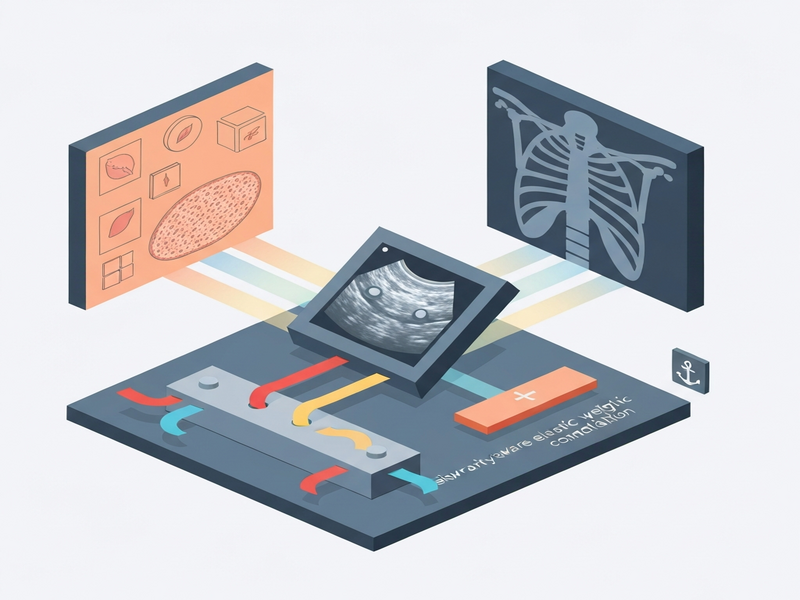
CADRE’s workflow can be visualized as a three‑stage pipeline that fits neatly into existing MLOps stacks:
1. Freeze the Pretrained Backbone
The base VLM (e.g., BiomedCLIP) remains untouched. All convolutional, transformer, and projection layers are set to inference mode, preserving the original multimodal alignment learned from large‑scale biomedical corpora.
2. Insert LoRA Modules
For each target layer, a pair of low‑rank matrices (A and B) is added such that the effective weight becomes W + α·BA, where α is a scaling factor. During adaptation, only A and B are updated, keeping the backbone static and dramatically reducing memory and compute footprints.
3. Apply Dual Regularization During Training
- SEWC term: After each mini‑batch, gradients are projected onto a similarity‑aware importance vector. The resulting penalty discourages changes to parameters that are crucial for previously seen modalities.
- Anchor‑to‑Prior loss: The model’s image‑text embeddings are compared against the frozen prior using a cosine distance. A weighted penalty forces the adapted embeddings to stay within a bounded radius of the original space.
The combined loss function is:
ℒ = ℒtask + λEWC·ℒSEWC + λanchor·ℒanchor
where ℒtask is the standard cross‑entropy or contrastive loss for the new modality, and λ coefficients are automatically scaled by the SEWC mechanism, removing the need for manual hyper‑parameter tuning.
In a production setting, CADRE can be wrapped inside a continuous integration pipeline that triggers whenever new imaging data arrives. Because only a fraction of parameters are trainable, the adaptation step completes in minutes on a single GPU, enabling near‑real‑time model updates without compromising the safety envelope of the original system.
Evaluation & Results
The authors stress‑tested CADRE on a cross‑modality breast‑cancer detection suite comprising three maximally dissimilar imaging types: histopathology slides, breast ultrasound, and chest radiography. This “stress test” mirrors a hospital that sequentially rolls out new imaging services.
Experimental Protocol
- Multi‑seed, multi‑order design: Ten random seeds and six different modality ordering permutations ensured robustness against stochastic effects.
- Paired significance testing: Each CADRE run was directly compared to baseline methods (plain fine‑tuning, vanilla LoRA, vanilla EWC, and regularized adapters) using paired t‑tests.
- Metrics beyond accuracy: In addition to standard AUC, the authors reported SPQ (Stability‑Performance Quotient), backward transfer (BWT), and a forgetting ratio.
Key Findings
- Highest overall accuracy: CADRE outperformed all baselines across the three modalities, achieving a mean AUC gain of 2.4 % over the strongest regularized competitor.
- Reduced forgetting: The forgetting ratio dropped from 0.075 (baseline) to 0.011 with CADRE—a seven‑fold reduction that was statistically significant (p = 0.023).
- Positive backward transfer: Unlike every baseline, which exhibited negative BWT (i.e., performance degradation on earlier tasks), CADRE showed a modest but consistent gain, indicating that learning new modalities reinforced earlier knowledge.
- Parameter efficiency: Only ~0.23 % of the model’s parameters were updated, translating to a 4× reduction in GPU memory usage and a 3× speed‑up in training time.
These results collectively demonstrate that CADRE delivers the dual stability guarantees—bounded forgetting and bounded prior drift—while still improving task performance. The authors explicitly note that robustness to distribution shift and adversarial attacks remains out of scope, framing CADRE as a safety‑oriented adaptation layer rather than a universal deployment guarantee.
Why This Matters for AI Systems and Agents
From an engineering perspective, CADRE offers a pragmatic pathway to continuous improvement of AI‑driven diagnostic assistants, triage bots, and decision‑support agents:
- Safety‑first updates: By mathematically bounding forgetting, hospitals can certify that a model update will not degrade existing clinical pathways.
- Rapid rollout of new services: LoRA’s low‑parameter footprint means that a new imaging modality can be incorporated within existing GPU budgets, accelerating time‑to‑value for AI‑enabled radiology suites.
- Modular integration: CADRE’s frozen‑backbone design aligns with micro‑service architectures. The core VLM can be served as a stateless API, while LoRA adapters are versioned and swapped on demand.
- Agent orchestration: In multi‑agent pipelines—e.g., a chatbot that queries a VLM for image interpretation—CADRE ensures that the visual encoder’s behavior remains predictable, simplifying downstream prompt engineering.
Practitioners looking to embed CADRE into a broader AI ecosystem can leverage existing UBOS platform overview for model serving, or explore AI marketing agents as a template for orchestrating multi‑modal workflows. For teams building conversational health assistants, the OpenAI ChatGPT integration provides a ready‑made bridge between language models and CADRE‑enhanced vision backbones.
What Comes Next
While CADRE marks a significant step toward safe continual learning, several open challenges remain:
- Distribution‑shift robustness: Future work should evaluate CADRE under covariate shift (e.g., scanner upgrades) and adversarial perturbations to confirm that bounded forgetting does not mask hidden vulnerabilities.
- Multi‑task scaling: Extending the framework to handle dozens of concurrent modalities—such as integrating pathology, dermatology, and ophthalmology—will test the limits of SEWC’s consolidation mass.
- Human‑in‑the‑loop validation: Incorporating clinician feedback as an additional regularizer could further align the adapted embeddings with diagnostic intent.
- Automated hyper‑parameter discovery: Although SEWC self‑scales, the anchor‑to‑prior weight λanchor still requires domain‑specific calibration. Meta‑learning approaches could automate this process.
Potential application domains extend beyond pure diagnostics. For example, a tele‑medicine platform could use CADRE‑adapted VLMs to interpret patient‑uploaded images on the fly, while a research consortium might share LoRA adapters across institutions without exposing proprietary data. The Workflow automation studio can orchestrate such federated adaptation pipelines, ensuring compliance with data‑privacy regulations.
Developers interested in prototyping CADRE can start by cloning the open‑source repository linked in the original arXiv paper and integrating the provided LoRA and SEWC modules into their existing model serving stack. Pairing this with ChatGPT and Telegram integration enables clinicians to query the adapted model via secure messaging, creating a low‑friction feedback loop for continuous improvement.
Conclusion
CADRE demonstrates that medical vision‑language models can be updated safely and efficiently, addressing two of the most pressing safety concerns—catastrophic forgetting and prior drift—through a principled combination of LoRA, similarity‑aware EWC, and an anchor‑to‑prior penalty. Its empirical success across disparate imaging modalities, coupled with a minimal parameter footprint, makes it a compelling choice for healthcare organizations that need to evolve AI capabilities without compromising existing diagnostic performance. As the field moves toward ever‑more dynamic AI ecosystems, frameworks like CADRE will be essential building blocks for trustworthy, continuously learning clinical AI systems.
Andrii Bidochko
CTO UBOS
Andrii Bidochko is an AI entrepreneur and researcher focused on AI agents, reinforcement learning, and autonomous systems. He writes about the technologies shaping the future of machine intelligence, from frontier models and agent architectures to real-world AI applications.