

- Updated: July 19, 2026
- 6 min read
Bridging Cognitive Neuroscience and Graph Intelligence: Hippocampus-Inspired Multi-View Hypergraph Learning for Web Finance Fraud
Direct Answer
The paper introduces HIMVH – a Hippocampus‑Inspired Multi‑View Hypergraph learning framework that detects web‑based financial fraud by spotting cross‑view inconsistencies and novelty patterns. It matters because it lifts the detection ceiling on rare, camouflaged fraud cases that cripple today’s fintech platforms.
Background: Why This Problem Is Hard
Online financial services operate in an open, high‑velocity environment where billions of transactions flow daily. Two intertwined challenges keep fraud‑detection pipelines from reaching optimal performance:
- Long‑tailed data distribution: Legitimate transactions dominate the data, while truly malicious events form a thin tail. Standard classifiers become biased toward the majority class and miss the few but high‑impact frauds.
- Fraud camouflage: Sophisticated actors deliberately mimic benign behavior—splitting amounts, timing transfers like normal users, or using legitimate merchant codes—to evade rule‑based or shallow‑learning detectors.
Graph Neural Networks (GNNs) have become the de‑facto tool for modeling transaction networks because they capture relational patterns. Yet most GNN‑based fraud detectors treat the transaction graph as a single view and aggregate messages uniformly. This design overlooks:
- Heterogeneous signals (e.g., device fingerprints, geo‑location, temporal bursts) that reside in separate “views.”
- Subtle conflicts between views that often betray camouflaged fraud.
- Dynamic novelty—how a transaction deviates from its local neighborhood over time.
Consequently, existing solutions struggle to surface rare, cross‑view anomalies, leading to false negatives that erode user trust and increase financial loss.
What the Researchers Propose
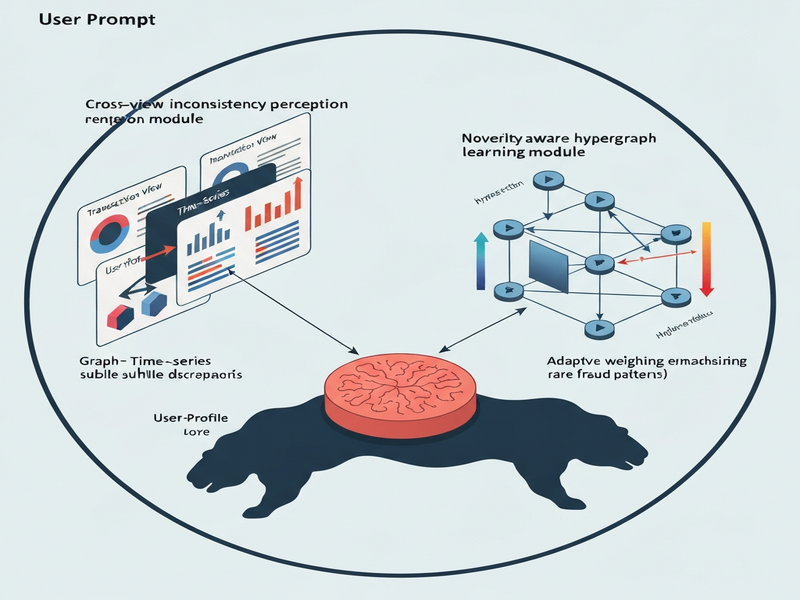
HIMVH (Hippocampus‑Inspired Multi‑View Hypergraph) reframes fraud detection as a neuroscience‑guided learning problem. The model draws two analogies from the hippocampus:
- Cross‑view inconsistency perception: Mirroring the hippocampal scene‑conflict monitoring, the system builds a cross‑view inconsistency perception module that quantifies how much a transaction’s representations diverge across multiple views (e.g., payment channel, device ID, temporal slice).
- Novelty‑aware hypergraph learning: Inspired by the CA1 region’s match‑mismatch detection, a novelty‑aware hypergraph learning module measures each node’s deviation from its hyper‑neighborhood expectations and re‑weights message passing accordingly.
These two mechanisms work together to surface both camouflaged fraud (through view conflicts) and rare fraud (through novelty scores), delivering a more sensitive and robust detector.
How It Works in Practice
Conceptual Workflow
- Multi‑view construction: Raw transaction logs are split into complementary views—such as transaction amount patterns, device‑usage graphs, and temporal sequences. Each view is encoded into a separate graph.
- Hypergraph assembly: Nodes that belong to the same transaction across views are linked via hyperedges, forming a multi‑view hypergraph that preserves cross‑modal relationships.
- Inconsistency perception: For every hyperedge, the module computes a divergence score (e.g., cosine distance) between view‑specific embeddings. High divergence flags potential camouflage.
- Neighborhood novelty scoring: The hypergraph learner aggregates messages from neighboring nodes, then compares the aggregated representation to the node’s own embedding. A large mismatch triggers a novelty weight.
- Adaptive message passing: Both the inconsistency score and novelty weight modulate the strength of messages flowing through the hypergraph, ensuring that suspicious patterns dominate the final representation.
- Classification head: The enriched node embeddings feed into a binary classifier that outputs a fraud probability for each transaction.
Key Interactions
- The inconsistency perception module acts as a gatekeeper, amplifying signals where views disagree.
- The novelty‑aware learner acts as a dynamic calibrator, boosting attention to nodes that look unusual relative to their local hyper‑neighborhood.
- Both modules share a common embedding backbone, enabling end‑to‑end training with gradient flow across view encoders and hypergraph layers.
What Sets HIMVH Apart
Traditional GNNs aggregate uniformly, assuming homogeneity across edges. HIMVH, by contrast, treats each view as a distinct cognitive channel and explicitly measures conflicts, much like the hippocampus flags mismatched sensory inputs. Moreover, the novelty‑aware re‑weighting mirrors biological surprise detection, allowing the model to stay sensitive to the long tail of rare fraud events.
Evaluation & Results
Experimental Setup
The authors benchmarked HIMVH on six publicly available web‑finance fraud datasets covering peer‑to‑peer lending, mobile payments, and e‑commerce platforms. Each dataset exhibits a pronounced long‑tail distribution and includes engineered camouflage scenarios.
Baseline comparators comprised 15 state‑of‑the‑art models, including:
- Standard GNNs (GCN, GraphSAGE)
- Heterogeneous GNNs (HAN, RGCN)
- Hypergraph networks (HGNN, HyperGCN)
- Ensemble fraud detectors (XGBoost + graph features)
Metrics
Performance was measured using Area Under the ROC Curve (AUC), F1‑score, and Average Precision (AP) – the latter being especially sensitive to rare‑class detection.
Key Findings
- HIMVH improved average AUC by **6.42 %** over the strongest baseline.
- F1‑score rose by **9.74 %**, indicating better balance between precision and recall on the minority fraud class.
- Average Precision jumped **39.14 %**, confirming a dramatic lift in detecting rare, camouflaged cases.
- Ablation studies showed that removing either the inconsistency perception or novelty‑aware module reduced performance by more than 4 % across all metrics, underscoring their complementary value.
These results demonstrate that a hippocampus‑inspired dual‑module architecture can consistently outshine conventional graph‑based fraud detectors, especially when fraudsters deliberately blend into normal traffic.
Why This Matters for AI Systems and Agents
Fintech operators can embed HIMVH into existing fraud‑prevention pipelines without discarding legacy rule engines. The model’s multi‑view design aligns naturally with modern data‑fabric architectures that already collect device logs, geo‑metadata, and transaction streams.
For AI agents that orchestrate risk‑assessment workflows, HIMVH offers two practical advantages:
- Early‑warning novelty signals: Agents can trigger additional verification steps (e.g., OTP, manual review) when the novelty‑aware module flags a high‑surprise transaction, reducing false positives.
- Explainable cross‑view conflicts: The inconsistency scores can be surfaced as human‑readable alerts (“Device fingerprint deviates from amount pattern”), aiding compliance teams and satisfying regulatory transparency requirements.
Integrating HIMVH with a ChatGPT and Telegram integration enables real‑time alerts to fraud analysts, while a Chroma DB integration can store novelty embeddings for downstream analytics.
What Comes Next
While HIMVH sets a new benchmark, several avenues remain open for exploration:
- Real‑time streaming: Adapting the hypergraph construction to a sliding‑window architecture would allow sub‑second fraud detection on high‑throughput payment rails.
- Additional views: Incorporating textual data from transaction memos or user‑generated support tickets could enrich the multi‑view representation.
- Continual learning: Deploying a lifelong learning regime would let the novelty‑aware module evolve as fraud patterns shift.
- Cross‑institution collaboration: Sharing anonymized hypergraph structures across banks via federated learning could amplify detection power without compromising privacy.
Organizations interested in prototyping these extensions can explore the UBOS platform overview for modular AI pipelines, or join the UBOS partner program to co‑develop industry‑specific solutions.
References
Cui, R., Zhang, N., Zhu, K., & Zhang, Q. (2026). Bridging Cognitive Neuroscience and Graph Intelligence: Hippocampus‑Inspired Multi‑View Hypergraph Learning for Web Finance Fraud. arXiv preprint arXiv:2601.11073v3.
Andrii Bidochko
CTO UBOS
Andrii Bidochko is an AI entrepreneur and researcher focused on AI agents, reinforcement learning, and autonomous systems. He writes about the technologies shaping the future of machine intelligence, from frontier models and agent architectures to real-world AI applications.