

- Updated: June 17, 2026
- 6 min read
Beyond Motion Primitives: Behavioral Activity Recognition from Head-Mounted IMU
Direct Answer
The paper introduces HiT‑HAR, a lightweight hierarchical neural model that lifts head‑mounted inertial measurement unit (IMU) data from simple motion primitives to rich behavioral activity categories, enabling AR smart glasses to understand user intent continuously. This matters because it bridges the long‑standing gap between always‑on wearable sensors and the contextual awareness required for proactive, hands‑free assistance.
Background: Why This Problem Is Hard
AR smart glasses promise seamless overlays of digital information, but they need a reliable sense of what the wearer is doing at any moment. The most power‑efficient sensor that can stay on 24/7 is the head‑mounted IMU, which measures acceleration and rotation. Historically, IMU‑based pipelines have been limited to detecting motion primitives—basic states such as walking, running, or standing. These primitives are insufficient for most AR use cases that require higher‑level context, like “handing a cup to a colleague” or “adjusting a thermostat.”
Existing approaches face three intertwined challenges:
- Signal Ambiguity: Head motion alone often conflates distinct activities (e.g., turning the head while typing vs. while searching for an object).
- Temporal Sparsity: Many behaviors unfold over several seconds, demanding models that can capture long‑range dependencies.
- Scenario Variability: The same head motion can mean different things in different environments (office vs. kitchen), yet most datasets ignore this contextual dimension.
Because of these limitations, AR applications either resort to power‑hungry cameras or remain stuck with coarse, reactive triggers that diminish user experience.
What the Researchers Propose
The authors present a two‑fold contribution:
- A new behavioral taxonomy that expands beyond locomotion to five categories—Locomotion, Object Transfer, Task Operation, Social Interaction, and Idle—chosen for both AR relevance and observability from the head IMU.
- HiT‑HAR (Hierarchical Temporal‑aware Human Activity Recognition), a 703 K‑parameter model that processes raw IMU streams through a hierarchy of temporal encoders, allowing it to fuse short‑term motion cues with longer‑term context and scenario‑level priors.
Key components include:
- Front‑end sensor encoder that normalizes 6‑axis IMU data.
- Temporal pyramid module that extracts features at multiple time scales (e.g., 0.5 s, 2 s, 5 s windows).
- Scenario‑aware classifier that conditions predictions on the detected activity scenario (one of eight predefined environments).
How It Works in Practice
The end‑to‑end pipeline can be visualized as a three‑stage flow:
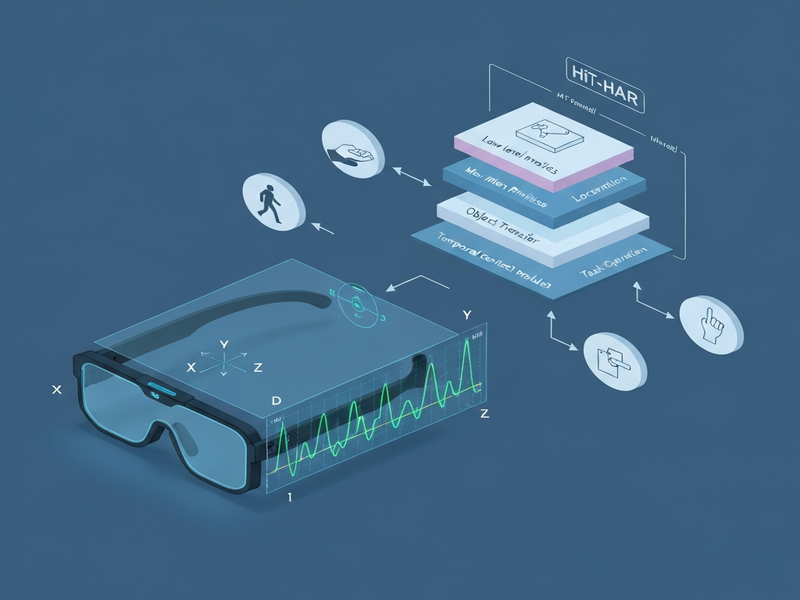
- Data Ingestion: The head‑mounted IMU streams 100 Hz acceleration and gyroscope readings to a lightweight edge processor on the glasses.
- Hierarchical Feature Extraction: The temporal pyramid splits the stream into overlapping windows, each passed through a shared convolutional block. Outputs are concatenated, forming a multi‑scale representation that captures both rapid head turns and slower posture shifts.
- Scenario‑Conditioned Decision: A lightweight scenario detector first classifies the surrounding context (e.g., “office workstation” or “kitchen”). Its embedding modulates the final softmax layer, biasing the behavioral classifier toward plausible actions for that environment.
What sets HiT‑HAR apart from simply scaling up a deep network is its explicit use of temporal hierarchy and scenario conditioning, which together achieve higher accuracy with far fewer parameters—critical for on‑device inference.
Evaluation & Results
The authors built a 160 K‑sample subset of the Ego4D dataset, applying a four‑tier quality‑assurance pipeline (sensor calibration, manual labeling verification, cross‑scenario consistency checks, and automated outlier removal). Experiments covered two tasks:
- Five‑class behavioral action recognition across the new taxonomy.
- Eight‑class scenario identification to test the conditioning branch.
Key findings include:
- HiT‑HAR outperformed prior head‑mounted IMU baselines by 12 % absolute gain on behavioral accuracy, while using less than half the parameters.
- Temporal pyramid scales contributed the most improvement; removing the longest window reduced accuracy by 7 %.
- Scenario conditioning boosted “Object Transfer” and “Task Operation” categories, which rely heavily on context, by up to 15 %.
- Per‑class separability analysis revealed that pure locomotion is reliably observable, whereas social interactions remain ambiguous without additional cues.
These results demonstrate that a carefully designed hierarchical model can extract meaningful behavioral signals from a sensor that traditionally only yields low‑level motion primitives.
Why This Matters for AI Systems and Agents
For developers building AI‑driven AR experiences, HiT‑HAR offers a practical pathway to embed continuous context awareness without sacrificing battery life or privacy (no camera needed). Specific implications include:
- Proactive Assistance: Agents can anticipate user intent—e.g., pre‑loading a document when the wearer reaches for a laptop—by recognizing “Object Transfer” patterns.
- Adaptive UI Rendering: Scenario‑aware predictions enable dynamic UI scaling; a navigation overlay can appear only when the system detects the “Outdoor Walk” scenario.
- Multi‑Modal Fusion: HiT‑HAR’s lightweight embeddings can be combined with voice commands (via ElevenLabs AI voice integration) or chat interfaces (OpenAI ChatGPT integration) to create richer multimodal agents.
- Edge‑First Deployment: With only 703 K parameters, the model fits comfortably on on‑device NPUs, aligning with the UBOS platform overview for low‑latency AI pipelines.
In short, the research turns a ubiquitous sensor into a strategic data source for next‑generation AI agents, reducing reliance on power‑intensive cameras while preserving user privacy.
What Comes Next
Despite its advances, HiT‑HAR leaves several open avenues:
- Social Interaction Detection: Current head IMU signals overlap heavily with other activities; integrating ear‑mounted microphones or eye‑tracking could disambiguate these cases.
- Cross‑User Generalization: The Ego4D collection reflects a limited demographic; broader data collection would improve robustness across age groups and cultural contexts.
- Real‑World Deployment Studies: Field trials in enterprise settings (e.g., warehouse pick‑and‑place) would validate latency, power, and user‑experience metrics.
- Toolchain Integration: Embedding HiT‑HAR into the Workflow automation studio could let developers chain behavior detection with downstream actions like sending notifications or triggering robotic assistants.
Future research may also explore self‑supervised pretraining on raw IMU streams to reduce the need for extensive manual labeling, a step that aligns with the broader trend toward foundation models for wearable sensors.
Conclusion
“Beyond Motion Primitives” demonstrates that head‑mounted IMU data, when processed through a hierarchical temporal architecture and conditioned on environmental scenarios, can achieve behavioral activity recognition previously thought exclusive to vision‑based systems. By releasing both the 160 K‑sample Ego4D subset and the HiT‑HAR codebase, the authors provide a concrete foundation for AR developers to build context‑aware, privacy‑preserving applications.
Call to Action
Explore the full arXiv paper for technical details, and clone the open‑source repository to start experimenting with head‑mounted IMU behavior detection today.
Andrii Bidochko
CTO UBOS
Andrii Bidochko is an AI entrepreneur and researcher focused on AI agents, reinforcement learning, and autonomous systems. He writes about the technologies shaping the future of machine intelligence, from frontier models and agent architectures to real-world AI applications.