

- Updated: June 23, 2026
- 7 min read
Beyond Fixed Budgets: Characterizing the Inelasticity and Limitations of Tree-of-Thought Reasoning Strategies
Direct Answer
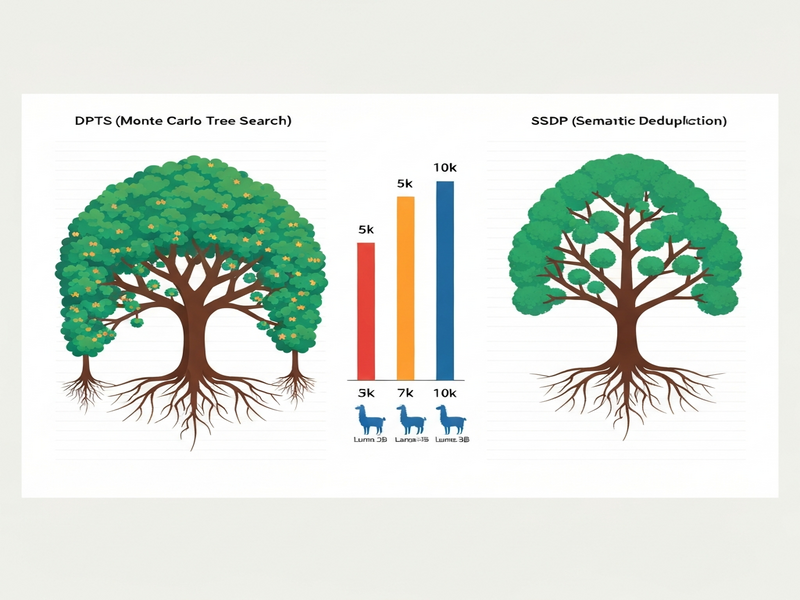
The paper “Beyond Fixed Budgets: Characterizing the Inelasticity and Limitations of Tree‑of‑Thought Reasoning Strategies” reveals that two popular Tree‑of‑Thought (ToT) search methods—DPTS (a Monte‑Carlo‑Tree‑Search variant) and SSDP (a semantic‑deduplication approach)—behave very differently when the compute budget changes. DPTS stalls at low token budgets, while SSDP runs out of useful search frontier at high budgets, showing that a single static exploration or pruning rule cannot serve the whole budget spectrum. The authors argue for adaptive, progress‑aware strategies that reshape the search dynamics on‑the‑fly.
Background: Why This Problem Is Hard
Large language models (LLMs) have become remarkably good at answering factual questions, but complex multi‑step problems—such as math word problems or logical puzzles—still expose their reasoning limits. Tree‑of‑Thought search attempts to mitigate this by expanding a branching “thought” space, letting the model explore many candidate solution paths before committing to a final answer. In practice, however, two practical constraints dominate:
- Compute budget elasticity: Real‑world deployments (e.g., chat‑bots, autonomous agents) must respect token limits, latency SLAs, and cost ceilings. A method that works well with 10 k tokens may be unusable when only 3 k tokens are available.
- Model scale variance: Smaller LLMs (3 B parameters) have weaker internal reasoning than larger ones (8 B+), yet many enterprises run the former for cost reasons.
Existing ToT implementations typically adopt a fixed exploration policy (e.g., always expand the top‑k nodes) or a static pruning rule (e.g., discard duplicates after a set depth). These heuristics were tuned on a single budget and model size, so they fail to generalize across the diverse operating points that modern AI products encounter.
What the Researchers Propose
The authors do not introduce a brand‑new algorithm; instead, they provide a systematic characterization of the “inelasticity” of two representative ToT strategies:
- DPTS (Dynamic Progressive Tree Search): A Monte‑Carlo‑Tree‑Search (MCTS) variant that balances exploration and exploitation using a UCB‑style score. It expands nodes based on simulated rollouts and prunes low‑value branches.
- SSDP (Semantic‑Space Deduplication Planner): An approach that clusters generated thoughts in a semantic embedding space, then discards near‑duplicate nodes to keep the frontier diverse.
Both methods are evaluated under a matrix of conditions (two benchmarks, two model sizes, four token budgets). The key contribution is a set of empirical observations that expose where each method’s assumptions break down, and a call for “adaptive search orchestration” that can switch tactics based on real‑time progress signals.
How It Works in Practice
Conceptual Workflow
Regardless of the underlying algorithm, a ToT system follows a common pipeline:
- Prompt Generation: The original problem statement is transformed into a “thought prompt” that asks the LLM to produce a partial reasoning step.
- Node Expansion: The LLM generates multiple candidate thoughts for the current node. In DPTS, each candidate receives a rollout score; in SSDP, each candidate is embedded for similarity checks.
- Evaluation & Scoring: A lightweight evaluator (often a smaller LLM or a heuristic) assigns a utility value to each new node.
- Selection & Pruning: The search controller decides which nodes to keep for the next expansion round. DPTS uses a UCB‑derived priority; SSDP removes nodes that fall within a semantic radius of an existing node.
- Termination: The process stops when the token budget is exhausted or a satisfactory solution is found.
Interaction Between Components
Figure 1 (illustrated below) shows the feedback loop:
The loop highlights two critical control points:
- Progress Monitoring: Real‑time metrics such as “average rollout reward” (DPTS) or “semantic frontier density” (SSDP) indicate whether the search is still productive.
- Budget‑Aware Adaptation: When progress stalls, the controller can either allocate more tokens to deeper rollouts (DPTS) or relax the deduplication radius (SSDP) to re‑inject diversity.
This adaptive stance is what differentiates the authors’ recommendation from prior static pipelines.
Evaluation & Results
Benchmarks, Models, and Budgets
The experiments span two widely used math reasoning datasets:
- Math500: 500 handcrafted arithmetic and algebra problems designed to stress multi‑step reasoning.
- GSM8K: A 8 k‑sample benchmark of grade‑school math questions with known solution trees.
Both Llama‑3B and Llama‑8B serve as the underlying LLMs, and four token budgets are examined: 3 k, 5 k, 7 k, and 10 k tokens per problem.
Key Findings
- DPTS suffers a cold‑start bottleneck at low budgets. With only 3 k tokens, the Monte‑Carlo rollouts cannot gather enough samples to compute reliable UCB scores, leading the search to converge prematurely on sub‑optimal branches.
- SSDP experiences frontier depletion at higher budgets. As the token budget grows, the semantic deduplication aggressively prunes nodes, eventually leaving too few candidates to explore new reasoning directions. The search stalls despite remaining compute.
- No single static policy dominates. Across the budget continuum, DPTS outperforms SSDP at the extremes (very low or very high token limits), while SSDP is superior in the mid‑range where its diversity mechanism shines.
- Model size matters, but does not erase the patterns. The 8 B model improves absolute accuracy for both methods, yet the relative inelasticity (cold‑start vs. frontier depletion) remains consistent.
These observations collectively demonstrate that “one‑size‑fits‑all” ToT configurations are fundamentally limited. The authors’ data suggest that an adaptive controller—one that monitors progress signals and toggles between DPTS‑style deep rollouts and SSDP‑style diversity preservation—could sustain higher accuracy across the entire budget range.
Why This Matters for AI Systems and Agents
For practitioners building AI‑driven agents, the study offers concrete guidance on how to allocate compute resources without sacrificing reasoning quality:
- Cost‑effective deployment: Small‑scale agents (e.g., chat‑bots on edge devices) can adopt a lightweight SSDP variant with a relaxed deduplication radius, avoiding the cold‑start penalty that would cripple DPTS under tight token caps.
- Scalable orchestration: Enterprise AI platforms—such as the UBOS platform overview—can embed a budget‑aware scheduler that switches between DPTS and SSDP based on real‑time usage metrics, ensuring consistent performance across workloads.
- Workflow automation: The Workflow automation studio can expose “reasoning budget” knobs to end‑users, letting them trade latency for depth in a transparent UI.
- Agent reliability: Adaptive search reduces the risk of agents returning incomplete or nonsensical answers when operating under unpredictable load, a critical factor for compliance‑sensitive sectors like finance or healthcare.
In short, the paper equips AI engineers with evidence‑based heuristics to design more resilient reasoning pipelines, moving beyond ad‑hoc parameter tuning toward systematic, data‑driven orchestration.
What Comes Next
While the study clarifies the failure modes of two prominent ToT strategies, several open challenges remain:
- Dynamic policy learning: Future work could train a meta‑controller (e.g., a reinforcement‑learning agent) that learns to allocate tokens between exploration and exploitation on a per‑problem basis.
- Hybrid node representations: Combining semantic embeddings with rollout statistics might yield a richer frontier metric, mitigating both cold‑start and depletion effects.
- Cross‑domain validation: Extending the analysis to non‑math tasks—such as code synthesis, planning, or multi‑modal reasoning—will test whether the observed inelasticity generalizes.
- Integration with external tools: Linking ToT search to knowledge bases (e.g., Chroma DB integration) could provide grounding signals that reduce the need for deep rollouts.
Practitioners interested in experimenting with adaptive ToT pipelines can start by prototyping a simple rule‑based switcher inside the Enterprise AI platform by UBOS. By monitoring progress metrics (reward variance for DPTS, frontier density for SSDP), the system can automatically adjust its search mode, delivering higher accuracy without manual re‑configuration.
Ultimately, the paper’s call for “budget‑aware, progress‑driven” reasoning aligns with the broader industry shift toward AI agents that can self‑regulate resources, a prerequisite for trustworthy, large‑scale deployment.
Andrii Bidochko
CTO UBOS
Andrii Bidochko is an AI entrepreneur and researcher focused on AI agents, reinforcement learning, and autonomous systems. He writes about the technologies shaping the future of machine intelligence, from frontier models and agent architectures to real-world AI applications.