

- Updated: June 15, 2026
- 6 min read
Beyond Binary Moral Judgment: Modeling Ethical Pluralism in AI
Direct Answer
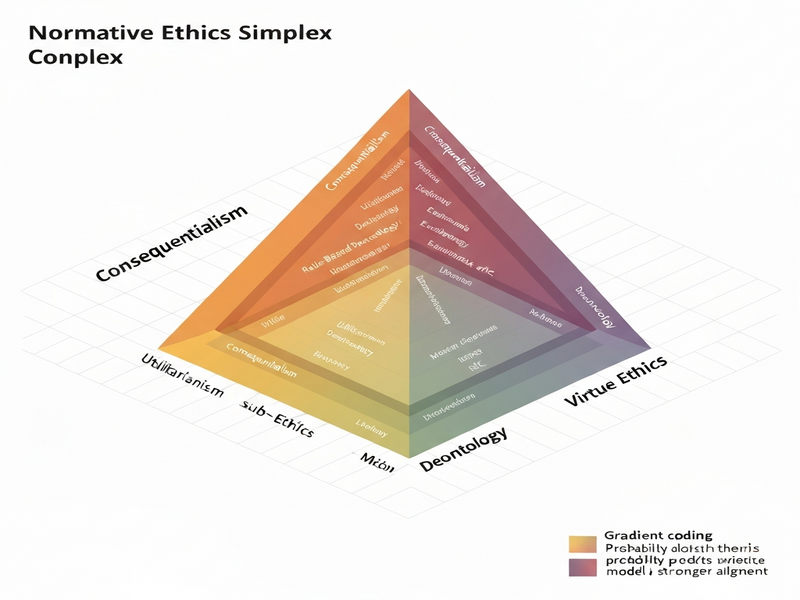
The paper introduces a normative ethics simplex that treats moral judgment as a probability distribution over multiple ethical theories, enabling AI systems to reason with ethical pluralism instead of a single binary or scalar score. This matters because it gives autonomous agents the ability to explain, justify, and adapt their decisions in socially critical contexts, a prerequisite for trustworthy AI deployment.
Background: Why This Problem Is Hard
AI‑driven decision‑making is moving from narrow recommendation tasks to high‑stakes domains such as healthcare triage, autonomous policing, and financial credit scoring. In these arenas, a single “right” answer rarely exists; moral dilemmas often involve competing principles—maximizing overall welfare, respecting individual rights, or embodying virtuous character. Existing approaches typically collapse this richness into a binary “acceptable/unacceptable” label or a scalar utility value. Such simplifications suffer from three critical shortcomings:
- Lack of explanatory power: Binary outputs give no insight into which ethical considerations drove the decision.
- Context blindness: A single scalar cannot capture nuanced situational factors that shift the balance between, for example, deontological duties and consequentialist outcomes.
- Accountability gaps: Regulators and end‑users demand traceable reasoning chains; a monolithic score offers no audit trail.
These limitations hinder the adoption of AI in regulated environments and erode public trust. The research community therefore needs a framework that can simultaneously represent multiple normative perspectives, quantify their relative influence, and surface that information to human stakeholders.
What the Researchers Propose
The authors present a normative ethics simplex, a geometric construct that embeds three broad ethical families—consequentialism, virtue ethics, and deontology—along with fifteen fine‑grained sub‑theories (e.g., utilitarianism, Kantian duty, Aristotelian virtue). Each point inside the simplex corresponds to a specific mixture of these theories, expressed as a probability distribution. In practice, an AI system queries this simplex to retrieve a weighted ethical profile for any given dilemma.
Key components of the proposal include:
- Normative Stream: A dedicated encoder that transforms extracted contextual features (e.g., stakeholder identities, outcome horizons) into a vector aligned with the simplex axes.
- Semantic Stream: A language model that captures the natural‑language nuance of the dilemma description, producing contextual embeddings.
- Stacked Ensemble Learner: A multi‑level classifier that first predicts the broad ethical family, then refines the prediction to one of the fifteen sub‑theories, finally outputting the full distribution over the simplex.
How It Works in Practice
The operational workflow can be broken down into four stages:
- Case Ingestion: A natural‑language description of an ethical dilemma is fed into the system. Simultaneously, a feature extractor parses structured cues (e.g., number of affected parties, legal constraints).
- Dual Encoding: The semantic stream processes the raw text with a transformer‑based encoder, while the normative stream encodes the structured features into a low‑dimensional ethical vector.
- Fusion & Stacking: The two streams are concatenated and passed through a hierarchy of classifiers. The first layer selects among consequentialism, virtue ethics, and deontology; the second layer chooses the appropriate sub‑theory; the final layer outputs a probability simplex point.
- Decision Output & Explanation: The resulting distribution is presented to downstream agents. For example, a self‑driving car could weigh a 60 % deontological component (obey traffic law) against a 30 % consequentialist component (minimize overall harm) and a 10 % virtue‑ethical component (exhibit prudence), then generate a human‑readable justification.
What sets this approach apart is the explicit separation of normative knowledge from linguistic context, allowing the system to inject ethical priors even when the language model alone would default to analogical reasoning.
Evaluation & Results
The researchers built a benchmark of 450 ethically charged scenarios, each annotated with the appropriate sub‑theory and a set of 20 contextual features. The dataset spans medical triage, autonomous weapon use, financial fraud detection, and more, ensuring broad coverage of real‑world dilemmas.
Experiments compared three configurations:
- Baseline semantic‑only model (no normative stream).
- Normative‑semantic two‑stream model without stacking.
- Full two‑stream model with stacked ensemble (the proposed system).
Key findings:
- The full system achieved an overall classification accuracy of 88.89 %, a 12‑point lift over the semantic‑only baseline.
- Ablation studies revealed that removing the normative stream dropped accuracy by 7 %, confirming that structured ethical priors contribute beyond raw language understanding.
- Entropy analysis showed higher confidence (lower entropy) for cases with clear legal precedents, while ambiguous scenarios produced broader distributions—mirroring human moral uncertainty.
- Visualization of the simplex highlighted clusters of dilemmas that naturally align with specific ethical families, offering an intuitive audit tool for developers.
These results demonstrate that modeling ethical pluralism as a probabilistic distribution not only improves predictive performance but also yields richer, explainable outputs suitable for compliance and governance pipelines.
Why This Matters for AI Systems and Agents
For practitioners building autonomous agents, the normative ethics simplex provides a plug‑and‑play module that can be layered onto existing decision pipelines. The benefits are threefold:
- Enhanced Trustworthiness: Agents can surface a transparent ethical breakdown, satisfying regulator‑mandated explainability requirements.
- Dynamic Policy Alignment: By adjusting the probability weights within the simplex, organizations can tailor agents to reflect corporate values or jurisdiction‑specific norms without retraining the entire model.
- Improved Orchestration: In multi‑agent ecosystems, each participant can broadcast its ethical profile, enabling higher‑level coordination mechanisms that resolve conflicts before execution.
Companies looking to embed responsible AI into their products can leverage the AI marketing agents to ensure campaign decisions respect privacy norms, or adopt the Enterprise AI platform by UBOS for end‑to‑end governance across large‑scale deployments.
What Comes Next
While the study marks a significant step toward human‑like moral reasoning, several open challenges remain:
- Scalability of Sub‑theories: Extending the simplex to incorporate cultural relativism or emerging normative frameworks will require richer feature engineering.
- Real‑Time Adaptation: Deployments in fast‑moving environments (e.g., financial markets) need mechanisms to update the distribution on‑the‑fly based on feedback loops.
- Cross‑Domain Transfer: Validating whether a model trained on medical dilemmas can generalize to autonomous logistics without degradation.
Future research could explore reinforcement learning agents that actively query the simplex during policy optimization, or integrate causal reasoning to better capture downstream effects of ethical choices.
Practitioners interested in prototyping these ideas can start with the UBOS platform overview to access modular pipelines, or explore the UBOS for startups program for early‑stage experimentation.
References & Further Reading
For a complete technical description, see the original arXiv paper. Additional resources on ethical AI frameworks and alignment strategies are available through the About UBOS page.
Andrii Bidochko
CTO UBOS
Andrii Bidochko is an AI entrepreneur and researcher focused on AI agents, reinforcement learning, and autonomous systems. He writes about the technologies shaping the future of machine intelligence, from frontier models and agent architectures to real-world AI applications.