

- Updated: July 20, 2026
- 6 min read
Beyond Attention Scores: SVD-Based Vision Token Pruning for Efficient Vision-Language Models
Direct Answer
SVD‑Prune is a training‑free, plug‑and‑play token‑pruning technique that uses singular value decomposition (SVD) to keep only the vision tokens that contribute most to the dominant global variance of a Vision‑Language Model (VLM). By selecting tokens with the highest statistical leverage scores, it dramatically reduces the computational load while preserving accuracy even when the model is forced to operate with as few as 16 or 32 visual tokens.
Background: Why This Problem Is Hard
Modern Vision‑Language Models such as CLIP, BLIP, and Flamingo process images by first converting them into a long sequence of visual tokens—often hundreds or thousands per frame. Each token is fed through multi‑head self‑attention layers, which scale quadratically with sequence length. In real‑world deployments—mobile assistants, edge devices, or large‑scale inference services—this quadratic cost translates into high latency, excessive GPU memory consumption, and inflated cloud‑compute bills.
Existing token‑reduction strategies typically rely on heuristics like attention scores, token norms, or learned gating networks. While intuitive, these methods suffer from two fundamental drawbacks:
- Positional bias: Tokens that happen to appear early in the sequence often receive higher attention simply because of their position, not because they carry more semantic information.
- Information dispersion: When visual scenes are dense (e.g., crowded streets, detailed product catalogs), important cues are spread across many tokens. Pruning based on local scores can discard subtle yet critical details, causing steep performance drops at high pruning ratios.
Consequently, practitioners face a trade‑off: keep the full token set for accuracy or aggressively prune and risk losing essential visual context. The need for a principled, data‑driven pruning method that works across diverse image domains has never been more pressing.
What the Researchers Propose
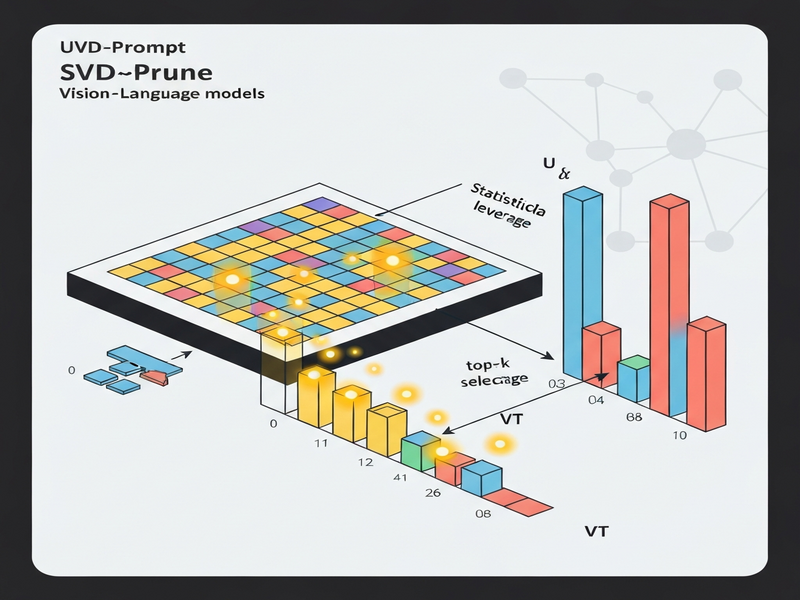
The authors introduce SVD‑Prune, a method that treats the entire vision token matrix as a single statistical object. By performing a singular value decomposition on this matrix, the technique isolates the directions (singular vectors) that capture the most variance across all tokens. Tokens are then ranked by their statistical leverage scores—a measure of how much each token contributes to the dominant singular vectors.
Key components of the framework include:
- Token Feature Matrix: An n × d matrix where n is the number of visual tokens and d is the embedding dimension.
- SVD Engine: A lightweight, off‑the‑shelf SVD routine that decomposes the matrix into UΣVᵀ without any gradient updates.
- Leverage‑Score Selector: A statistical module that computes the row‑wise leverage scores from the left singular vectors (U) and picks the top‑k tokens.
- Plug‑and‑Play Wrapper: A thin integration layer that swaps the original token set with the selected subset before the VLM’s transformer layers execute.
Because SVD‑Prune operates entirely post‑hoc—after the visual encoder has produced token embeddings—it requires no additional training, no extra parameters, and no modification to the underlying VLM architecture.
How It Works in Practice
The workflow can be broken down into four deterministic steps:
- Encode Image → Token Matrix: An image passes through the VLM’s visual backbone (e.g., a ViT or Swin transformer) producing a dense token matrix
X ∈ ℝⁿˣᵈ. - Decompose with SVD: Compute the truncated SVD of
X, retaining the top‑r singular values (typically r ≪ n). This yieldsUₙₓᵣ,Σᵣₓᵣ, andVᵀᵣₓᵈ. - Calculate Leverage Scores: For each token i, the leverage score ℓᵢ = ‖Uᵢ‖₂², i.e., the squared L2‑norm of the i‑th row of
U. Higher ℓᵢ indicates stronger alignment with the dominant variance directions. - Select Top‑k Tokens: Rank tokens by ℓᵢ and keep the top‑k (where k is the desired budget, e.g., 32). The remaining tokens are discarded, and the reduced matrix
X̂is fed into the downstream multimodal transformer.
What sets SVD‑Prune apart from attention‑based heuristics is its global perspective: instead of looking at each token in isolation, it evaluates how each token contributes to the overall structure of the visual representation. This mitigates positional bias and ensures that even sparsely distributed visual cues survive the pruning process.
Evaluation & Results
The authors benchmarked SVD‑Prune on three representative VLMs (CLIP‑ViT‑B/32, BLIP‑Base, and Flamingo‑Small) across two downstream tasks: zero‑shot image classification and image‑text retrieval. Experiments varied the token budget from the full set (≈196 tokens) down to extreme limits (16 tokens).
Key findings include:
- Consistent Superiority: Across all models and tasks, SVD‑Prune outperformed attention‑score pruning, norm‑based pruning, and learned gating by margins ranging from 1.5% to 4.2% in top‑1 accuracy.
- Robustness at Extreme Budgets: With only 32 tokens, the drop in classification accuracy was under 2% relative to the full‑token baseline, whereas competing methods suffered 5‑10% degradation.
- Speed & Memory Gains: Reducing token count to 16 cut transformer FLOPs by ~85% and lowered GPU memory usage by 70%, enabling inference on a single RTX 3080 for models that previously required multi‑GPU setups.
- Domain Generalization: On a fine‑grained dataset (iNaturalist) with highly detailed imagery, SVD‑Prune retained 93% of the baseline performance, while attention‑based pruning fell below 80%.
These results demonstrate that a statistically grounded token selection strategy can preserve the semantic richness of visual inputs even when the computational budget is severely constrained.
Why This Matters for AI Systems and Agents
For product teams building multimodal agents—whether chatbots that understand screenshots, autonomous drones that interpret aerial imagery, or recommendation engines that fuse product photos with textual reviews—the ability to run VLMs efficiently is a decisive competitive factor.
- Lower Inference Costs: By cutting FLOPs and memory, SVD‑Prune makes it feasible to host VLMs on cost‑effective cloud instances or edge devices, directly translating into lower OPEX for SaaS platforms.
- Faster Response Times: Reduced token sequences shrink latency, which is critical for real‑time agents that must answer user queries within sub‑second windows.
- Scalable Orchestration: When VLMs are part of a larger agent pipeline (e.g., vision → language → action), the pruning step can be inserted as a lightweight micro‑service, simplifying workflow orchestration.
- Enabling New Use‑Cases: Scenarios that were previously prohibitive—such as processing high‑resolution video frames on‑device or running VLMs in low‑bandwidth environments—become practical.
Developers can integrate SVD‑Prune into existing pipelines without retraining, making it a drop‑in optimization for platforms like the UBOS platform overview, where multimodal agents are assembled from modular components.
What Comes Next
While SVD‑Prune delivers impressive gains, several avenues remain open for exploration:
- Adaptive Budgeting: Dynamically adjusting k based on image complexity (e.g., more tokens for crowded scenes) could further balance accuracy and efficiency.
- Hybrid Pruning: Combining global SVD leverage scores with local attention cues might capture both macro‑ and micro‑level importance.
- Hardware‑Aware Implementations: Tailoring the SVD computation to specific accelerators (TPUs, NPUs) could reduce the overhead of the pruning step itself.
- Cross‑Modal Extensions: Extending the leverage‑score concept to textual token streams could enable joint pruning for truly symmetric multimodal models.
Practitioners interested in experimenting with SVD‑Prune can start by leveraging the ChatGPT and Telegram integration to prototype a low‑latency vision‑language chatbot, then scale up using the Enterprise AI platform by UBOS for production workloads.
For a deeper dive into the methodology and full experimental tables, consult the original paper.
Andrii Bidochko
CTO UBOS
Andrii Bidochko is an AI entrepreneur and researcher focused on AI agents, reinforcement learning, and autonomous systems. He writes about the technologies shaping the future of machine intelligence, from frontier models and agent architectures to real-world AI applications.