

- Updated: June 13, 2026
- 6 min read
Better Accuracies, Worse Reasoning: A Step-Level Audit of Medical Chain-of-Thought Distillation
Direct Answer
The paper introduces a step‑level audit of chain‑of‑thought (CoT) distillation for medical question answering, revealing that while distilled models can achieve higher final‑answer accuracy, their reasoning traces become substantially less factual. This paradox matters because many AI‑driven healthcare tools expose or reuse intermediate reasoning, and relying solely on answer‑level metrics can mask dangerous degradations in clinical justification.
Background: Why This Problem Is Hard
Medical multiple‑choice exams such as the USMLE require not only the correct final answer but also a sound clinical rationale. In practice, AI systems are increasingly asked to generate step‑by‑step explanations that clinicians can audit, patients can understand, or downstream agents can consume. However, two entrenched challenges limit progress:
- Opaque evaluation pipelines. Most research on CoT distillation measures success with aggregate accuracy or calibration scores, ignoring the fidelity of each intermediate claim.
- Compact answer spaces. Short answer options (A‑E) leave a large portion of the diagnostic reasoning under‑specified, giving a distilled student model room to mimic the surface form of a teacher’s trace without grounding each step in medical facts.
Existing approaches assume that a higher‑performing student automatically inherits the teacher’s reasoning quality. This assumption breaks down when the student is smaller, when the teacher’s trace is long, or when the domain (e.g., clinical decision‑making) demands strict factual grounding at every step.
What the Researchers Propose
The authors propose a systematic, step‑level audit framework that treats each line of a CoT trace as an independent classification problem. Their methodology consists of three conceptual components:
- Blind LLM‑judge evaluation. A separate, style‑blind language model (referred to as Kimi‑K2.6) judges each step without seeing the surrounding context, thereby measuring local factuality.
- Clinical expert verification. A domain specialist conducts a blind review of a random sample of steps (150 in the study) to validate the LLM‑judge’s findings.
- Boundary‑check analysis. The audit isolates scenarios where answer brevity under‑constrains the rationale, highlighting when a student can “look like” an expert without being one.
By decoupling answer correctness from trace correctness, the framework surfaces hidden trade‑offs that traditional metrics overlook.
How It Works in Practice
The practical workflow can be broken down into four stages:
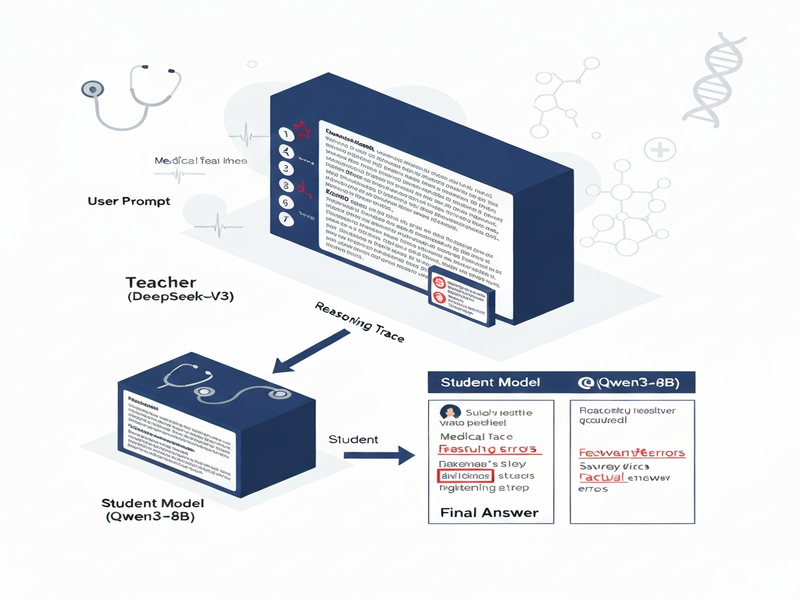
1. Teacher Generation
A large, high‑capacity model (e.g., DeepSeek‑V3 family) is prompted to answer a medical QA item and to produce a full chain‑of‑thought explanation. The output includes a sequence of reasoning steps followed by the final answer choice.
2. Student Distillation
A smaller model (Qwen3‑8B in the primary experiment) is trained via supervised fine‑tuning to imitate the teacher’s entire trace, not just the final answer. The loss function treats each token equally, encouraging the student to reproduce the teacher’s style and structure.
3. Step‑Level Auditing
Each reasoning step is fed independently to a blind LLM‑judge, which classifies the step as correct or incorrect based solely on factual consistency with medical knowledge. The judge’s decisions are aggregated to compute an error rate per step.
4. Expert Cross‑Check
A clinical expert reviews a stratified sample of steps, confirming whether the LLM‑judge’s labels align with professional judgment. This step validates that the automated audit reflects real‑world clinical standards.
What distinguishes this pipeline from prior distillation studies is the explicit, granular measurement of reasoning fidelity, rather than assuming that a lower‑error final answer implies a trustworthy trace.
Evaluation & Results
The authors evaluated the framework across multiple dimensions:
- Answer‑level performance. The distilled Qwen3‑8B student improved MedQA‑USMLE accuracy from 74.7 % to 84.4 % (SC@64) and reduced expected calibration error from 0.096 to 0.034.
- Step‑level factuality. Under the blind LLM‑judge, the student’s per‑step error rose dramatically from 30.6 % (teacher) to 50.3 % (student).
- Cross‑validation. A clinical expert’s 150‑step audit reproduced the same ordering, confirming that the degradation is not an artifact of the judge model.
- Robustness checks. The inverse relationship persisted across different teacher strengths, student model families, scaling regimes, and alternative medical benchmarks.
These findings demonstrate a clear divergence: higher answer accuracy does not guarantee better reasoning. In fact, the more capable the student becomes at mimicking the teacher’s surface form, the more likely it is to hallucinate or omit factual support in individual steps.
Why This Matters for AI Systems and Agents
For practitioners building AI‑driven healthcare assistants, diagnostic chatbots, or automated medical literature summarizers, the study raises several actionable warnings:
- Trace exposure risk. When an agent publishes its reasoning (e.g., in a patient‑facing report), a flawed step can mislead clinicians, even if the final recommendation is correct.
- Orchestration pipelines. Systems that chain multiple models—one for retrieval, another for reasoning—must verify each hand‑off, not just the end result.
- Evaluation redesign. Relying on aggregate accuracy or calibration alone is insufficient; step‑level audits should become a standard part of the validation suite.
- Regulatory compliance. Emerging medical AI regulations (e.g., FDA’s “Good Machine Learning Practice”) emphasize traceability and explainability, aligning directly with the paper’s audit methodology.
Integrating these insights can improve the safety and trustworthiness of AI agents that operate in high‑stakes domains. For example, developers can embed the ChatGPT and Telegram integration to surface step‑by‑step explanations to clinicians in real time, while simultaneously running an automated LLM‑judge in the background to flag dubious claims before they reach the user.
What Comes Next
While the audit uncovers a critical blind spot, several limitations and open questions remain:
- Scalability of expert review. Manual clinical verification does not scale to millions of generated traces; future work should explore semi‑automated verification or crowdsourced medical expertise.
- Generalization beyond USMLE‑style QA. The current study focuses on multiple‑choice questions; extending the framework to open‑ended diagnosis or treatment planning will test its robustness.
- Model architecture impact. Investigating whether retrieval‑augmented or instruction‑tuned students exhibit the same trade‑off could inform better distillation recipes.
- Mitigation strategies. Techniques such as fact‑checking loops, contrastive learning on step‑level correctness, or hierarchical prompting may reduce hallucinations while preserving accuracy.
Potential applications of a refined audit pipeline include:
- Embedding step‑level verification into the Workflow automation studio for regulated healthcare workflows.
- Leveraging the Chroma DB integration to store and query verified reasoning traces for future reference.
- Deploying voice‑enabled explanations via the ElevenLabs AI voice integration, ensuring that spoken medical advice is both accurate and well‑grounded.
In sum, the paper challenges the community to look beyond headline accuracy numbers and to treat reasoning traces as first‑class citizens in model evaluation. By adopting step‑level audits, AI developers can build safer, more transparent medical agents that meet both user expectations and regulatory standards.
For readers who want to explore the full technical details, the original pre‑print is available on arXiv.
Andrii Bidochko
CTO UBOS
Andrii Bidochko is an AI entrepreneur and researcher focused on AI agents, reinforcement learning, and autonomous systems. He writes about the technologies shaping the future of machine intelligence, from frontier models and agent architectures to real-world AI applications.