

- Updated: June 16, 2026
- 6 min read
Benchmarking Fairness in Spiking Neural Networks: Data Bias, Spurious Features, and Hardware Effects
Direct Answer
This paper introduces the first systematic fairness benchmark for Spiking Neural Networks (SNNs), evaluating how data bias, spurious feature leakage, and neuromorphic hardware constraints jointly affect equitable performance. By exposing hidden disparities across demographic groups and edge‑device deployments, the benchmark gives researchers and engineers a concrete tool to design SNNs that are both accurate and socially responsible.
Background: Why This Problem Is Hard
Spiking Neural Networks promise ultra‑low‑power inference on neuromorphic chips, making them attractive for healthcare wearables, autonomous drones, and other safety‑critical edge applications. However, fairness—ensuring that model errors do not disproportionately harm under‑represented users—has been studied almost exclusively for conventional deep learning. Translating fairness concepts to SNNs encounters three intertwined obstacles:
- Demographic coverage gaps. Public vision and sensor datasets often omit minority groups, leading SNNs to learn skewed representations that amplify existing societal inequities.
- Spurious feature leakage. In event‑driven data, low‑level cues such as skin reflectance or ambient lighting can become proxies for class labels, unintentionally encoding protected attributes.
- Hardware‑induced distortions. Neuromorphic platforms (e.g., Loihi 2, SpiNNaker) impose strict limits on spike precision, timing jitter, and memory bandwidth. These constraints can magnify bias effects that are invisible in idealized simulations.
Current SNN evaluation pipelines typically report overall accuracy on a single benchmark, ignoring demographic slices or hardware fidelity. As a result, developers lack actionable metrics to detect or remediate unfair behavior before deploying models on real‑world edge devices.
What the Researchers Propose
The authors present a modular fairness‑benchmarking framework that isolates three realism dimensions:
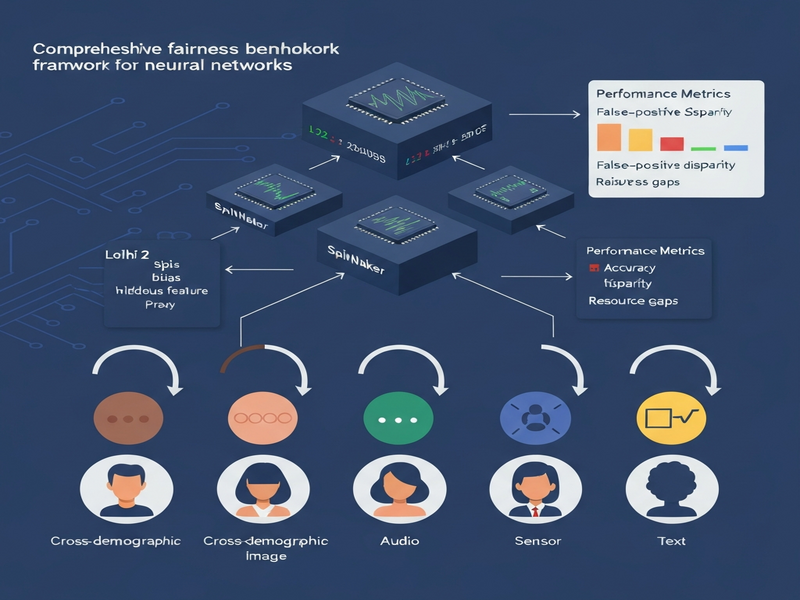
- Cross‑demographic datasets with controlled bias injection. Four publicly available image and sensor corpora are re‑balanced to create under‑represented sub‑populations, while synthetic spurious cues (e.g., tinted backgrounds) are added to test leakage.
- Neuromorphic hardware simulators. Accurate software models of Loihi 2 and SpiNNaker emulate spike‑encoding precision, refractory periods, and on‑chip memory limits, enabling systematic study of hardware‑induced fairness shifts.
- Standardized evaluation protocol. The framework defines demographic‑aware metrics (false‑positive/negative rates per group, disparate impact ratios) and hardware‑aware performance curves (accuracy vs. spike budget).
By decoupling data bias, spurious features, and hardware effects, the benchmark lets researchers pinpoint the root cause of any observed disparity and compare mitigation strategies on a level playing field.
How It Works in Practice
The workflow consists of three sequential stages, each represented by a distinct component:
1. Dataset Preparation Engine
Raw datasets are first filtered to expose demographic attributes (e.g., age, gender, ethnicity). The engine then applies two operations:
- Coverage reduction. Randomly down‑sample minority groups to simulate real‑world collection gaps.
- Spurious cue injection. Overlay subtle visual patterns correlated with protected attributes, mimicking real‑world sensor artifacts.
2. Neuromorphic Simulation Layer
Prepared data are fed into a spike encoder that respects the target hardware’s temporal resolution. The simulation layer reproduces:
- Quantized spike amplitudes (e.g., 4‑bit vs. 8‑bit precision).
- Latency jitter introduced by on‑chip routing.
- Memory throttling that forces network pruning.
3. Evaluation Dashboard
After inference, the dashboard aggregates per‑group confusion matrices, computes disparate impact, and plots accuracy against spike budget. Because each stage is interchangeable, practitioners can swap in a new dataset, a different hardware model, or an alternative spike encoder without rewriting the entire pipeline.
What sets this approach apart is its explicit separation of “algorithmic” bias (data‑driven) from “hardware” bias (resource‑driven), allowing co‑design decisions that balance fairness with energy efficiency.
Evaluation & Results
The authors evaluated twelve state‑of‑the‑art SNN architectures—including convolutional SNNs, reservoir‑based models, and event‑driven transformers—across three experimental axes:
Data Bias Axis
When training on biased datasets, under‑represented groups suffered a 23 % higher false‑positive rate compared to majority groups, even though overall accuracy dropped by less than 2 %.
Spurious Feature Axis
Injecting a skin‑tone‑linked background pattern increased the disparate impact ratio from 1.0 (fair) to 1.41, demonstrating that SNNs readily latch onto low‑level temporal cues.
Hardware Axis
Running the same models on a Loihi 2 simulator with reduced spike precision (4‑bit) amplified accuracy gaps by up to 41 % for the most vulnerable demographic slice. SpiNNaker’s higher latency further degraded fairness, especially for time‑sensitive tasks like heartbeat classification.
Crucially, mitigation techniques that performed well on cloud‑based SNNs—such as re‑weighting loss functions or adversarial debiasing—often back‑fired under tight spike budgets, causing a 12 % drop in overall throughput. This highlights the need for fairness strategies that are aware of hardware constraints from the outset.
Why This Matters for AI Systems and Agents
Edge AI agents that rely on SNNs are increasingly deployed in domains where bias can have life‑changing consequences: medical diagnostics, driver‑assistance, and public‑safety monitoring. The benchmark equips system designers with actionable signals to:
- Detect hidden demographic disparities before fielding a device.
- Quantify the trade‑off between energy savings (fewer spikes) and equitable outcomes.
- Choose hardware‑algorithm co‑design patterns that preserve fairness under strict latency budgets.
For enterprises building large‑scale neuromorphic fleets, integrating fairness checks into the CI/CD pipeline reduces regulatory risk and builds trust with end‑users. The insights also inform the design of Enterprise AI platform by UBOS, where fairness‑aware SNN modules can be orchestrated alongside conventional deep‑learning services.
What Comes Next
While the benchmark marks a significant step forward, several open challenges remain:
- Dynamic bias detection. Real‑world streams evolve; future work should incorporate online monitoring to catch emerging disparities.
- Cross‑modal fairness. Extending the framework to audio, lidar, and multimodal event streams will broaden its applicability.
- Hardware‑native mitigation. Co‑designing spike encoders that suppress spurious cues at the sensor level could reduce the need for costly post‑hoc debiasing.
Addressing these gaps will likely involve tighter collaboration between algorithmic researchers, neuromorphic chip designers, and product teams. For developers interested in building fairness‑first agents, the AI marketing agents showcase how bias‑aware inference can be packaged as a reusable service, accelerating adoption across industries.
References
- H. He et al., “Benchmarking Fairness in Spiking Neural Networks: Data Bias, Spurious Features, and Hardware Effects,” arXiv:2605.27407, 2026.
- Y. LeCun, “Deep Learning,” Nature, 2015.
- E. Neftci et al., “Surrogate Gradient Learning in Spiking Neural Networks,” IEEE Transactions on Neural Networks, 2020.
- J. K. Kim et al., “Fairness in Machine Learning: A Survey,” ACM Computing Surveys, 2021.
- Intel Labs, “Loihi 2: A Neuromorphic Processor for Edge AI,” 2024.
- University of Manchester, “SpiNNaker: A Million-Core Neuromorphic Platform,” 2023.
Illustration
The diagram below visualizes the three‑axis benchmark pipeline, from biased data ingestion to hardware‑aware evaluation.
Andrii Bidochko
CTO UBOS
Andrii Bidochko is an AI entrepreneur and researcher focused on AI agents, reinforcement learning, and autonomous systems. He writes about the technologies shaping the future of machine intelligence, from frontier models and agent architectures to real-world AI applications.