

- Updated: July 2, 2026
- 7 min read
BELLS-O: Evaluating the Operational Trade‑offs of LLM Supervision Systems
Direct Answer
The paper introduces BELLS‑O (Benchmark for the Evaluation of LLM Supervision Systems, Operational), the first vendor‑neutral, operational‑focused benchmark that measures how well large‑language‑model (LLM) supervision tools—such as content‑moderation filters and jailbreak detectors—perform across detection quality, false‑positive rates, latency, and monetary cost. It matters because it gives product teams a realistic, side‑by‑side comparison of specialized guardrails and repurposed generalist LLMs, enabling informed decisions that balance safety with deployment economics.
Background: Why This Problem Is Hard
AI‑driven products increasingly rely on LLMs for chat, code generation, and creative assistance. While these models unlock powerful capabilities, they also expose organizations to misuse, disallowed content, and jailbreak attacks that can bypass safety layers. The industry’s primary defense is a patchwork of supervision systems—ranging from narrow, rule‑based filters to heavyweight, generalist LLMs that act as “detective” agents.
Existing benchmarks suffer from three critical shortcomings:
- Vendor bias. Most public evaluations are sponsored by a single provider, skewing results toward proprietary solutions.
- Missing operational metrics. Accuracy alone tells only half the story; latency and cost are decisive factors when scaling to millions of requests per day.
- Lack of apples‑to‑apples comparison. Guardrails built specifically for moderation are rarely pitted against frontier LLMs (e.g., GPT‑5.4, Claude Sonnet 4.6) that have been repurposed as supervisors, leaving teams uncertain which approach fits their use case.
These gaps create a decision‑making vacuum for engineers and product managers who must choose a safety stack that does not cripple user experience or burn through cloud budgets.
What the Researchers Propose
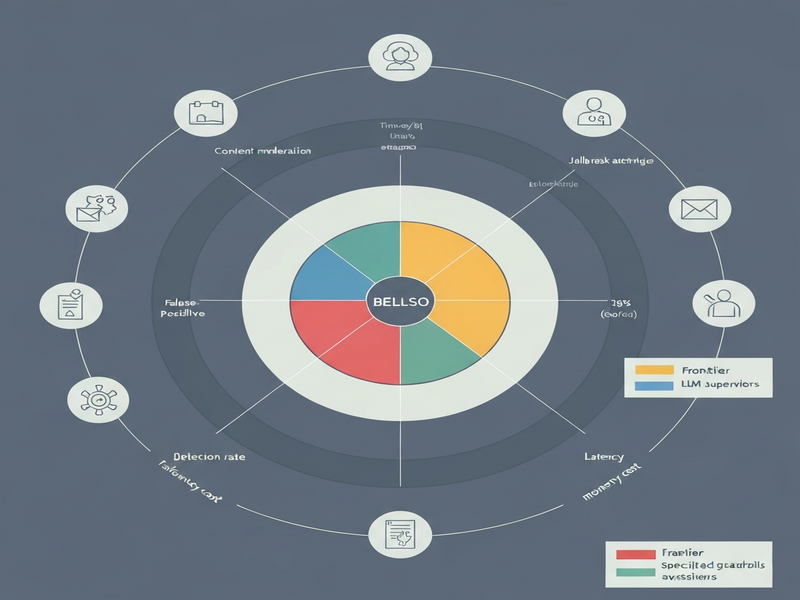
The authors present BELLS‑O, a comprehensive, operational benchmark that evaluates 28 supervision systems from 17 providers across two core safety dimensions:
- Content moderation. Eleven harm categories (e.g., hate speech, self‑harm, illicit instructions) are tested for detection rate and false‑positive rate.
- Jailbreak detection. Thirteen adversarial attack techniques are used to probe whether a system can spot attempts to subvert its own guardrails.
Each system is measured on four axes:
- Detection effectiveness (how many harmful inputs are caught).
- False‑positive rate (how often benign inputs are mistakenly blocked).
- Latency (time from request to decision).
- Monetary cost (estimated per‑token or per‑call expense).
The benchmark’s architecture treats every supervision system as a black‑box “agent” that receives an input prompt and returns a binary decision (allow/deny) or a confidence score. By standardizing the interface, BELLS‑O can compare specialized guardrails (e.g., LlamaGuard‑4, ShieldGemma‑2) with frontier LLMs that have been prompted to act as detectors.
How It Works in Practice
The BELLS‑O workflow consists of three logical stages:
1. Prompt Generation & Paraphrasing
Researchers first craft a seed set of harmful and benign prompts using three sources: handcrafted expert prompts, curated real‑world examples, and high‑quality synthetic generations. To eliminate “generator fingerprints” that could give away the synthetic origin, each sample is run through a paraphrasing model, ensuring that supervision systems cannot rely on superficial token patterns.
2. Supervision Invocation
Each prompt is dispatched to every supervision system via a unified API wrapper. The wrapper records:
- Raw decision (allow/deny or confidence score).
- Response latency measured from request dispatch to final answer.
- Estimated cost based on the provider’s pricing model (e.g., per‑token or per‑call rates).
Because the benchmark treats every system as a stateless service, it can be run on‑premise, in the cloud, or as a hybrid deployment, mirroring real‑world integration patterns.
3. Metric Aggregation & Pareto Analysis
After all calls complete, the framework aggregates detection and false‑positive rates, then plots each system on a four‑dimensional Pareto frontier. Systems that dominate (higher detection, lower false‑positives, lower latency, lower cost) are highlighted as operationally optimal for specific deployment scenarios.
What sets BELLS‑O apart is its focus on “operational dominance” rather than raw accuracy. By surfacing trade‑offs, the benchmark empowers teams to answer concrete questions such as:
- Which guardrail can block 95% of hate‑speech content while staying under 2% false‑positives and responding within 50 ms?
- Is it worth paying 10‑50× more for a frontier LLM if it reduces jailbreak miss‑rate by 5%?
Evaluation & Results
The authors evaluated the 28 systems on a test suite of roughly 12,000 prompts (balanced across harm categories and jailbreak techniques). Key findings include:
Content Moderation
- Specialized guardrails lead the pack. The top three specialized systems (LlamaGuard‑4, ShieldGemma‑2, Lakera Guard) achieved detection rates around 95% with false‑positive rates ≤2%.
- Speed and cost advantage. These specialists processed requests 5‑10× faster (average latency 30‑45 ms) and cost roughly 10× less per 1,000 tokens compared to frontier LLMs.
- Frontier LLMs close the gap in raw detection. GPT‑5.4 and Claude Sonnet 4.6 reached ~94% detection but incurred higher false‑positives (≈3‑4%) and latency (200‑350 ms).
Jailbreak Detection
- Frontier LLMs dominate. When faced with sophisticated jailbreak prompts, GPT‑5.4 detected 88% of attacks, Claude Sonnet 4.6 detected 85%, while the best specialized guardrail lagged at ~70%.
- Cost‑latency penalty. The same frontier models required 10‑50× more compute, translating to $0.12‑$0.45 per 1,000 tokens and latency upwards of 300‑500 ms.
- False‑positive trade‑off. Frontier LLMs kept false‑positives under 1%, whereas some specialized detectors spiked above 5% when misclassifying benign creative prompts.
By mapping these results onto a Pareto frontier, the authors identified clear “sweet spots.” For high‑throughput consumer chat services where latency and cost dominate, specialized guardrails are operationally superior. For high‑risk enterprise environments where jailbreaks could lead to data leakage, the extra expense of frontier LLMs may be justified.
Why This Matters for AI Systems and Agents
From a product‑engineering perspective, BELLS‑O provides a decision matrix that aligns safety requirements with engineering constraints. The implications are threefold:
- Informed guardrail selection. Teams can now choose a supervision system based on concrete latency budgets and cost ceilings rather than anecdotal performance claims.
- Modular safety pipelines. Because the benchmark treats each supervisor as a plug‑and‑play service, developers can orchestrate hybrid pipelines—e.g., a fast specialized filter for routine moderation followed by a heavyweight LLM for edge‑case jailbreak detection.
- Continuous compliance monitoring. By integrating BELLS‑O’s evaluation scripts into CI/CD pipelines, organizations can track drift in detection quality as models are updated or new attack vectors emerge.
Practically, a SaaS platform that powers AI‑enhanced customer support could deploy a low‑latency specialized guardrail for everyday profanity filtering, while routing suspicious escalation requests through a more expensive LLM‑based jailbreak detector. This layered approach preserves user experience, controls spend, and satisfies regulatory expectations.
For teams building autonomous agents—such as AI marketing agents—the benchmark highlights that a single “one‑size‑fits‑all” guardrail is rarely optimal. Instead, agents can dynamically select the appropriate supervision tier based on the risk profile of each task.
Moreover, the benchmark’s cost model aligns with the UBOS pricing plans, allowing organizations to forecast guardrail spend alongside compute budgets.
What Comes Next
While BELLS‑O marks a significant step forward, several limitations and open research avenues remain:
- Dataset freshness. The synthetic and curated prompts reflect the threat landscape as of mid‑2026. Continuous updates are needed to capture emerging jailbreak techniques and evolving harmful content trends.
- Multi‑modal supervision. Current evaluation focuses on text‑only inputs. Future work should extend to image, audio, and code generation pipelines, where guardrails face new modalities of abuse.
- Adaptive adversaries. Attackers may train models specifically to evade the detectors benchmarked today. Incorporating adversarial training loops could keep the benchmark ahead of the curve.
- Explainability. Providing per‑decision rationales (e.g., why a prompt was flagged) would aid compliance teams and improve user trust.
Potential next‑step applications include:
- Embedding BELLS‑O’s evaluation engine into the Workflow automation studio to auto‑tune guardrail configurations based on real‑time traffic patterns.
- Leveraging the benchmark’s dataset as a training source for “meta‑guardrails” that learn to predict which supervision system will perform best for a given request.
- Collaborating with the UBOS partner program to certify third‑party guardrails against the BELLS‑O standard, creating a marketplace of vetted safety components.
Ultimately, BELLS‑O invites the community to treat safety as an operational engineering problem, not just a research curiosity. By foregrounding latency, cost, and false‑positive trade‑offs, the benchmark equips enterprises to build AI products that are both powerful and responsibly guarded.
References
BELLS‑O: Evaluating the Operational Trade‑offs of LLM Supervision Systems (arXiv)
Andrii Bidochko
CTO UBOS
Andrii Bidochko is an AI entrepreneur and researcher focused on AI agents, reinforcement learning, and autonomous systems. He writes about the technologies shaping the future of machine intelligence, from frontier models and agent architectures to real-world AI applications.