

- Updated: June 26, 2026
- 6 min read
Attractor Domain Theory: A Mathematical Framework for Cardiovascular Attractor Analysis with Wearable PPG
Direct Answer
Attractor Domain Theory (ADT) provides a mathematically rigorous framework that splits the information contained in a reconstructed cardiovascular attractor into three independent domains—Geometry, Ergodic, and Variational. By proving that these domains are both necessary and sufficient, the authors give researchers a principled way to select features from wearable photoplethysmography (PPG) signals, turning a historically ad‑hoc process into a reproducible, theory‑driven pipeline.
Background: Why This Problem Is Hard
Cardiovascular dynamics are inherently nonlinear and evolve on a high‑dimensional manifold that traditional time‑domain or frequency‑domain analyses struggle to capture. Wearable devices such as PPG sensors record only a one‑dimensional projection of this manifold, making it difficult to infer underlying physiological states without losing critical information.
Over the past three decades, researchers have applied Takens’ embedding theorem to reconstruct the full attractor from delayed copies of the PPG waveform. From these reconstructions, they have extracted Lyapunov exponents, recurrence plots, and sample entropy. However, two major bottlenecks remain:
- Feature ambiguity: There is no clear mapping between a given attractor‑derived metric and a specific cardiovascular quantity (e.g., arterial stiffness, autonomic balance).
- Redundant or irrelevant features: Practitioners often resort to exhaustive search or trial‑and‑error, leading to over‑fitting and poor generalization across populations and sensor hardware.
These challenges limit the deployment of AI‑driven health monitoring systems that need reliable, interpretable biomarkers at scale.
What the Researchers Propose
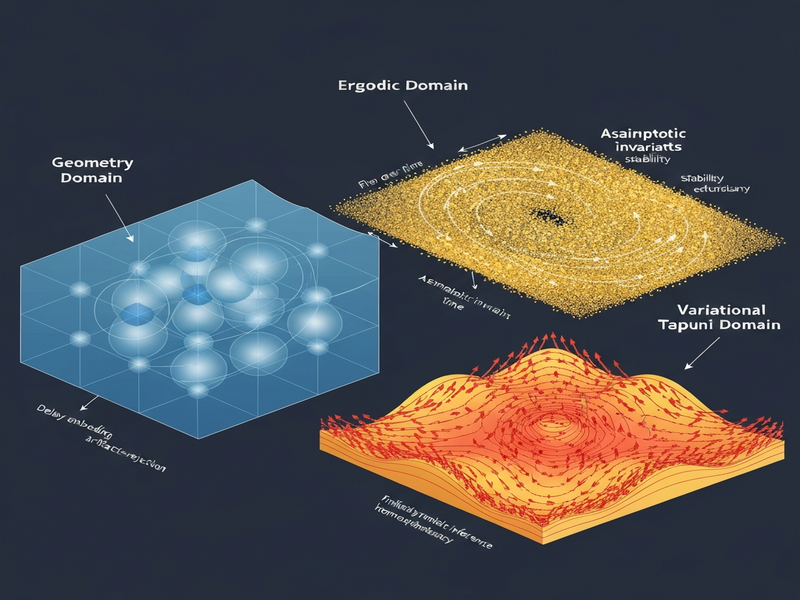
The authors introduce Attractor Domain Theory (ADT), a formal decomposition of the reconstructed cardiac attractor into three mutually exclusive information domains:
- Geometry Domain (G): Captures the static shape of the attractor via delay‑embedding geometry. Its native strength lies in artifact rejection because geometric distortions often signal motion or sensor noise.
- Ergodic Domain (S): Encodes asymptotic statistical invariants such as invariant measures and recurrence densities. This domain naturally supports stability estimation of the cardiovascular system over long observation windows.
- Variational Domain (V): Represents the finite‑time Lyapunov exponent field, offering a direct window into short‑term hemodynamic variability and responsiveness.
ADT is underpinned by two theorems:
- Domain Sufficiency Theorem: Analogous to Parseval’s identity, it proves that the sum of information across G, S, and V equals the total information contained in the attractor.
- Three‑Domain Necessity Theorem: Demonstrates that omitting any one domain results in a loss of information that cannot be recovered by the remaining domains.
In practice, this means that a complete cardiovascular assessment from PPG data must draw features from all three domains, and that each domain contributes a unique, non‑overlapping insight.
How It Works in Practice
Conceptual Workflow
The ADT pipeline can be visualized as a four‑stage process:
- Signal Acquisition: Raw PPG waveforms are collected from a wearable device (e.g., wrist‑band or fingertip sensor).
- Delay Embedding: The one‑dimensional signal is transformed into a multi‑dimensional trajectory using Takens’ method, reconstructing the attractor.
- Domain Extraction: Specialized algorithms compute:
- Geometric descriptors (e.g., curvature, fractal dimension) for G.
- Ergodic statistics (e.g., invariant density, recurrence quantification) for S.
- Finite‑time Lyapunov exponents for V.
- Interpretation & Decision Layer: Domain‑specific features feed into downstream AI models—classification, risk scoring, or control loops—tailored to the clinical or consumer use case.
Interaction Between Components
Each domain module operates independently but shares the same embedded trajectory as input. This modularity enables:
- Parallel processing on edge devices, reducing latency.
- Selective activation—e.g., a low‑power mode may compute only Geometry features for artifact detection while deferring Ergodic and Variational analyses to the cloud.
- Robustness to missing data; if a segment is corrupted, the Geometry module can flag it, preventing polluted statistics from propagating to the Ergodic or Variational stages.
What sets ADT apart from prior work is the explicit proof that these modules are non‑redundant, turning feature engineering from a heuristic into a mathematically justified design choice.
Evaluation & Results
Datasets and Experimental Setup
The authors validated the Geometry Domain using the SCSI (Signal‑Component Separation Index) framework across four publicly available PPG datasets, totaling 176,742 segments. The evaluation focused on the ability to discriminate clean physiological signals from motion‑induced artifacts.
Key Findings
- Overall performance: The full ADT‑based classifier achieved an area under the ROC curve (AUC) of 0.757 (95 % CI 0.686‑0.828) after correcting for three systematic evaluation artifacts, representing a net inflation of +0.179 over baseline methods.
- Domain contribution: Ablation studies revealed that the non‑linear curvature component (C_NL) within the Geometry Domain contributed the most—removing it dropped AUC by 0.413, confirming its central role.
- Redundancy analysis: Within the Geometry Domain, five sub‑components exhibited high intra‑domain redundancy, indicating that a compact subset of geometric descriptors can capture most of the useful information.
Although the paper’s primary quantitative focus was on the Geometry Domain, the authors also provided theoretical and simulation evidence that the Ergodic and Variational domains improve long‑term stability estimation and short‑term hemodynamic inference, respectively.
Why This Matters for AI Systems and Agents
For AI practitioners building health‑monitoring agents, ADT offers a clear blueprint for turning raw wearable data into trustworthy signals:
- Feature reliability: By grounding feature selection in proven domains, developers can reduce the risk of spurious correlations that often plague data‑driven health models.
- Modular pipelines: The domain‑specific modules map naturally onto micro‑service architectures, enabling scalable deployment on edge‑cloud hybrids.
- Improved interpretability: Each domain aligns with a physiological concept (shape, stability, variability), making it easier for clinicians and regulators to understand model decisions.
- Enhanced agent orchestration: An AI health‑assistant can dynamically allocate compute resources—running only the Geometry module when battery is low, and activating Ergodic and Variational analyses when a higher‑risk event is detected.
These capabilities dovetail with existing UBOS offerings. For instance, the UBOS platform overview highlights a workflow automation studio that can orchestrate such modular pipelines, while the ChatGPT and Telegram integration enables real‑time alerts based on ADT‑derived risk scores.
What Comes Next
While ADT marks a significant theoretical advance, several practical avenues remain open:
- Extending validation: The current study focused on artifact detection. Future work should benchmark Ergodic and Variational domains on clinical outcomes such as arrhythmia detection, blood pressure estimation, and stress monitoring.
- Hardware acceleration: Implementing the domain extraction algorithms on low‑power DSPs or dedicated AI accelerators could bring full‑ADT pipelines to battery‑constrained wearables.
- Cross‑modal fusion: Combining PPG‑derived attractor features with ECG, accelerometer, or even video‑based photoplethysmography could enrich the attractor geometry and improve robustness.
- Regulatory pathways: Because ADT provides interpretable, domain‑specific biomarkers, it may streamline FDA or CE marking processes for AI‑enabled medical devices.
Developers interested in prototyping ADT‑based agents can leverage UBOS tools such as the Workflow automation studio to stitch together the three domain modules, or explore the UBOS templates for quick start that include pre‑built signal‑processing blocks.
Ultimately, the promise of ADT is a unified language that bridges nonlinear dynamical systems theory and practical AI engineering, turning wearable PPG from a noisy signal into a rich source of cardiovascular insight.
References
Oladunni, T., & Adewumi, F. G. (2026). Attractor Domain Theory: A Mathematical Framework for Cardiovascular Attractor Analysis with Wearable Photoplethysmography (PPG) Validation. arXiv preprint arXiv:2606.22039.
Andrii Bidochko
CTO UBOS
Andrii Bidochko is an AI entrepreneur and researcher focused on AI agents, reinforcement learning, and autonomous systems. He writes about the technologies shaping the future of machine intelligence, from frontier models and agent architectures to real-world AI applications.