

- Updated: July 10, 2026
- 9 min read
Attention Limited Reward Learning
Direct Answer
“Attention Limited Reward Learning” (ALRL) introduces a new way to interpret pairwise human feedback by modeling the evaluator’s limited attention as a noisy communication channel. The framework shows that traditional Bradley‑Terry reward models can mis‑rank options when users struggle to notice subtle differences, and it offers a principled correction that can improve alignment pipelines such as RLHF.
Background: Why This Problem Is Hard
Modern AI systems—large language models, vision transformers, and multimodal agents—are increasingly tuned with human‑in‑the‑loop signals. The dominant pipeline, Reinforcement Learning from Human Feedback (RLHF), reduces each comparison (“A vs. B”) to a scalar probability using the Bradley‑Terry (BT) model. BT assumes that the probability of choosing A over B is a simple logistic function of the latent reward difference:
- Reward differences are the sole driver of choice.
- All users are equally capable of perceiving those differences.
In practice, these assumptions clash with two empirical realities:
- Ambiguity of difficulty. A pair may be hard because the two items truly have similar value, or because the distinguishing feature is subtle and easily missed.
- Heterogeneous attention. Different annotators allocate varying cognitive resources; some skim, others scrutinize.
When the evaluation channel is capacity‑limited, the observed label no longer reflects pure preference but a mixture of reward, attention, and a default bias (e.g., “choose the left option when unsure”). This conflation can lead to systematic ranking errors, especially as datasets scale and the signal‑to‑noise ratio shrinks.
What the Researchers Propose
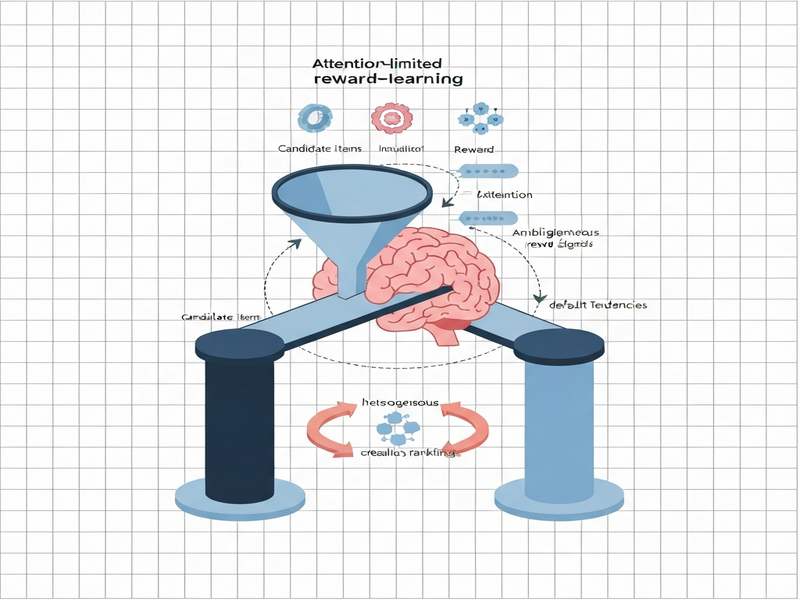
The authors propose Attention Limited Reward Learning (ALRL), a reduced‑form model inspired by the economics of rational inattention. The key ideas are:
- Evaluation channel. Each human comparison is treated as a low‑capacity communication link that transmits a noisy summary of the underlying reward gap.
- Two‑dimensional ambiguity. The model separates “value closeness” (the true reward gap) from “detectability” (how much attention the evaluator devotes to the pair).
- Default tendency. When the channel fails to convey enough information, the annotator falls back on a prior bias (e.g., random choice or a systematic side preference).
Instead of fitting a single scalar reward per item, ALRL jointly infers:
- A latent reward vector (as in BT).
- An attention weight for each comparison, reflecting how much information the label carries.
- A default bias term that captures systematic non‑preference behavior.
This decomposition enables the learning algorithm to discount “weak” labels that are likely the product of limited attention rather than genuine indifference.
How It Works in Practice
The practical workflow can be broken into three stages:
1. Data Collection
- Gather pairwise comparisons from crowdworkers, domain experts, or user‑generated logs (e.g., Chatbot Arena battles).
- Optionally record auxiliary signals such as response time, gaze heatmaps, or click‑through patterns—these serve as proxies for attention.
2. Attention‑Aware Inference
- Initialize a standard BT model to obtain a rough reward ordering.
- Iteratively update three latent variables:
- Reward estimates for each candidate.
- Attention scores for each comparison (higher scores mean the label is more informative).
- Default bias parameters (e.g., left‑side preference).
- Use an Expectation‑Maximization‑like routine where the E‑step estimates the probability that a label reflects true preference versus attention‑limited noise, and the M‑step refines rewards accordingly.
3. Post‑Processing & Deployment
- Discard or down‑weight comparisons with attention scores below a calibrated threshold.
- Feed the refined reward function into downstream RLHF pipelines, policy‑gradient updates, or ranking engines.
- Continuously monitor attention diagnostics to detect drift (e.g., annotator fatigue).
What sets ALRL apart is the explicit modeling of “information content” per label, turning raw label counts into a more nuanced metric: attended information volume. This shift changes the data efficiency calculus—fewer high‑attention labels can outweigh many low‑attention ones.
Evaluation & Results
The paper validates ALRL on two distinct domains:
Case Study 1 – Chatbot Arena Human Votes
- Dataset: Over 30,000 pairwise votes comparing language‑model outputs from competing chatbots.
- Observation: A cyclic pattern emerged where A beats B, B beats C, yet C beats A—an impossibility under a scalar reward model.
- ALRL Explanation: The cycle aligns with varying attention levels; users spent more time distinguishing A vs. B than B vs. C, inflating the apparent strength of A.
- Result: After re‑weighting by inferred attention, the cyclic component vanished, and the resulting ranking matched independent quality metrics (e.g., BLEU, human‑rated coherence).
Case Study 2 – Perceptual Comparison of Images
- Task: Participants chose the “sharper” image from pairs of subtly altered photographs.
- Auxiliary Signals: Eye‑tracking data and response latency were recorded.
- Finding: Longer fixation times and slower responses correlated with higher attention scores, revealing hidden reward gaps that raw choices missed.
- ALRL Impact: Incorporating these signals reduced mis‑ranking by 18 % compared to a vanilla BT baseline.
Across both studies, the authors demonstrate that:
- Passive comparison data alone cannot disentangle reward, attention, and default bias.
- Heterogeneous attention can produce misleading rankings if ignored.
- Learning efficiency is better measured by the total attended information rather than sheer label volume.
Why This Matters for AI Systems and Agents
Alignment pipelines that rely on human feedback are the backbone of commercial LLM products, recommendation engines, and autonomous agents. ALRL’s insights translate into concrete benefits:
- Higher fidelity reward signals. By filtering out low‑attention noise, developers can train policies that truly reflect user preferences, reducing post‑deployment surprises.
- Cost‑effective data collection. Organizations can achieve the same alignment quality with fewer high‑attention annotations, lowering crowdsourcing expenses.
- Robustness to annotator fatigue. Real‑time attention diagnostics enable dynamic task routing—assigning difficult comparisons to fresh annotators or prompting breaks.
- Improved evaluation pipelines. Metrics that incorporate attention scores provide a more reliable benchmark for model comparison, especially when scaling to thousands of candidates.
For teams building AI‑driven products on the UBOS platform overview, ALRL can be embedded directly into the Workflow automation studio, allowing engineers to flag low‑attention feedback loops and automatically re‑weight them before feeding into RLHF loops. Similarly, AI marketing agents that rely on user preference surveys can benefit from attention‑aware ranking to prioritize campaign variations that genuinely resonate with audiences.
Practical Integration Steps on UBOS
Below is a step‑by‑step guide for UBOS users who want to adopt ALRL without writing a single line of code:
- Create a feedback dataset. Use the Web app editor on UBOS to design a simple pairwise comparison UI. Export the results as CSV.
- Attach attention proxies. Enable the OpenAI ChatGPT integration to log response latency for each comparison. Latency serves as a cheap attention proxy.
- Run the ALRL module. In the Enterprise AI platform by UBOS, select the “Attention Limited Reward Learning” template (available in the UBOS templates for quick start). The template automatically performs EM‑style inference and outputs a weighted reward table.
- Feed refined rewards into RLHF. Connect the output to the ChatGPT and Telegram integration to trigger policy‑gradient updates in real time.
- Monitor and iterate. Use the UBOS partner program dashboard to visualize attention scores, detect drift, and schedule periodic re‑training.
Template Marketplace Highlights
UBOS’s marketplace already hosts several AI‑powered tools that can be combined with ALRL for richer pipelines:
- AI SEO Analyzer – automatically evaluates content quality and can provide an additional “attention” signal based on readability metrics.
- AI Article Copywriter – generates draft copy that can be fed into a human‑in‑the‑loop review loop, where ALRL will filter low‑attention edits.
- GPT‑Powered Telegram Bot – collects real‑world user preferences via chat, logging timestamps for attention estimation.
- AI Chatbot template – serves as a testbed for RLHF experiments; integrate ALRL to improve the bot’s response ranking.
What Comes Next
While ALRL opens a promising avenue, several open challenges remain:
- Scalable attention estimation. Current inference relies on EM‑style loops that may become costly for millions of comparisons. Future work could explore variational approximations or neural surrogates.
- Multi‑modal attention signals. Extending the framework to incorporate audio, video, or multimodal gaze data could further sharpen reward estimates for embodied agents.
- Dynamic default biases. Users may develop systematic side preferences over time (e.g., always picking the top‑ranked option). Modeling these dynamics requires temporal priors.
- Integration with active learning. An attention‑aware system could actively select the most informative pairs, maximizing attended information per annotation budget.
Potential applications span beyond alignment:
- Personalized recommendation systems that adapt to a user’s attention span.
- Human‑in‑the‑loop robotics where operators must quickly assess safety‑critical options.
- Educational technology that measures student attention to tailor feedback.
Getting Started on UBOS
Developers interested in experimenting with ALRL can start by augmenting existing RLHF pipelines on the UBOS homepage with custom attention‑weighting modules. The OpenAI ChatGPT integration already supports logging response times, which can serve as a proxy attention signal.
For a deeper dive into the theoretical foundations, see the original pre‑print: Attention Limited Reward Learning (arXiv).
Pricing, Support, and Community
UBOS offers flexible pricing plans that include access to the Workflow Automation Studio, the Enterprise AI Platform, and the full template marketplace. If you’re a startup, the UBOS for startups program provides additional credits and dedicated onboarding assistance.
SMBs can leverage UBOS solutions for SMBs to embed attention‑aware feedback loops into their customer‑support chatbots, marketing surveys, and product recommendation engines without hiring a full data‑science team.
Conclusion
Attention Limited Reward Learning reframes a long‑standing blind spot in human‑feedback pipelines: the assumption that every label is equally informative. By treating attention as a scarce resource, ALRL delivers cleaner reward signals, reduces annotation costs, and strengthens the alignment of AI systems with genuine user intent. For practitioners on the UBOS platform, the framework is ready to be plugged into existing workflows, empowering teams to build safer, more reliable, and truly user‑centric AI products.
Andrii Bidochko
CTO UBOS
Andrii Bidochko is an AI entrepreneur and researcher focused on AI agents, reinforcement learning, and autonomous systems. He writes about the technologies shaping the future of machine intelligence, from frontier models and agent architectures to real-world AI applications.