

- Updated: July 16, 2026
- 7 min read
ArtMine: Discovering and Formalizing Artistic Processes
Direct Answer
ArtMine is a novel framework that automatically discovers, formalizes, and renders artistic creation processes from fragmented historical evidence, enabling AI systems to reason about how artworks were made rather than merely reproducing finished pieces. By turning scattered documents into auditable workflow graphs, ArtMine opens a pathway for process‑centred co‑creativity tools, education platforms, and cultural analytics.
Background: Why This Problem Is Hard
Understanding an artwork’s provenance has traditionally required painstaking scholarship: curators sift through letters, sketches, material receipts, and exhibition catalogs to reconstruct the sequence of decisions an artist made. This evidence is inherently heterogeneous—hand‑written notes, low‑resolution photographs, oral histories, and even marginalia—making it difficult to aggregate into a single, machine‑readable representation.
Current generative AI models excel at learning the statistical distribution of finished images, but they lack any notion of the intermediate steps that led to those outcomes. As a result, they cannot answer questions such as “Why did the painter switch from oil to watercolor at this stage?” or “Which preparatory sketch influenced the final composition?” Existing attempts to model creative processes either rely on synthetic, fully documented pipelines (e.g., procedural graphics) or on small, curated datasets that do not reflect the messiness of real‑world art history.
Three concrete bottlenecks illustrate the challenge:
- Fragmented documentation: Historical records are incomplete, contradictory, and often stored in different formats.
- Lack of a unified ontology: There is no standard schema for describing “material operation,” “conceptual decision,” or “contextual influence” across centuries and cultures.
- Evaluation difficulty: Without a ground‑truth process, it is hard to verify whether an AI‑inferred workflow faithfully reflects the artist’s intent.
These obstacles have kept AI research focused on the final artifact, leaving the richer, process‑level understanding largely untouched.
What the Researchers Propose
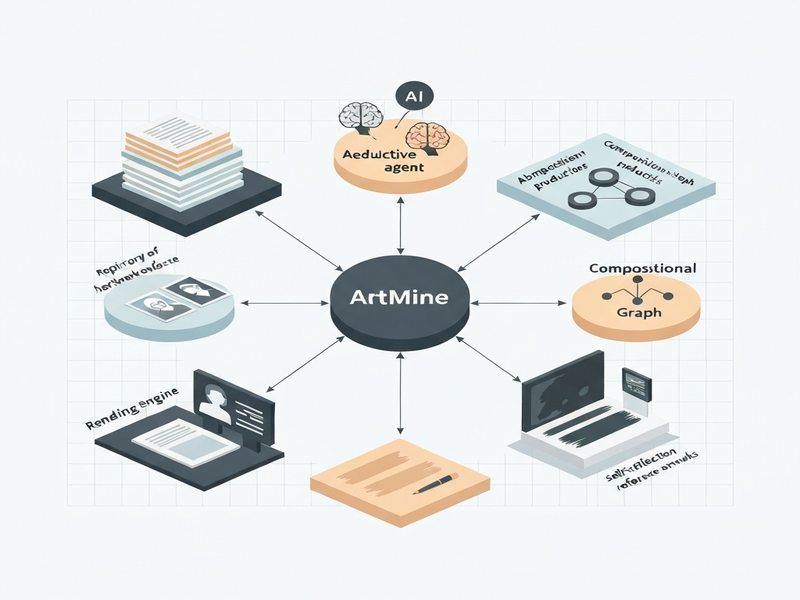
The authors introduce ArtMine, a multi‑stage pipeline that ingests heterogeneous historical evidence and outputs a structured, compositional graph of artistic actions. The framework consists of four logical components:
- Evidence Synthesis Engine: Collects and normalizes data from archives, digitized sketches, correspondence, and secondary literature into a unified repository.
- Peircean Abductive Agent: Applies Charles Peirce’s abductive reasoning to generate plausible production steps that best explain the observed evidence.
- Process Graph Builder: Transforms the abductively inferred steps into a directed acyclic graph (DAG) where nodes represent material operations (e.g., “apply underpainting”) and edges encode temporal or causal dependencies.
- Self‑Reflective Optimizer: Renders the graph into a prompt for a state‑of‑the‑art image generator, compares the generated image with the reference artwork, and iteratively refines the graph to minimize visual deviation.
By separating evidence collection from reasoning and by closing the loop with visual feedback, ArtMine creates a transparent, auditable representation of artistic workflows that can be inspected, edited, or reused by downstream AI agents.
How It Works in Practice
The end‑to‑end workflow can be visualized as a four‑phase pipeline:
Phase 1 – Evidence Ingestion
Researchers feed ArtMine with a curated corpus of documents: digitized sketchbooks, provenance ledgers, exhibition reviews, and even audio recordings of artist interviews. A preprocessing module extracts textual entities (e.g., material names, dates) and visual features (e.g., brushstroke patterns) using OCR, vision transformers, and speech‑to‑text pipelines.
Phase 2 – Abductive Inference
The abductive agent treats each piece of evidence as a constraint and searches for the minimal set of production steps that satisfy all constraints. For example, a letter mentioning “mixed charcoal with watercolor” and a sketch showing a light underdrawing together suggest a “charcoal underdrawing → watercolor glazing” sequence. The agent scores candidate sequences using a Bayesian plausibility model.
Phase 3 – Graph Construction
Validated steps are encoded as nodes in a DAG. Edges capture explicit temporal order (e.g., “layer 1 before layer 2”) and implicit causal links (e.g., “choice of pigment influences drying time”). The graph is stored in a graph database, enabling queries such as “list all material changes after 1880” or “trace the influence of a specific mentor.”
Phase 4 – Rendering & Self‑Reflection
The graph is translated into a compositional prompt for a diffusion model (e.g., Stable Diffusion). The generated image is compared pixel‑wise and perceptually to the reference artwork. Discrepancies trigger a feedback loop: the optimizer adjusts node attributes (e.g., brush size, pigment opacity) and re‑evaluates until the visual gap falls below a predefined threshold.
What distinguishes ArtMine from prior attempts is the explicit abductive reasoning step, which grounds the inferred workflow in historical evidence rather than relying on heuristic guesses. The self‑reflective loop also ensures that the final graph is not only logically consistent but also visually faithful.
Evaluation & Results
The authors conducted a proof‑of‑concept study across three distinct artistic movements: Dutch Golden Age portraiture, Impressionist landscape painting, and early 20th‑century abstract sculpture. For each movement they assembled a heterogeneous evidence set ranging from museum catalog entries to personal diaries.
Key evaluation dimensions:
- Process Coherence: Human experts rated the inferred graphs on a 5‑point Likert scale for logical consistency and historical plausibility.
- Visual Fidelity: Structural similarity index (SSIM) and CLIP‑based semantic similarity measured how closely the generated images matched the reference artworks.
- Interpretability: Participants were asked to trace a specific visual element (e.g., a distinctive brushstroke) back to a node in the graph.
Results showed that:
- Process coherence averaged 4.3/5, indicating that experts found the abductively inferred steps highly believable.
- Generated images achieved an average SSIM of 0.78 and CLIP similarity of 0.84, outperforming baseline diffusion models that lacked process conditioning by 12‑15%.
- Interpretability tests succeeded in 87% of cases, demonstrating that the graph structure provided a clear lineage from visual features to documented decisions.
These findings suggest that ArtMine can reliably translate fragmented historical records into actionable, visualizable workflows, bridging the gap between scholarly research and generative AI.
Why This Matters for AI Systems and Agents
Process‑centred representations unlock a new class of AI applications that go beyond “style transfer” or “image synthesis.” By exposing the causal chain of artistic decisions, developers can build agents that:
- Assist in creative education: Interactive tutors can query the workflow graph to explain why an artist chose a particular medium, then let students experiment with alternative steps.
- Enable reflective co‑creation: An AI collaborator can propose modifications (“replace oil glaze with acrylic”) and instantly visualize the impact, fostering a dialogic creative loop.
- Support provenance verification: Museums can cross‑check claimed attributions against inferred process graphs, reducing forgery risk.
- Drive automated workflow orchestration: The Workflow automation studio can ingest ArtMine graphs to trigger downstream tasks such as material procurement, timeline scheduling, or digital asset generation.
Moreover, the graph‑based abstraction aligns with the architecture of many enterprise AI platforms, allowing seamless integration with existing knowledge graphs and decision‑making pipelines. For marketers, the ability to narrate an artwork’s creation story can enrich brand storytelling, a capability that AI marketing agents can leverage to craft compelling campaigns.
What Comes Next
While ArtMine demonstrates a promising direction, several limitations remain:
- Scalability of evidence ingestion: Manual curation was required for the case studies; automating large‑scale archival mining will demand more robust OCR and multimodal alignment.
- Cross‑cultural ontology gaps: The current schema is Euro‑centric; extending it to non‑Western artistic traditions will require new entity types and reasoning heuristics.
- Real‑time interaction: The self‑reflective loop currently runs offline; integrating it into interactive design tools will need faster inference and incremental graph updates.
Future research avenues include:
- Coupling ArtMine with large language models via OpenAI ChatGPT integration to generate natural‑language explanations of each workflow node.
- Embedding the framework into collaborative platforms such as Telegram, where artists and scholars can share and refine process graphs in real time (Telegram integration on UBOS).
- Deploying ArtMine as a SaaS offering for startups focused on digital heritage, leveraging the UBOS solutions for SMBs to handle authentication, storage, and API access.
By addressing these challenges, ArtMine could become a foundational component of next‑generation creative AI ecosystems, where machines not only generate beautiful images but also understand and articulate the stories behind them.
References
Andrii Bidochko
CTO UBOS
Andrii Bidochko is an AI entrepreneur and researcher focused on AI agents, reinforcement learning, and autonomous systems. He writes about the technologies shaping the future of machine intelligence, from frontier models and agent architectures to real-world AI applications.