

- Updated: July 3, 2026
- 7 min read
Artificial collectives of specialists and generalists excel at different tasks
Direct Answer
The paper Artificial collectives of specialists and generalists excel at different tasks shows that multi‑agent systems composed of narrow‑skill specialists outperform broad‑skill generalists on negotiation‑heavy problems, while the opposite holds for generation, selection, and coordination tasks. The findings give system designers a principled way to match agent “interpretive networks” to task demands and to the computational limits of the agents themselves.
Background: Why This Problem Is Hard
Collective artificial intelligence promises to tackle problems that are too large or too complex for a single model—think drug discovery pipelines, large‑scale resource allocation, or decentralized governance. In practice, however, engineers lack a scientific taxonomy that tells them when to deploy a swarm of highly specialized bots versus a handful of versatile, all‑purpose agents. Existing approaches tend to be prescriptive (e.g., “use a hierarchical controller”) without quantifying how agent interpretive breadth, rationality limits, or task structure interact. This gap leads to over‑engineered systems that waste compute, or under‑engineered ones that fail to converge on high‑quality solutions.
Three intertwined challenges make the problem especially stubborn:
- Interpretive ability spectrum: Specialists can parse a narrow slice of the decision space with high fidelity, while generalists can understand many slices but with shallower insight.
- Rationality bounds: Real‑world agents operate under limited time, memory, or energy, which caps the depth of their search or gradient estimation.
- Task heterogeneity: Some problems require exhaustive sampling (negotiation), others need rapid generation and coordination (creative design, scheduling).
Without a unified framework, designers resort to trial‑and‑error, leading to unpredictable performance and inflated operational costs.
What the Researchers Propose
The authors introduce a descriptive framework that maps three dimensions—interpretive network topology, agent rationality bounds, and task quality attributes—to collective performance. In this view:
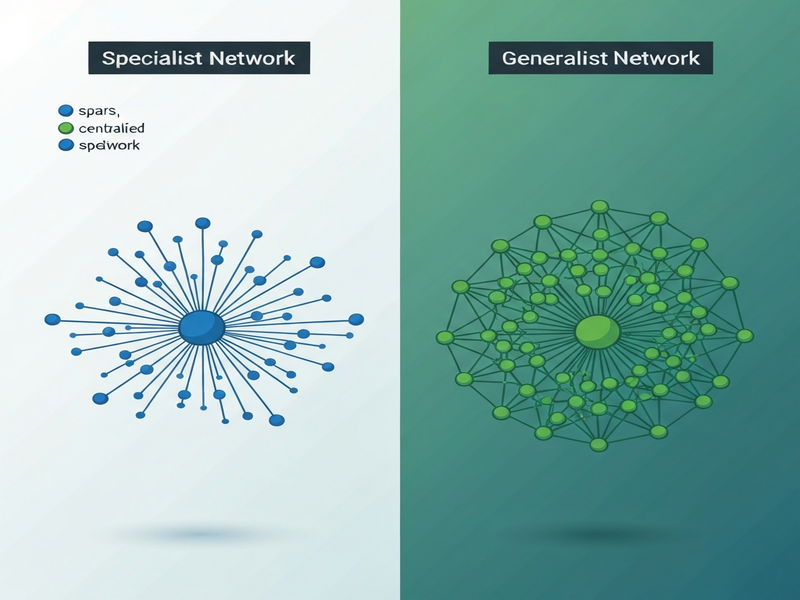
- Specialist collectives form sparse, centrally‑linked networks where a few “mediator” agents bridge otherwise isolated experts.
- Generalist collectives create dense, decentralized graphs where every agent can directly interact with many peers.
- Performance effects of network topology are modest on average (≈0.07 σ) but explode for specific task qualities (up to 1.84 σ), revealing a strong interaction effect.
The framework does not prescribe a single architecture; instead, it provides a decision matrix that tells engineers which combination of specialist‑generalist mix, network density, and rationality budget is most likely to succeed for a given problem class.
How It Works in Practice
Implementing the framework follows a four‑step workflow:
- Task profiling: Decompose the target problem into measurable qualities—generation intensity, coordination demand, negotiation depth, and information asymmetry.
- Agent capability audit: Classify each available model (e.g., LLM, reinforcement learner, domain‑specific optimizer) as a specialist (narrow interpretive bandwidth) or a generalist (broad interpretive bandwidth). Record each agent’s computational budget, which defines its rationality bound.
- Network synthesis: Using the decision matrix, instantiate either a sparse, hub‑and‑spoke graph (specialist‑centric) or a fully‑meshed graph (generalist‑centric). Add a handful of “mediator” generalists to a specialist network when negotiation is dominant.
- Iterative execution & monitoring: Run the collective, collect performance signals (convergence speed, solution quality), and adjust the rationality budget or edge density in real time.
What sets this approach apart is its explicit separation of interpretive ability (what an agent can understand) from rationality bound (how deeply it can think). Traditional pipelines conflate the two, assuming that a more powerful model automatically yields better collective outcomes—a premise the experiments disprove.
Evaluation & Results
The researchers evaluated the framework across six synthetic benchmark families that emulate real‑world AI workloads:
- Generation tasks: Creative text, image synthesis, and design space exploration.
- Selection tasks: Ranking, filtering, and best‑of‑N decision making.
- Coordination tasks: Multi‑robot path planning and distributed scheduling.
- Negotiation tasks: Bargaining games, resource allocation with conflicting objectives.
- Hybrid tasks: Scenarios that blend generation and negotiation (e.g., collaborative story writing).
Key takeaways from the experiments:
| Task Category | Best Collective Type | Performance Lift (σ) | Convergence Speed |
|---|---|---|---|
| Generation / Selection / Coordination | Generalist‑dense | +0.33 (average) – up to +1.84 | Faster gradient estimation |
| Negotiation | Specialist‑sparse + few generalist mediators | +0.07 (average) – up to +0.33 | Higher sampling efficiency in high‑dimensional spaces |
| Mixed (Hybrid) | Adaptive blend (dynamic edge rewiring) | Variable, dependent on rationality bound | Trade‑off observed at moderate bounds |
When rationality bounds were loose (agents could explore many options), specialist networks excelled because they sampled the decision space more broadly. Tight bounds (limited compute) favored generalist networks, which could estimate gradients more accurately with fewer samples. The authors also identified a “sweet spot” at moderate bounds where performance peaked but convergence slowed, highlighting a classic speed‑accuracy trade‑off.
Why This Matters for AI Systems and Agents
For practitioners building enterprise‑grade AI orchestration platforms, the paper delivers three actionable insights:
- Match agent topology to task profile. If your product revolves around negotiation—think contract‑review bots or dynamic pricing engines—design a sparse specialist network with a few generalist mediators. For content generation pipelines (e.g., marketing copy, code synthesis), a dense generalist mesh will converge faster and produce higher‑quality outputs.
- Allocate compute wisely. When budget constraints force tight rationality bounds, prioritize generalist agents; when you can afford broader search, lean on specialists to explore the solution space more exhaustively.
- Dynamic reconfiguration. The framework suggests that a static architecture is sub‑optimal for long‑running workflows. Platforms that can add or prune edges on‑the‑fly—similar to the Workflow automation studio—will be able to shift between specialist‑centric and generalist‑centric modes as the workload evolves.
These principles directly inform the design of Enterprise AI platform by UBOS, where customers can configure agent collectives through a visual editor, set rationality budgets per node, and let the system auto‑tune network density based on real‑time performance metrics.
What Comes Next
While the study establishes a solid empirical foundation, several open challenges remain:
- Scalability to thousands of agents. The experiments capped at a few dozen agents; extending the framework to massive swarms will require new sampling strategies.
- Real‑world validation. Benchmarks are synthetic; applying the model to domains like autonomous logistics or multi‑company supply chains will test its robustness.
- Learning the decision matrix. Future work could embed a meta‑learning layer that automatically infers the optimal specialist‑generalist mix from historical task data.
- Energy‑aware rationality. Integrating power consumption metrics could turn rationality bounds into a multi‑objective optimization problem.
Developers interested in experimenting with these ideas can start by exploring the UBOS platform overview, which offers plug‑and‑play modules for specialist and generalist agents, as well as built‑in support for dynamic network reconfiguration. For teams focused on conversational AI, the OpenAI ChatGPT integration provides a ready‑made generalist component that can be paired with domain‑specific specialist bots.
Conclusion
The research clarifies a long‑standing intuition: “one size does not fit all” in multi‑agent AI. By quantifying how interpretive breadth, rationality limits, and task characteristics interact, the authors give engineers a data‑driven compass for building efficient, high‑performing collectives. Whether you are orchestrating a fleet of negotiation bots for financial services or a creative studio of generative models for marketing, aligning your agent topology with the task’s core demands can shave off compute costs, accelerate convergence, and ultimately deliver better outcomes.
Further Reading & Internal Resources
Deepen your understanding of specialist‑generalist dynamics and see how UBOS translates theory into practice:
- UBOS templates for quick start – pre‑built agent configurations for common business scenarios.
- AI marketing agents – examples of dense generalist collectives generating brand copy.
- ChatGPT and Telegram integration – a specialist‑mediator pattern for real‑time negotiation.
- About UBOS – learn more about the team behind the platform.
Ready to experiment with specialist‑generalist collectives? Visit the UBOS homepage and start building smarter, more efficient AI teams today.
Andrii Bidochko
CTO UBOS
Andrii Bidochko is an AI entrepreneur and researcher focused on AI agents, reinforcement learning, and autonomous systems. He writes about the technologies shaping the future of machine intelligence, from frontier models and agent architectures to real-world AI applications.