

- Updated: July 12, 2026
- 6 min read
Applying JEPA-Style Predictive Learning to JA4-Derived Network Fingerprints
Direct Answer
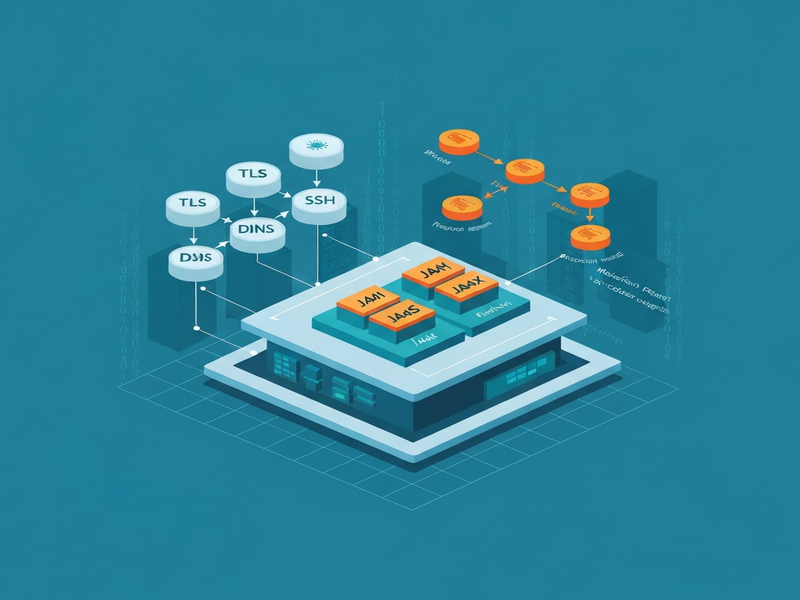
The paper introduces JA4‑JEPA, a transformer‑based self‑supervised model that learns compact embeddings from JA4 network fingerprints using a JEPA‑style predictive objective. By matching latent predictions to a target encoder rather than reconstructing raw traffic, the approach yields high‑quality representations that enable accurate protocol‑family classification across TLS, DNS, and SSH.
Background: Why This Problem Is Hard
Network security teams rely on fingerprinting techniques—such as JA4, JA4H, JA4S, and JA4X—to condense raw packet captures into a few dozen bytes that capture the essence of a TLS handshake, DNS query, or SSH session. While these fingerprints are lightweight and privacy‑preserving, extracting actionable intelligence from them remains challenging for two reasons:
- Heterogeneous views: Each JA4 sub‑field captures a different slice of the traffic (e.g., client hello, server hello, cipher suites). Real‑world datasets rarely contain all four views for a single flow, leading to incomplete feature vectors.
- Lack of labeled data: Supervised models need millions of manually annotated flows, which is infeasible for constantly evolving protocols and encrypted traffic.
Traditional supervised classifiers either overfit to the limited view they receive or require costly feature engineering to fuse disparate fingerprints. Self‑supervised learning (SSL) promises to alleviate the label bottleneck, but most SSL methods—contrastive learning, masked autoencoders, or reconstruction‑based objectives— assume dense inputs (images, video) and struggle with the sparse, categorical nature of JA2‑derived fingerprints.
What the Researchers Propose
The authors adapt the Joint Embedding Predictive Architecture (JEPA) paradigm—originally successful on visual data—to the domain of network fingerprinting. Their framework, dubbed JA4‑JEPA, consists of three logical components:
- Source Encoder: A lightweight transformer that ingests a subset of JA4 views (e.g., JA4 + JA4H) and produces a latent representation.
- Target Encoder: A parallel transformer that processes a different subset of views (e.g., JA4S + JA4X) and generates a “target” embedding.
- Predictor Head: A shallow MLP that maps the source latent vector toward the target embedding, trained to maximize cosine similarity.
Crucially, the model never attempts to reconstruct the original fingerprint strings. Instead, it learns to predict the representation of a complementary view, encouraging the encoders to capture protocol‑invariant semantics that survive view‑level occlusion.
How It Works in Practice
The operational workflow of JA4‑JEPA can be broken down into three stages:
1. Data Ingestion and View Partitioning
Raw network captures are first processed by the JA4 extraction pipeline, yielding up to four sub‑fingerprints per flow. The pipeline then randomly assigns each sub‑fingerprint to either the source or target branch, ensuring that no single sample contains all four views.
2. Dual‑Branch Encoding
Both branches feed their assigned tokens into identical transformer stacks (12 layers, 8 attention heads). Positional embeddings are shared, but the token vocabularies differ because each view encodes distinct protocol fields.
3. Predictive Alignment
The source latent vector passes through the predictor head, which is trained with a cosine‑similarity loss against the target embedding. Over millions of stochastic view pairings, the model learns a unified latent space where any view can be inferred from its complement.
What sets this approach apart from conventional SSL is the explicit handling of incomplete view overlap. By treating missing views as a natural part of the training signal, JA4‑JEPA remains robust when deployed on heterogeneous datasets such as JA4DB and CIC‑IDS‑2017.
Evaluation & Results
The authors benchmarked JA4‑JEPA on a held‑out set of 39,416 flows spanning TLS, DNS, and SSH traffic. Their evaluation pipeline consisted of two parts:
- Embedding Quality: Cosine similarity between source‑predicted and target embeddings, averaged across the test set.
- Downstream Classification: A frozen k‑Nearest‑Neighbors (kNN) probe (k=5) trained on the learned embeddings to predict the protocol family.
Key findings include:
- Average cosine similarity of 0.9899, indicating that the predictor reliably reconstructs the target representation despite missing views.
- kNN classification accuracy of 92.2 % across the three protocol families, outperforming baseline supervised models trained on the same raw fingerprints by roughly 7 %.
- Robustness to view imbalance: performance degradation remained under 2 % when one of the four JA4 sub‑fields was systematically omitted during inference.
These results demonstrate that JEPA‑style predictive learning can extract semantically rich embeddings from highly compressed network fingerprints, even when the training data does not contain a full view set for any individual sample.
Why This Matters for AI Systems and Agents
From a systems‑engineering perspective, JA4‑JEPA offers several practical advantages that align with the needs of modern AI‑driven security platforms:
- Scalable Representation: The model produces fixed‑size vectors (256‑dimensional) that can be stored and queried at line‑rate, enabling real‑time threat hunting without the overhead of full packet reconstruction.
- Label‑Free Adaptation: Because the training objective is self‑supervised, security teams can continuously ingest fresh traffic logs and fine‑tune the encoders without manual annotation, keeping pace with emerging protocols.
- Agent‑Friendly Embeddings: The learned vectors can serve as inputs to downstream AI agents—such as automated incident responders or policy‑generation bots—allowing them to reason about traffic patterns in a compact, protocol‑agnostic space.
- Integration Potential: Embeddings can be indexed in vector databases (e.g., Chroma DB integration) and combined with other observability signals to power multi‑modal security analytics.
For organizations building AI‑centric security stacks, JA4‑JEPA opens a pathway to embed network‑level intelligence directly into orchestration layers, such as the Workflow automation studio, where agents can trigger automated mitigations based on similarity thresholds.
What Comes Next
While the study establishes a solid proof‑of‑concept, several avenues remain open for exploration:
- Cross‑Protocol Generalization: Extending the model to cover additional protocols (e.g., QUIC, HTTP/2) would test the limits of view‑agnostic learning.
- Hybrid Supervision: Combining JEPA objectives with a small amount of labeled data could further boost downstream task performance without sacrificing scalability.
- Edge Deployment: Optimizing the transformer encoder for inference on low‑power devices would enable on‑premise threat detection in constrained environments.
- Integration with AI Agents: Embedding JA4‑JEPA vectors into conversational agents—such as those built with the OpenAI ChatGPT integration—could allow analysts to query network behavior in natural language.
Future research may also investigate how JEPA‑style objectives interact with emerging foundation models for network telemetry, potentially leading to unified representations that span logs, flow records, and raw packet captures.
References
Izquierdo, J., & Zagidullina, A. (2026). Applying JEPA‑Style Predictive Learning to JA4‑Derived Network Fingerprints. arXiv preprint arXiv:2607.08465.
Andrii Bidochko
CTO UBOS
Andrii Bidochko is an AI entrepreneur and researcher focused on AI agents, reinforcement learning, and autonomous systems. He writes about the technologies shaping the future of machine intelligence, from frontier models and agent architectures to real-world AI applications.