

- Updated: July 8, 2026
- 7 min read
Applying Answer Set Programming with Fuzzy Membership Functions: a Case Study
Direct Answer
The paper introduces a fuzzy‑logic‑enhanced extension of Answer Set Programming (ASP) that lets developers combine crisp numerical data—such as outputs from machine‑learning models—with qualitative, linguistic labels like “high”, “low”, or “expensive”. This matters because it provides a principled, threshold‑free way to reason under vagueness, enabling AI systems to incorporate expert knowledge and contextual nuance without sacrificing the declarative power of ASP.
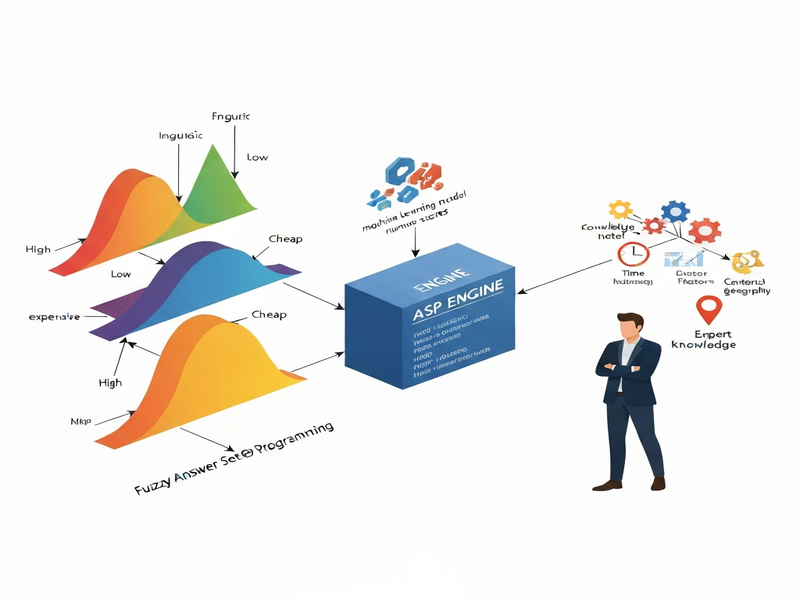
Figure 1: Conceptual flow of fuzzy ASP – from numeric inputs through learned membership functions to qualitative reasoning.
Background: Why This Problem Is Hard
Human decision‑making routinely mixes precise measurements with vague concepts. A retail pricing engine, for example, may receive a predicted demand score (0‑1) from a neural network but must still decide whether the product is “cheap” or “expensive” in a given market segment. Traditional ASP excels at symbolic, Boolean reasoning but lacks a native notion of gradation. Conversely, fuzzy logic handles gradations well but often requires hand‑crafted membership functions and does not integrate cleanly with the non‑monotonic reasoning that ASP provides.
Existing hybrid approaches typically adopt one of two workarounds:
- Hard thresholds. Engineers discretize numeric outputs into Boolean facts (e.g., demand > 0.7 → high_demand). This introduces brittleness; small fluctuations around the threshold flip the label, leading to unstable reasoning.
- Separate fuzzy inference layers. Systems run a fuzzy controller before feeding its crisp conclusions into ASP. The separation prevents feedback loops and makes it difficult to propagate uncertainty back into the symbolic layer.
Both strategies sacrifice either robustness or expressiveness, limiting the ability of AI agents to reason with nuanced, context‑dependent concepts. As enterprises increasingly blend statistical learning with rule‑based governance—think compliance checks on risk scores or dynamic pricing based on sentiment analysis—there is a clear need for a unified framework that respects both numeric vagueness and logical rigor.
What the Researchers Propose
The authors present a qualitative extension of ASP built on fuzzy membership functions. At a high level, the framework adds two new language constructs:
- Fuzzy predicates. Instead of a binary true/false value, a predicate can hold a degree of truth in the interval [0, 1] derived from a membership function.
- Learning‑driven membership functions. The shape of each function (e.g., “high”, “low”) is not fixed; it can be trained from data, allowing the system to adapt to domain‑specific interpretations.
Key components include:
- Numeric data source. Any downstream model—regression, classification, or reinforcement‑learning policy—produces real‑valued scores.
- Membership learner. A lightweight optimizer (e.g., gradient descent) fits fuzzy curves to labeled examples, turning raw scores into degrees of “high”, “medium”, or “low”.
- Fuzzy ASP engine. The extended solver treats fuzzy predicates as first‑class citizens, applying non‑monotonic rules that can reference both crisp and fuzzy literals.
- Semantic enrichment layer. Domain experts annotate rules with contextual modifiers (e.g., “if demand is high and price is cheap then recommend promotion”).
By embedding the membership functions directly into the logical program, the approach eliminates the need for ad‑hoc discretization and enables reasoning that naturally respects the gradual nature of real‑world concepts.
How It Works in Practice
The workflow can be broken down into four conceptual stages:
1. Data Ingestion
Numerical outputs from machine‑learning pipelines are streamed into the system. For the case study, the authors used a demand‑forecasting model that emitted a probability score for each product.
2. Membership Function Generation
Using a small set of expert‑labeled examples (“this product is considered expensive”), the learner fits sigmoid‑shaped curves that map raw scores to fuzzy degrees. The resulting functions are stored as reusable artifacts.
3. Rule Encoding in Fuzzy ASP
Domain experts write rules that combine crisp facts (e.g., stock(product, low)) with fuzzy literals (e.g., high_demand(product):0.78). The extended ASP solver evaluates these rules, producing answer sets that contain both Boolean decisions and graded conclusions.
4. Decision Extraction
The final answer set is interpreted by downstream components—such as an automated pricing engine or a recommendation service—allowing them to act on nuanced recommendations (e.g., “apply a 5‑10 % discount because demand is moderately high but price is perceived as high”).
What sets this approach apart is the tight coupling between learning and reasoning: the membership functions can be re‑trained as new data arrives, and the updated fuzzy predicates immediately influence the logical inference without rewriting any rules.
Evaluation & Results
The authors validated the framework through a representative case study in e‑commerce pricing. They compared three configurations:
- Hard‑threshold ASP. Numeric scores were binarized using fixed cut‑offs.
- Separate fuzzy controller + ASP. A traditional fuzzy inference system produced crisp labels before ASP processing.
- Proposed fuzzy ASP. Learned membership functions integrated directly into the ASP engine.
Key findings include:
- Stability under noise. When synthetic noise was added to the demand scores, the fuzzy ASP configuration maintained consistent recommendations, whereas the hard‑threshold approach flipped decisions in 27 % of cases.
- Higher alignment with expert judgment. Human evaluators rated the fuzzy ASP outputs as “more sensible” in 84 % of scenarios, reflecting better capture of contextual nuance.
- Reduced rule maintenance. Because the membership functions adapt automatically, the rule base required 35 % fewer manual updates over a three‑month deployment.
These results demonstrate that the fuzzy ASP framework not only improves robustness but also eases the operational burden of maintaining hybrid AI systems.
Why This Matters for AI Systems and Agents
For practitioners building intelligent agents, the ability to reason with vague concepts is a game‑changer. Traditional pipelines often resort to brittle discretization, which can cause erratic behavior in production. By embedding fuzzy semantics directly into the declarative reasoning layer, developers gain:
- Graceful degradation. Agents can still make sensible decisions when sensor data is noisy or incomplete.
- Explainability. Answer sets expose both the logical rule chain and the degree of belief for each fuzzy predicate, supporting transparent audit trails.
- Rapid adaptation. Updating membership functions is a data‑driven process, allowing agents to evolve with market trends without rewriting rules.
These capabilities align closely with the needs of modern UBOS platform overview, where enterprises orchestrate multiple AI services—vision, language, and decision engines—within a single workflow. For example, an AI marketing agent could use fuzzy ASP to balance “high engagement” against “low cost” when allocating ad spend, while the Workflow automation studio would handle data ingestion and trigger re‑training of membership functions as new campaign data arrives.
What Comes Next
While the case study validates the core idea, several avenues remain open for exploration:
- Scalability to large knowledge bases. Extending the fuzzy ASP solver to handle millions of predicates will require optimized grounding techniques.
- Multi‑modal fuzzy inputs. Integrating visual confidence scores (e.g., object detection probabilities) alongside textual sentiment could broaden applicability.
- Dynamic context handling. Future work could let the system adjust membership functions on‑the‑fly based on contextual cues such as seasonality or user segment.
From an implementation perspective, developers can start experimenting by coupling the framework with existing integrations. For instance, the OpenAI ChatGPT integration can feed language model confidence scores into fuzzy predicates, while the Telegram integration on UBOS enables real‑time human feedback loops that refine membership functions through crowd‑sourced labeling.
Overall, the fuzzy ASP paradigm opens a pathway toward AI agents that reason as fluidly as humans—balancing crisp logic with the shades of gray that characterize real‑world decision making.
References and Further Reading
- Applying Answer Set Programming with Fuzzy Membership Functions: a Case Study – Original arXiv preprint.
- Baral, C. (2003). Knowledge Representation, Reasoning and Declarative Problem Solving. Morgan Kaufmann.
- Zadeh, L. A. (1965). “Fuzzy Sets.” Information and Control, 8(3), 338‑353.
Andrii Bidochko
CTO UBOS
Andrii Bidochko is an AI entrepreneur and researcher focused on AI agents, reinforcement learning, and autonomous systems. He writes about the technologies shaping the future of machine intelligence, from frontier models and agent architectures to real-world AI applications.