

- Updated: July 8, 2026
- 7 min read
APeB: Benchmarking Personalization Ability of Large Language Model Agents
Direct Answer
The paper introduces APeB (Agent Personalized Benchmark), a large‑scale testbed that evaluates how well LLM‑powered agents can personalize their responses when users issue raw, underspecified queries. It matters because it exposes a blind spot in current agent evaluations—most benchmarks assume users already know what they want, while real‑world interactions often start with vague intent that must be inferred from noisy interaction histories.
Background: Why This Problem Is Hard
Personalization is the cornerstone of modern AI‑driven products, from e‑commerce recommendation engines to conversational assistants. Yet, the path from a user’s initial, ambiguous request to a tailored answer is riddled with challenges:
- Latent intent extraction: Users rarely phrase their needs in a fully formed way. An agent must infer the underlying goal before it can retrieve or generate a relevant response.
- Noisy interaction histories: Real‑world logs contain typos, off‑topic turns, and contradictory signals. Sifting signal from noise requires robust memory handling.
- Competing alternatives: Even when intent is clear, multiple products or actions may satisfy it. Selecting the best candidate demands a nuanced understanding of user preferences.
Existing benchmarks—such as MS‑MARCO, TREC‑CAR, or the more recent LLM‑Agent suites—typically provide users with refined queries or artificially clean histories. This simplification masks the difficulty of early‑stage personalization, leading to overly optimistic performance reports.
What the Researchers Propose
The authors propose a two‑pronged solution:
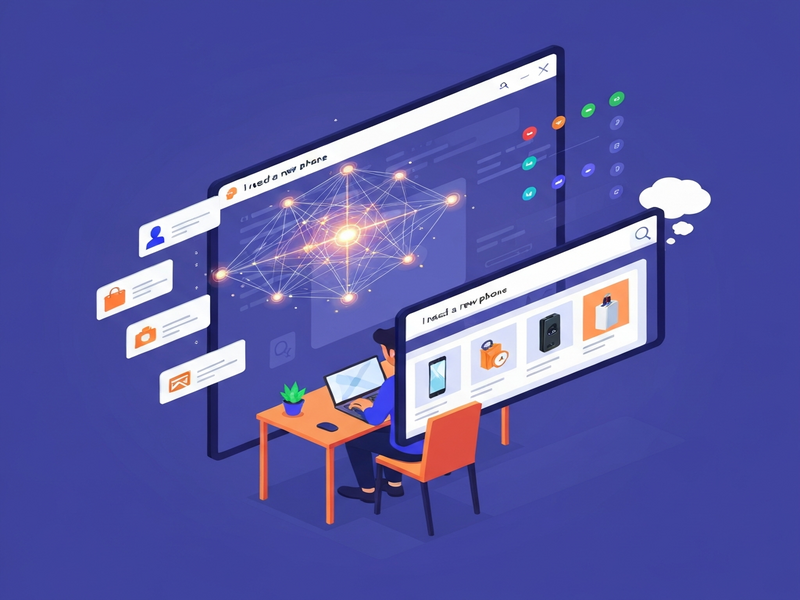
- Personalized Product Search (PPS) testbed: A realistic scenario where an LLM agent must help a shopper find a product based on a vague request (e.g., “I need something good for hiking”) while leveraging a rich, noisy interaction log.
- Agent Personalized Benchmark (APeB): A curated dataset derived from real‑world action logs that pairs underspecified intents with corresponding user histories and a set of candidate items the user eventually viewed.
Key components of the framework include:
- Raw query module – receives the initial user utterance.
- History encoder – ingests the full interaction log, applying attention mechanisms to surface preference signals.
- Intent inference engine – combines raw query and encoded history to hypothesize the user’s latent goal.
- Candidate ranking layer – scores a pre‑filtered product set against the inferred intent and preference profile.
How It Works in Practice
The workflow can be visualized as a multi‑step pipeline that mirrors how a human sales associate would operate:
- Receive raw request: The agent captures the user’s first utterance without any clarification.
- Retrieve interaction history: All prior messages, clicks, and view events are fetched from a persistent store (e.g., a vector database like Chroma DB).
- Encode history: A transformer‑based encoder transforms the heterogeneous log into a dense preference vector.
- Refine query: The raw request is combined with the preference vector to produce a “refined” query that is more specific (e.g., “lightweight waterproof hiking boots for cold weather”).
- Search and rank: The refined query drives a product retrieval engine; the ranking layer re‑orders results using both relevance and the user’s historical taste.
- Present answer: The top‑k items are formatted into a natural‑language response, optionally accompanied by explanations that reference past interactions.
What sets this approach apart is the explicit history‑aware query refinement step. Most existing agents either ignore history or treat it as a post‑hoc reranker. By integrating preferences early, the system can ask more targeted follow‑up questions or surface items that align with subtle user signals.
Evaluation & Results
The authors evaluated several state‑of‑the‑art LLM agents—including GPT‑4, Claude‑2, and LLaMA‑2‑70B—using the APeB benchmark. Experiments were organized around three query stages:
- Explicit stage: Users already articulate a clear intent (e.g., “Show me 4‑K TVs under $800”).
- Early stage: Users provide only a high‑level need (e.g., “I want a good TV”).
- Discovery stage: Users issue a single word or phrase with no context (e.g., “TV”).
Key findings:
- All models performed competitively on the explicit stage, achieving >85% success in retrieving the user‑viewed item.
- Performance dropped sharply on early‑stage queries, with success rates falling between 38% and 52%.
- Rubric analysis pinpointed “ineffective history utilization” as the primary cause of the gap.
- A lightweight history‑aware query‑refinement pipeline named VQRA (Vector‑Query‑Refine‑Assist) added an average of +12% absolute improvement across early‑stage queries, confirming that dedicated history modules are essential.
These results demonstrate that current LLM agents excel when the problem is well‑specified but still struggle to discover intent from sparse signals—a critical limitation for any commercial AI assistant.
Why This Matters for AI Systems and Agents
For practitioners building AI‑driven products, APeB offers a realistic yardstick that goes beyond traditional IR metrics. The benchmark highlights three actionable takeaways:
- Design agents with built‑in memory processors. Simple prompt‑engineering tricks are insufficient; a dedicated module that continuously updates a user preference vector is required.
- Incorporate query‑refinement loops. Early‑stage interactions should trigger a refinement sub‑routine that asks clarifying questions or internally expands the query using history.
- Evaluate with raw, underspecified inputs. Deploying agents in production without testing on vague queries can lead to silent failures and poor user experience.
These insights map directly onto existing UBOS capabilities:
- Integrating a Chroma DB integration enables fast vector storage of interaction histories, supporting the history encoder step.
- The Workflow automation studio can orchestrate the multi‑step VQRA pipeline without custom code.
- Deploying personalized recommendation flows on the Enterprise AI platform by UBOS ensures scalability for high‑traffic e‑commerce scenarios.
What Comes Next
While APeB marks a significant step forward, several open challenges remain:
- Long‑term preference drift: Users’ tastes evolve; future benchmarks should model temporal decay and re‑learning.
- Multimodal histories: Incorporating images, voice snippets, or click‑stream heatmaps could enrich the preference vector.
- Privacy‑preserving personalization: Techniques such as federated learning or differential privacy need to be evaluated within the APeB framework.
Potential research directions include:
- Developing adaptive memory networks that automatically prune outdated signals.
- Exploring reinforcement‑learning‑based query refinement where the agent receives feedback on the usefulness of its clarifying questions.
- Extending the benchmark to domain‑specific domains (e.g., healthcare, finance) where personalization carries higher stakes.
Practitioners interested in prototyping these ideas can leverage UBOS’s flexible ecosystem:
- Start with UBOS for startups to spin up a sandbox environment that includes pre‑built LLM connectors.
- Experiment with the OpenAI ChatGPT integration to test VQRA‑style refinements on real user data.
- Scale successful prototypes using the UBOS solutions for SMBs, which provide managed hosting and compliance tooling.
Conclusion
The APeB benchmark surfaces a critical gap in the evaluation of LLM agents: the ability to personalize from raw, underspecified queries using noisy interaction histories. By constructing a realistic personalized product search scenario and providing a rigorously annotated dataset, the authors give the community a concrete tool to measure and improve this capability. Early experiments reveal that even the most powerful LLMs falter without dedicated history‑aware modules, but a simple VQRA pipeline can recover a substantial portion of the lost performance. For AI product teams, APeB offers a roadmap to build agents that feel genuinely attentive, adaptable, and ready for real‑world deployment.
References
- Garry Yang, Zizhe Chen, Xinru Chen, et al. “APeB: Benchmarking Personalization Ability of Large Language Model Agents.” APeB paper, arXiv:2607.03162v1, 2026.
- OpenAI. “ChatGPT Technical Report.” 2023.
- Anthropic. “Claude 2 Model Card.” 2024.
- Meta AI. “LLaMA 2: Open Foundation Language Models.” 2023.
Andrii Bidochko
CTO UBOS
Andrii Bidochko is an AI entrepreneur and researcher focused on AI agents, reinforcement learning, and autonomous systems. He writes about the technologies shaping the future of machine intelligence, from frontier models and agent architectures to real-world AI applications.