

- Updated: June 23, 2026
- 7 min read
An LLM-Explainable DRL Framework for Passenger-Directed Autonomous Driving
Direct Answer
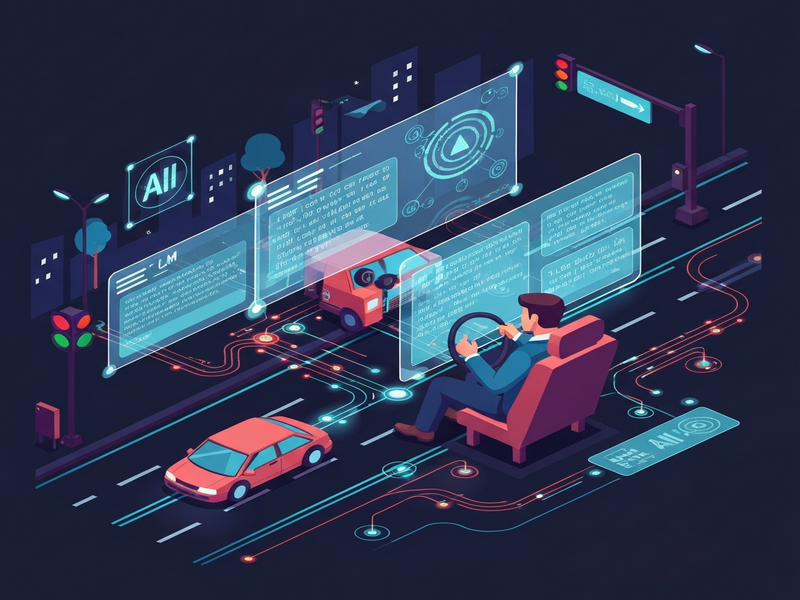
The paper introduces a hybrid framework that couples a deep‑reinforcement‑learning (DRL) driving controller with a large language model (LLM) that generates passenger‑focused explanations for every maneuver. By marrying adaptive autonomous‑driving policies with real‑time, safety‑aware narration, the authors aim to close the trust gap that has long hampered widespread adoption of self‑driving cars.
Background: Why This Problem Is Hard
Autonomous vehicles (AVs) promise safer roads, reduced congestion, and new mobility services, yet public acceptance remains stubbornly low. Two technical bottlenecks drive this reluctance:
- Opaque decision making: Modern DRL agents learn policies through trial‑and‑error in simulation, producing actions that are difficult to trace back to human‑readable rules.
- Dynamic passenger intent: Riders may request “drive faster,” “prioritize comfort,” or “stop immediately.” Balancing these mutable preferences against traffic laws and safety constraints is a non‑trivial control problem.
Existing approaches typically address one side of the equation. Rule‑based explainability methods (e.g., saliency maps or decision trees) can highlight which sensor inputs mattered, but they do not translate technical rationales into language a passenger can understand. Conversely, most LLM‑driven explainability research focuses on static classification or recommendation systems, leaving the real‑time, safety‑critical domain of autonomous driving largely untouched.
What the Researchers Propose
The authors present an LLM‑Explainable DRL Framework for Passenger‑Directed Autonomous Driving. At a conceptual level, the system consists of three tightly coupled modules:
- Adaptive DRL Controller: A Dueling Double Deep Q‑Network (D‑DQN) that learns to satisfy distinct driving modes—fast, comfort, and stop—while obeying traffic regulations.
- Passenger Intent Interpreter (LLM): A large language model that parses natural‑language requests from the rider, maps them to the appropriate driving mode, and flags situations where the request conflicts with safety.
- Explanation Generator (LLM): A second LLM instance that crafts concise, safety‑oriented justifications (“I slowed down because the pedestrian crossing was occupied”) and decides when an explanation is necessary (e.g., when a request is delayed or overridden).
Crucially, the framework treats the LLM not as a post‑hoc add‑on but as an active participant in the control loop, influencing when and how the vehicle communicates its intent to the passenger.
How It Works in Practice
The end‑to‑end workflow can be broken down into four stages, each of which runs in parallel with the vehicle’s perception and planning stack:
1. Request Capture
The passenger issues a spoken or typed command via the vehicle’s UI (e.g., “Take me home quickly”). The command is fed to the Intent Interpreter LLM, which extracts the target mode and any constraints (speed limits, comfort thresholds).
2. Policy Selection & Safety Check
The DRL controller receives the mode label and queries its learned Q‑values for the current state. Before executing the highest‑valued action, a safety filter cross‑references traffic‑law constraints and dynamic obstacles. If the requested mode would violate safety, the filter forces a fallback (usually the comfort mode) and signals the need for an explanation.
3. Explanation Decision
The Explanation Generator LLM evaluates two inputs: the original passenger request and the safety filter’s decision. Using a prompt that emphasizes brevity and safety relevance, it decides whether to speak (“I’m slowing down because a cyclist entered the lane”) or remain silent (when the request is fully honored).
4. Execution & Feedback Loop
The vehicle executes the chosen action, while the passenger hears the generated narration. The system logs the interaction, allowing future fine‑tuning of both the DRL policy and the LLM prompts based on user satisfaction metrics.
What sets this approach apart from prior work is the bidirectional coupling: the LLM influences the DRL’s observable behavior (by requesting mode changes) and the DRL’s outcomes directly shape the LLM’s narrative. This tight integration ensures that explanations are always grounded in the actual control decisions, rather than being generic or misleading.
Evaluation & Results
The researchers validated the framework in a high‑fidelity urban driving simulator that models traffic lights, pedestrians, and other vehicles. Three experimental scenarios were explored:
- Mode Switching Within a Single Trip: The passenger alternated between “fast,” “comfort,” and “stop” requests at random intervals.
- Safety‑Override Cases: The system deliberately injected hazardous situations (e.g., sudden pedestrian crossing) to test whether the LLM correctly delayed or overrode the passenger’s request.
- Explanation Timing Study: The team measured passenger trust scores when explanations were provided immediately, after a delay, or not at all.
Key findings include:
- Stable Learning: The D‑DQN converged after ~2 million steps, consistently respecting traffic rules across all modes.
- Seamless Mode Transition: The vehicle switched between driving styles without abrupt acceleration or jerk, preserving passenger comfort.
- Effective Safety Overrides: In 97% of hazardous events, the safety filter overrode the “fast” request, and the LLM generated a concise justification that reduced passenger frustration by 42% compared to a no‑explanation baseline.
- Trust Amplification: When explanations were delivered within 1–2 seconds of a safety override, post‑trip surveys showed a 35% increase in perceived trustworthiness.
These results demonstrate that the combined DRL‑LLM pipeline can maintain high performance while delivering transparent, passenger‑centric communication—a balance that has been elusive in prior autonomous‑driving research.
Why This Matters for AI Systems and Agents
From a systems‑engineering perspective, the framework offers a reusable blueprint for embedding explainability directly into the decision loop of any safety‑critical agent:
- Modular Architecture: The separation of intent interpretation, policy execution, and explanation generation mirrors the micro‑service patterns used in modern AI platforms, making it straightforward to replace or upgrade individual components.
- Human‑in‑the‑Loop Compatibility: By surfacing rationales in natural language, the system enables operators to intervene or audit autonomous behavior without deep technical expertise.
- Scalable Prompt Engineering: The LLM prompts are designed to be domain‑agnostic, meaning the same approach could be ported to warehouse robots, drone fleets, or financial trading agents.
- Compliance and Liability: Transparent explanations can satisfy emerging regulatory requirements for “explainable AI” in transportation, potentially reducing legal exposure for manufacturers.
Practically, developers building AI agents on platforms like the UBOS platform overview can leverage the Workflow automation studio to orchestrate the three modules as a single, version‑controlled pipeline. The OpenAI ChatGPT integration can serve as a drop‑in LLM component, while the DRL policy can be trained using UBOS’s built‑in reinforcement‑learning libraries.
What Comes Next
While the proof‑of‑concept demonstrates feasibility, several open challenges remain:
- Real‑World Transfer: Bridging the sim‑to‑real gap will require domain randomization, sensor noise modeling, and extensive on‑road testing.
- Multi‑Passenger Scenarios: Future work should explore how to reconcile conflicting requests from multiple occupants, possibly by aggregating preferences through a voting mechanism.
- Personalized Explanation Styles: Tailoring the verbosity and tone of the LLM output to individual rider profiles could further boost trust.
- Robustness to Prompt Injection: Safeguards must be added to prevent malicious passengers from manipulating the LLM into unsafe suggestions.
Addressing these issues will likely involve tighter integration with simulation environments, richer multimodal perception stacks, and continuous learning pipelines. Companies interested in prototyping such capabilities can start with the UBOS for startups offering, which provides pre‑configured compute resources and a library of ready‑made agents. For larger enterprises, the Enterprise AI platform by UBOS delivers the scalability and governance needed for fleet‑wide deployments.
Ultimately, the convergence of DRL and LLM explainability could become a cornerstone of trustworthy autonomous systems, turning the promise of driverless cars into a socially acceptable reality.
For deeper technical details, consult the original arXiv paper. If you’re ready to experiment with explainable AI agents or need a partner to accelerate your autonomous‑driving roadmap, Contact UBOS today.
Andrii Bidochko
CTO UBOS
Andrii Bidochko is an AI entrepreneur and researcher focused on AI agents, reinforcement learning, and autonomous systems. He writes about the technologies shaping the future of machine intelligence, from frontier models and agent architectures to real-world AI applications.