

- Updated: June 15, 2026
- 6 min read
An LLM-Based Assistance System for Intuitive and Flexible Capability-Based Planning
Direct Answer
The paper introduces a hybrid assistance system that couples a formal Satisfiability Modulo Theories (SMT) planner with a Large Language Model (LLM) interface, enabling intuitive natural‑language interaction, explanation, and on‑the‑fly adaptation of capability‑based planning models. This matters because it bridges the gap between rigorous symbolic planning and the usability demands of industrial engineers, making automated planning both trustworthy and accessible.
Background: Why This Problem Is Hard
Modern manufacturing environments are increasingly modular and reconfigurable. Machines, robots, and workstations are treated as interchangeable “capabilities” that can be composed to meet shifting production goals. While capability‑based planning promises automatic generation of feasible process sequences from semantic knowledge models, three practical obstacles have limited its adoption:
- Opaque solver feedback: When an SMT planner declares a problem unsatisfiable, the resulting conflict set is expressed in low‑level logical terms that are difficult for engineers to interpret.
- Static knowledge models: The semantic descriptions of resources must be manually updated whenever a machine is added, removed, or its performance changes, a task that is both time‑consuming and error‑prone.
- Human‑in‑the‑loop bottleneck: Existing tools require users to master formal specification languages, creating a steep learning curve that discourages non‑expert stakeholders from participating in planning cycles.
These challenges are amplified in high‑mix, low‑volume production lines where rapid re‑planning is essential. Without a way to surface solver insights in plain language and to adjust the underlying capability model interactively, organizations either revert to manual scheduling or accept sub‑optimal plans.
What the Researchers Propose
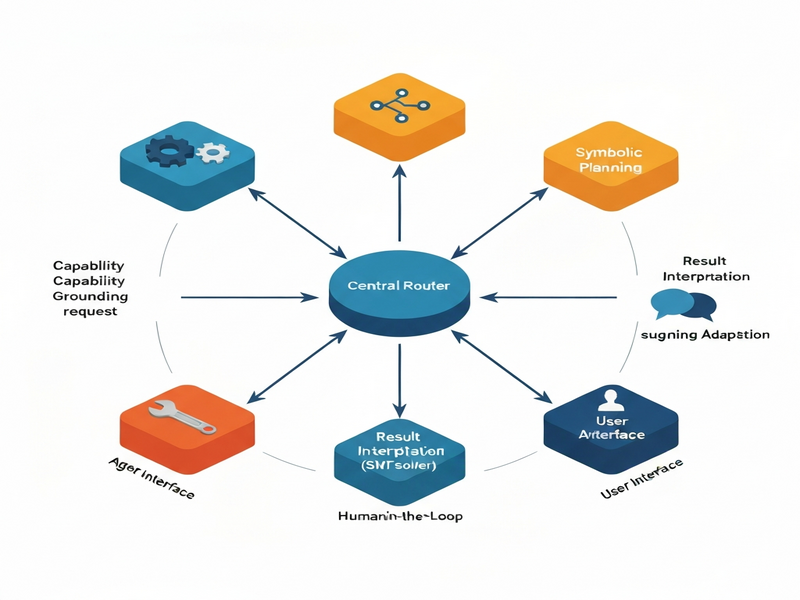
The authors present a four‑stage hybrid framework that retains the formal correctness guarantees of an SMT planner while delegating user‑facing tasks to an LLM. The system is organized as a routed agentic workflow, with a central router orchestrating five specialized agents:
- Capability Grounding Agent: Translates natural‑language queries about resources into formal capability predicates.
- Symbolic Planning Agent: Executes the SMT solver on the grounded model to produce a plan or an unsatisfiability proof.
- Result Interpretation Agent: Converts the solver’s raw output into a human‑readable explanation, highlighting why a plan succeeded or failed.
- Planning Adaptation Agent: Suggests concrete modifications to the knowledge model (e.g., adding a missing capability or relaxing a constraint) based on the explanation.
- Human‑in‑the‑Loop Approval Agent: Presents adaptation proposals to the user for explicit acceptance before the model is updated.
By separating concerns—formal reasoning stays within the Symbolic Planning Agent, while the LLM‑driven agents handle language, explanation, and model evolution—the framework achieves both rigor and usability.
How It Works in Practice
Conceptual Workflow
When a production manager asks, “Can we produce 500 units of product X using the current line configuration?” the following steps occur:
- Input Capture: The user’s natural‑language request is received by the router.
- Capability Grounding: The Capability Grounding Agent maps “product X” and “current line configuration” to a set of capability predicates (e.g.,
hasMachine(M1, welding),capacity(M2) ≥ 200). - Symbolic Planning: The Symbolic Planning Agent feeds these predicates into the SMT solver, which either returns a feasible sequence of operations or an unsatisfiability proof.
- Result Interpretation: If the plan fails, the Result Interpretation Agent translates the proof into a concise English explanation such as “Insufficient welding capacity on Machine M1.”
- Planning Adaptation: The Planning Adaptation Agent proposes remedies—e.g., “Add a second welding station” or “Relax the batch size to 300.”
- Human‑in‑the‑Loop Approval: The user reviews the suggestions, approves a change, and the knowledge model is updated accordingly.
- Re‑planning: The router triggers a new planning cycle with the revised model, delivering a satisfiable plan if the adaptation resolves the conflict.
What Makes This Approach Different
- Formal correctness is preserved: The SMT solver remains the sole decision engine, guaranteeing that any accepted plan satisfies all encoded constraints.
- Natural‑language accessibility: Users never need to write or read formal logic; the LLM handles translation both ways.
- Iterative, user‑guided model evolution: Instead of a one‑shot planning attempt, the system supports a dialogue where the model is refined until a feasible plan emerges.
- Agentic modularity: Each functional piece is encapsulated as an independent agent, simplifying maintenance, scaling, and future extensions (e.g., swapping the LLM for a domain‑specific model).
Evaluation & Results
The authors validated the system on a modular production line that could be reconfigured into four distinct scenario families:
- Knowledge Queries: 10 natural‑language questions about resource capabilities.
- Satisfiable Planning Cases: 4 instances where a feasible plan existed.
- Unsatisfiable Planning Cases: 4 instances where the initial model blocked a solution.
- Adaptive Planning Scenarios: 5 cases requiring model adjustments to become feasible.
Key findings include:
- 9 out of 10 knowledge queries were correctly grounded and answered by the LLM layer.
- All four satisfiable planning cases produced correct schedules without human intervention.
- In three of the four unsatisfiable cases, the system generated concrete repair proposals that directly addressed the root cause of infeasibility.
- All five adaptive scenarios were resolved through iterative, user‑approved modifications, ultimately yielding satisfiable plans.
These results demonstrate that the hybrid architecture not only preserves the rigor of symbolic planning but also dramatically improves the system’s accessibility and adaptability in realistic industrial settings.
Why This Matters for AI Systems and Agents
For AI practitioners building autonomous agents, the paper offers a blueprint for combining deterministic reasoning engines with generative language models without sacrificing correctness. The separation of concerns enables:
- Clear accountability: The planner’s output can be audited, while the LLM’s suggestions remain transparent through natural‑language explanations.
- Scalable orchestration: Agentic routing mirrors modern workflow‑automation platforms, making it easier to plug the system into existing orchestration stacks.
- Human‑centric control: By keeping the final decision in the hands of a domain expert, the approach aligns with emerging governance frameworks for AI in safety‑critical domains.
Enterprises looking to modernize their manufacturing execution systems can leverage such a hybrid model to reduce the expertise barrier, accelerate re‑planning cycles, and maintain compliance with industry standards. For example, the UBOS platform overview provides a low‑code environment where similar agentic workflows can be assembled, monitored, and extended.
What Comes Next
While the prototype validates the core concept, several avenues remain open for research and productization:
- Scalability to larger factories: Extending the SMT encoding to thousands of capabilities will test the limits of both solver performance and LLM context windows.
- Multi‑LLM ensembles: Combining domain‑specific LLMs with a general‑purpose model could improve grounding accuracy for specialized vocabularies.
- Automated conflict analysis: Future work could integrate counterexample‑guided abstraction refinement to suggest model changes without explicit human prompts.
- Integration with digital twins: Real‑time sensor feeds could automatically update capability predicates, enabling continuous planning loops.
Addressing these challenges will bring the vision of fully autonomous, self‑optimizing production lines closer to reality. Companies interested in building such end‑to‑end solutions can explore the Enterprise AI platform by UBOS, which already supports modular knowledge graphs, LLM connectors, and workflow orchestration needed for next‑generation planning assistants.
References
For a deeper dive, see the original arXiv paper titled “An LLM‑Based Assistance System for Intuitive and Flexible Capability‑Based Planning.”
Andrii Bidochko
CTO UBOS
Andrii Bidochko is an AI entrepreneur and researcher focused on AI agents, reinforcement learning, and autonomous systems. He writes about the technologies shaping the future of machine intelligence, from frontier models and agent architectures to real-world AI applications.