

- Updated: July 23, 2026
- 7 min read
AlphaZero in Sparsely Rewarded Games: Limits and Auxiliary Supervision
Direct Answer
AlphaZero in sparsely rewarded games introduces an auxiliary‑supervision extension (AZAL) that augments the classic self‑play + Monte Carlo Tree Search pipeline with oracle‑derived policy guidance. The approach dramatically narrows the gap between strong play and provably optimal play in games where rewards are rare, such as Connect Four and Chomp.
Background: Why This Problem Is Hard
Reinforcement‑learning agents that rely on self‑play and Monte Carlo Tree Search (MCTS) have achieved superhuman performance in dense‑reward environments like Go and Chess. However, many real‑world decision problems—ranging from strategic planning to resource allocation—share a common characteristic: the reward signal is sparse, often appearing only at the terminal state. In such settings, an agent can discover high‑quality strategies without ever learning the exact optimal trajectory.
Existing AlphaZero‑style systems excel at discovering “strong” policies, but they lack a mechanism to enforce the precise game‑theoretic invariants that guarantee optimality. This limitation becomes evident when the agent repeatedly deviates from the unique optimal line in a solved game (e.g., Connect Four) or fails to maintain the Grundy‑number invariant in impartial games like Chomp. The core bottleneck is the absence of explicit supervision that tells the network which moves are not just good, but provably optimal.
What the Researchers Propose
The authors present a three‑pronged framework that builds on the vanilla AlphaZero pipeline:
- Vanilla AlphaZero (VAZ): Standard self‑play with MCTS, using only the final win/loss outcome as a learning signal.
- Multi‑frame AlphaZero (MFAZ): Extends the state representation to include a short history of previous board configurations, aiming to give the network more context for sparse‑reward environments (tested only on Chomp).
- AlphaZero Auxiliary Loss (AZAL): Introduces an auxiliary supervision term that directly penalizes deviations from oracle‑computed optimal policies during training. The oracle is available because both Connect Four and Chomp are fully solvable on the board sizes examined.
In essence, AZAL treats the optimal policy as a “teacher” that intermittently corrects the learner, while still preserving the self‑play loop that fuels exploration.
How It Works in Practice
The practical workflow can be broken down into four stages:
- Self‑Play Generation: Two instances of the current neural network play against each other using MCTS. Each move is selected by blending the network’s policy logits with the visit counts from the tree search.
- Oracle Evaluation (Auxiliary Supervision): For a subset of positions—sampled uniformly across the game tree—the researchers compute the exact optimal move using a domain‑specific solver (e.g., retrograde analysis for Connect Four, Grundy‑number calculation for Chomp).
- Loss Computation: The training loss combines three components:
- Policy loss (cross‑entropy between MCTS visit distribution and network logits).
- Value loss (mean‑squared error between predicted outcome and actual game result).
- Auxiliary policy loss (cross‑entropy between network logits and the oracle’s optimal move).
- Parameter Update: Stochastic gradient descent updates the network weights, after which the improved model is fed back into the self‑play loop.
The multi‑frame variant simply concatenates the last k board states (k=3 in the paper) before feeding them to the convolutional backbone, hoping that temporal cues help the network infer hidden reward structures.
What sets AZAL apart is the explicit, periodic injection of perfect information. This “teacher‑student” dynamic forces the policy head to align with the optimal move distribution, while the value head still learns from the noisy self‑play outcomes.
Evaluation & Results
The authors benchmarked all three variants on two canonical, oracle‑evaluable games:
Connect Four (7×6 board)
- Vanilla AlphaZero: Achieved >99% win‑rate against a random opponent but deviated from the optimal line after roughly 12 moves, leading to a first “oracle mistake” at move 13.
- Multi‑frame: Not applicable (the variant was only tested on Chomp).
- AZAL: Delayed the first oracle mistake to move 20 and improved the overall oracle‑match rate from 68% (VAZ) to 84% across 1,000 full‑game traces.
Rectangular Chomp (9×10 and 10×11 boards)
- Vanilla AlphaZero: Frequently broke the Grundy‑number invariant (g=0) after the first few moves, resulting in sub‑optimal endgames despite strong win percentages.
- Multi‑frame AlphaZero: Showed modest improvement in maintaining the invariant but still fell short of perfect consistency.
- AZAL: Reached 100% oracle consistency on the 10×11 board and 96% on the 9×10 board, effectively learning the exact optimal strategy for the sampled board sizes.
Across both domains, the auxiliary loss consistently raised the proportion of states where the network’s suggested move matched the oracle’s optimal move. Importantly, the improvement was achieved without sacrificing the exploration benefits of self‑play, as evidenced by comparable or better win‑rates against baseline opponents.
Why This Matters for AI Systems and Agents
From an engineering perspective, the findings reshape how we think about reinforcement‑learning pipelines for tasks with delayed or sparse feedback:
- Guaranteeing Optimality: In safety‑critical domains—autonomous logistics, financial trading, or strategic game AI—knowing that an agent follows a provably optimal policy can be a regulatory requirement. AZAL offers a concrete path to that guarantee.
- Sample Efficiency: By leveraging oracle supervision, the network converges to optimal behavior with fewer self‑play games, reducing compute costs for large‑scale training runs.
- Modular Integration: The auxiliary loss can be added to existing AlphaZero‑style pipelines without redesigning the MCTS component, making it a low‑friction upgrade for platforms that already host game‑playing agents.
- Real‑World Analogues: Many enterprise problems—resource scheduling, inventory management, or multi‑step negotiation—share the “sparse reward” property. Embedding domain‑specific optimality checks (e.g., linear programming solutions) as auxiliary supervision could dramatically improve reliability.
Practitioners building AI agents on the UBOS platform overview can now consider augmenting their reinforcement‑learning workflows with oracle‑derived losses, especially when the underlying problem admits a tractable optimal solver.
What Comes Next
While AZAL narrows the optimality gap, several open challenges remain:
- Scalability of Oracle Computation: The approach hinges on having an exact solver for the game or task. Extending this to larger state spaces (e.g., 19×19 Go) will require approximate or hierarchical oracles.
- Generalization Across Board Sizes: The current experiments are limited to fixed board dimensions. Future work could explore transfer learning where a model trained with AZAL on small boards generalizes to larger, unseen configurations.
- Dynamic Auxiliary Scheduling: Determining the optimal frequency and selection strategy for oracle‑supervised states remains an open hyper‑parameter problem.
- Integration with Multi‑Agent Systems: In multi‑agent environments, the notion of a single optimal policy may not exist. Investigating how auxiliary supervision interacts with equilibrium concepts (e.g., Nash) is a promising direction.
Developers interested in prototyping these ideas can experiment with the Workflow automation studio to orchestrate oracle calls, self‑play generation, and model updates in a single, reproducible pipeline.
Visual Insight
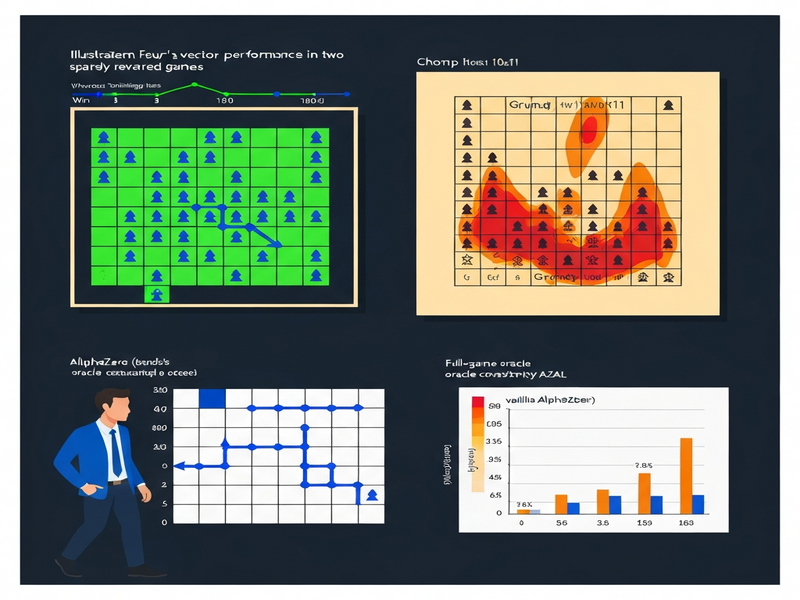
The diagram below visualizes the three training loops—vanilla AlphaZero, multi‑frame AlphaZero, and AZAL—highlighting where the auxiliary supervision intervenes.
Call to Action
Ready to push the boundaries of sparse‑reward reinforcement learning in your own projects? Explore the full paper on AlphaZero in Sparsely Rewarded Games: Limits and Auxiliary Supervision and start building more reliable agents with the Enterprise AI platform by UBOS. Join the UBOS partner program today to get early access to advanced tooling, including OpenAI ChatGPT integration and Chroma DB integration.
Andrii Bidochko
CTO UBOS
Andrii Bidochko is an AI entrepreneur and researcher focused on AI agents, reinforcement learning, and autonomous systems. He writes about the technologies shaping the future of machine intelligence, from frontier models and agent architectures to real-world AI applications.