

- Updated: June 15, 2026
- 7 min read
AlphaTransit: Learning to Design City-scale Transit Routes
Direct Answer
AlphaTransit is a novel AI framework that blends Monte Carlo Tree Search (MCTS) with a neural policy‑value network to automatically design city‑scale bus transit routes. By providing look‑ahead guidance during the incremental construction of a network, it overcomes the delayed‑feedback bottleneck that has long hampered transit planning algorithms.
Background: Why This Problem Is Hard
Designing a public‑transport network is fundamentally a sequential decision problem. Planners must decide, one by one, which street segment to add to a route, which routes to extend, and where to create transfer points. The quality of each decision is rarely apparent until the entire network is assembled and simulated against real‑world demand. This “delayed feedback” creates two intertwined challenges:
- Interaction effects: Adding a seemingly useful segment can generate transfer bottlenecks, cause redundant overlap with existing routes, or lower overall system throughput.
- Combinatorial explosion: A city with thousands of road edges yields an astronomical number of possible route extensions, making exhaustive search infeasible.
Traditional approaches—heuristic rule‑based planners, mixed‑integer programming, or pure reinforcement learning (RL)—struggle with these issues. Heuristics lack adaptability to heterogeneous demand patterns, while exact optimization quickly becomes intractable at city scale. RL agents can learn from simulation, but without look‑ahead they often converge to locally optimal, but globally sub‑par, networks because they receive sparse reward signals only after a full rollout.
What the Researchers Propose
The authors introduce AlphaTransit, a search‑based planning framework that couples two complementary AI components:
- Neural policy‑value network: A deep model that, given the current partial network, predicts (a) a probability distribution over promising next route extensions (the policy) and (b) an estimate of the eventual service quality if that extension is taken (the value).
- Monte Carlo Tree Search: An exploration algorithm that expands a decision tree of possible extensions, using the policy to bias which branches to explore and the value to prune unpromising paths.
In essence, the policy acts as a learned “intuition” about which streets are likely to improve coverage, while the value function supplies a surrogate of the final performance, allowing MCTS to perform look‑ahead without running costly full‑network simulations at every node.
How It Works in Practice
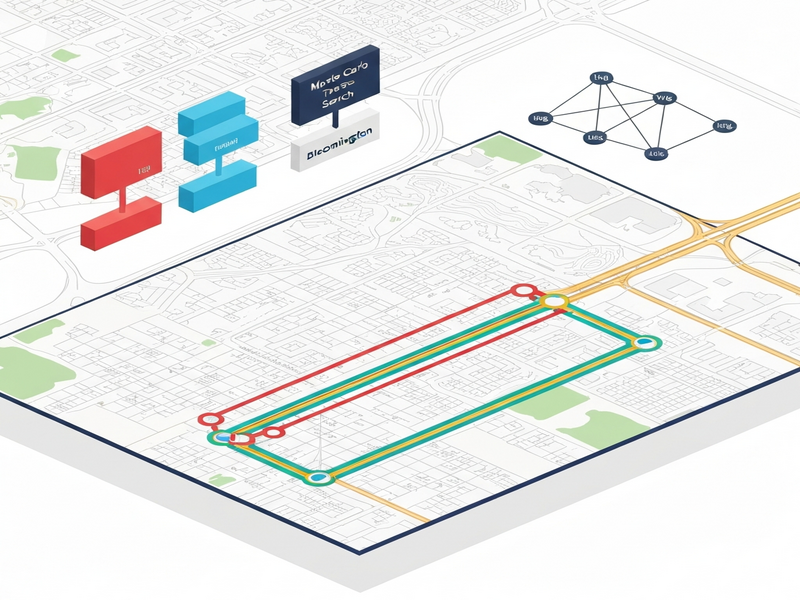
The AlphaTransit workflow can be broken down into four conceptual stages:
1. Initialization
The system starts with an empty set of routes and a demand matrix derived from census and travel‑survey data. Road topology is represented as a graph where nodes are intersections and edges are drivable segments.
2. Policy‑Guided Expansion
At each iteration, the policy network evaluates every feasible extension (e.g., adding an edge to an existing route or spawning a new route). It assigns a probability score that reflects how well the extension aligns with demand hotspots and network balance.
3. Value‑Informed Search
MCTS builds a search tree rooted at the current partial network. For each child node (a candidate extension), the value network predicts the downstream service rate—essentially a proxy for the final objective. Nodes with higher predicted value are explored more deeply, while low‑value branches are quickly discarded.
4. Selection and Commitment
After a predefined number of simulations, MCTS returns the most promising extension. AlphaTransit commits this decision, updates the network state, and repeats the cycle until a stopping criterion (e.g., budget of vehicles or maximum route length) is met.
What distinguishes AlphaTransit from prior methods is that it never runs a full traffic simulation inside the tree. Instead, the learned value function provides a fast, differentiable estimate of downstream performance, enabling thousands of rollouts per second. This dramatically reduces computational cost while preserving strategic foresight.
Evaluation & Results
To validate the approach, the authors built a new benchmark based on Bloomington, Indiana—a realistic road network with census‑derived travel demand. Two demand regimes were tested:
- Mixed demand: A blend of commuter, school, and leisure trips.
- Full transit demand: All trips are assumed to be served by public transport.
AlphaTransit was compared against three baselines:
- Pure reinforcement learning (no search).
- Plain Monte Carlo Tree Search (random policy, no learned guidance).
- Traditional heuristic planners (not detailed in the paper but included for context).
Key findings:
- In the mixed‑demand scenario, AlphaTransit achieved a service rate of 54.6 %, outperforming RL by 9.9 % and plain MCTS by 2.5 %.
- Under full transit demand, the framework reached 82.1 % service coverage, a gain of 11.4 % over RL and 11.2 % over MCTS.
- Computation time remained practical for city‑scale problems: each full network design completed within a few minutes on a single GPU, thanks to the surrogate value predictions.
These results demonstrate that the synergy of learned policy guidance and tree search yields a tangible performance boost that neither component can achieve alone.
Why This Matters for AI Systems and Agents
AlphaTransit showcases a concrete recipe for tackling delayed‑feedback, combinatorial planning problems that are common across AI‑driven industries. For AI system designers, the paper offers three actionable insights:
- Hybrid search‑learning loops: Embedding a neural policy‑value model inside a classic search algorithm can provide strategic foresight without the prohibitive cost of full simulations.
- Scalable surrogate evaluation: Training a value network to predict downstream metrics enables rapid “what‑if” analysis, a capability that can be repurposed for logistics, supply‑chain routing, or autonomous fleet management.
- Modular architecture: The separation of policy, value, and search modules makes the system adaptable to different domains simply by retraining the neural components on domain‑specific data.
Practically, city planners could integrate AlphaTransit into existing GIS tools to generate data‑driven route proposals, reducing the time spent on manual iteration. AI developers building autonomous agents for smart‑city orchestration can reuse the same framework to coordinate electric‑bus charging schedules, dynamic ride‑sharing fleets, or even pedestrian flow control.
For organizations already leveraging the UBOS platform overview, AlphaTransit’s modular design aligns well with a plug‑and‑play architecture, allowing teams to attach the policy‑value service as a micro‑service within broader urban‑mobility workflows. Moreover, the AI marketing agents on UBOS illustrate how similar hybrid agents can be deployed for non‑transport domains, reinforcing the cross‑industry relevance of the approach.
Read the full technical details in the original AlphaTransit paper.
What Comes Next
While AlphaTransit marks a significant step forward, several open challenges remain:
- Dynamic demand adaptation: Current experiments assume static demand matrices. Extending the framework to handle time‑varying demand (e.g., rush‑hour spikes) would require recurrent or attention‑based value models.
- Multi‑objective optimization: Real‑world transit planning balances service rate, operational cost, equity, and environmental impact. Incorporating Pareto‑front exploration into the search could produce richer solution sets.
- Robustness to data uncertainty: Census data can be noisy. Future work could integrate Bayesian uncertainty estimation into the value network to guide risk‑aware route extensions.
From an engineering perspective, the next logical step is to embed AlphaTransit into a full‑stack workflow automation environment. The Workflow automation studio on UBOS provides a visual canvas for chaining data ingestion, model inference, and simulation steps, making it straightforward to prototype end‑to‑end transit design pipelines.
Enterprises looking to scale the solution across multiple municipalities can leverage the Enterprise AI platform by UBOS, which offers managed compute, versioned model registries, and secure API gateways—critical for handling sensitive urban data.
Startups interested in rapid prototyping can explore the UBOS for startups program, which includes sandbox environments and pre‑built connectors to popular GIS and transportation data sources.
Conclusion
AlphaTransit demonstrates that coupling a learned policy‑value network with Monte Carlo Tree Search can effectively navigate the delayed‑feedback landscape of city‑scale transit design. The framework delivers measurable service‑rate improvements while keeping computational demands tractable, opening the door for AI‑augmented urban planning at scale. As smart‑city initiatives mature, hybrid search‑learning architectures like AlphaTransit are poised to become foundational building blocks for a new generation of autonomous, data‑driven infrastructure agents.
Call to Action
Explore the open‑source implementation, benchmark data, and detailed documentation on the AlphaTransit GitHub repository. For further resources on AI‑powered transit solutions and to experiment with UBOS’s low‑code AI tools, visit the UBOS homepage.
Andrii Bidochko
CTO UBOS
Andrii Bidochko is an AI entrepreneur and researcher focused on AI agents, reinforcement learning, and autonomous systems. He writes about the technologies shaping the future of machine intelligence, from frontier models and agent architectures to real-world AI applications.