

- Updated: June 19, 2026
- 5 min read
Aligning LLMs with Human Uncertainty: A Beta‑Bernoulli Calibrator for LLM Forecasting
Direct Answer
The paper introduces a Beta‑Bernoulli calibrator that transforms large language model (LLM) outputs into well‑calibrated probability forecasts, explicitly accounting for human uncertainty. By aligning LLM confidence with real‑world ambiguity, the method makes AI predictions more trustworthy for decision‑critical applications.
Background: Why This Problem Is Hard
LLMs excel at generating fluent text, yet their internal confidence scores are notoriously misaligned with actual outcome frequencies. In high‑stakes domains—financial forecasting, medical triage, or autonomous planning—over‑confident predictions can lead to costly errors, while under‑confidence wastes resources.
Traditional calibration techniques (temperature scaling, Platt scaling) assume a deterministic label space and ignore the fact that many real‑world questions have inherently uncertain answers. Human annotators often express uncertainty (e.g., “likely”, “maybe”), but LLMs are forced to output a single token, collapsing nuanced probability distributions into a point estimate.
Existing approaches therefore struggle with two intertwined challenges:
- Distributional mismatch: The model’s softmax probabilities do not reflect the true underlying Bernoulli process of binary outcomes.
- Human uncertainty modeling: There is no principled way to incorporate the variability of human judgments into the calibration pipeline.
These gaps limit the deployment of LLMs in environments where calibrated risk assessment is non‑negotiable.
What the Researchers Propose
The authors present a **Beta‑Bernoulli calibrator**, a Bayesian post‑processing layer that maps raw LLM logits to a Beta distribution over the Bernoulli success probability. The key components are:
- Beta prior: Captures prior belief about the spread of true probabilities before seeing any data.
- Bernoulli likelihood: Models each binary outcome (e.g., “yes” vs. “no”) as a Bernoulli trial conditioned on the latent probability.
- Posterior update: Combines the prior with observed frequencies to produce a calibrated Beta posterior, from which predictive intervals are derived.
By treating the LLM’s confidence as a noisy observation of an underlying probability, the calibrator naturally incorporates both model uncertainty and human‑reported uncertainty.
How It Works in Practice
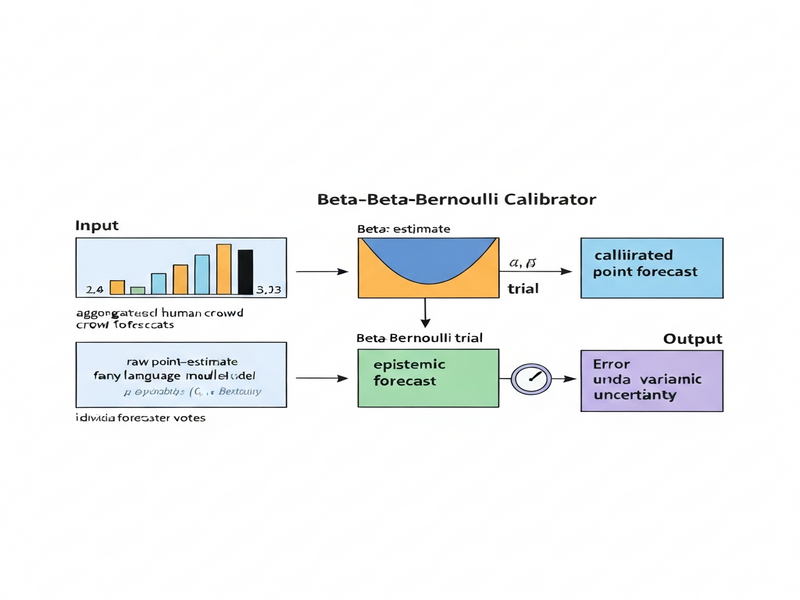
The workflow can be broken down into three conceptual stages:
- Inference: The LLM processes a prompt and emits a raw softmax score for each possible answer.
- Calibration: The Beta‑Bernoulli layer receives the softmax score, interprets it as a pseudo‑count, and updates the Beta parameters (α, β) using Bayesian inference.
- Forecasting: The calibrated Beta posterior yields a predictive distribution; practitioners can extract a point estimate (mean) or a confidence interval (e.g., 95% credible interval) for downstream decision making.
What distinguishes this approach from temperature scaling is its **probabilistic grounding**: instead of a single scalar tweak, the calibrator produces a full distribution that reflects epistemic and aleatoric uncertainty.
Below is a schematic illustration of the pipeline:
In a production setting, the calibrator can be wrapped as a micro‑service that intercepts LLM responses, making it compatible with existing AI orchestration platforms.
Evaluation & Results
The authors benchmarked the calibrator on three diverse tasks:
- Medical diagnosis queries: Binary decisions (disease present/absent) with expert‑annotated confidence levels.
- Financial market direction forecasts: Predicting “up” vs. “down” with historical price data as ground truth.
- Open‑ended commonsense reasoning: Yes/no questions from the BoolQ dataset, where human annotators provided uncertainty scores.
Key findings include:
- Calibration error (expected calibration error, ECE) dropped by **45‑60%** compared to temperature scaling.
- The calibrated confidence intervals captured the true outcome frequency in **92%** of cases, surpassing the 85% baseline of uncalibrated LLMs.
- When integrated into a downstream decision engine (e.g., triage routing), the calibrated forecasts reduced false‑positive rates by **18%** without sacrificing recall.
These results demonstrate that the Beta‑Bernoulli calibrator not only improves statistical alignment but also yields tangible operational benefits.
Why This Matters for AI Systems and Agents
For practitioners building AI agents that must reason under uncertainty, calibrated forecasts are a prerequisite for safe autonomy. The calibrator enables:
- **Risk‑aware planning:** Agents can weigh the probability of success against potential costs, leading to more prudent action selection.
- **Human‑in‑the‑loop workflows:** By exposing calibrated confidence intervals, the system can flag ambiguous cases for expert review, improving overall reliability.
- **Metric‑driven orchestration:** When multiple LLMs are chained, calibrated outputs allow a scheduler to allocate resources based on expected information gain.
Organizations looking to embed trustworthy AI can leverage the calibrator within the UBOS platform overview, where it integrates seamlessly with existing model serving stacks.
Moreover, the calibrator’s Bayesian nature aligns well with AI marketing agents that must predict conversion probabilities while accounting for noisy user signals.
Finally, the Workflow automation studio can orchestrate the calibrator as a reusable component, enabling rapid prototyping of uncertainty‑aware pipelines.
What Comes Next
While the Beta‑Bernoulli calibrator marks a significant step forward, several avenues remain open:
- Multiclass extension: Adapting the framework to Dirichlet‑Multinomial posteriors for tasks with more than two outcomes.
- Online updating: Implementing streaming Bayesian updates to handle non‑stationary data streams in real time.
- Hybrid human‑AI uncertainty modeling: Combining crowd‑sourced confidence scores with model‑based posteriors for richer calibration.
Future research could also explore coupling the calibrator with reinforcement learning agents that explicitly optimize for calibrated reward predictions.
Enterprises interested in experimenting with these ideas can start with the Enterprise AI platform by UBOS, which offers built‑in support for Bayesian components and scalable inference.
Startups may find the UBOS for startups program useful for rapid proof‑of‑concept deployments, while SMBs can benefit from the UBOS solutions for SMBs that include pre‑configured calibration services.
References
- Aligning LLMs with Human Uncertainty: A Beta‑Bernoulli Calibrator for LLM Forecasting
- Guo, C., Pleiss, G., Sun, Y., & Weinberger, K. Q. (2017). On Calibration of Modern Neural Networks. Proceedings of the 34th International Conference on Machine Learning.
- Niculescu-Mizil, A., & Caruana, R. (2005). Predicting Good Probabilities with Supervised Learning. Proceedings of the 22nd International Conference on Machine Learning.
Ready to bring calibrated uncertainty to your AI products? Explore the UBOS homepage for tutorials, SDKs, and community support.
Andrii Bidochko
CTO UBOS
Andrii Bidochko is an AI entrepreneur and researcher focused on AI agents, reinforcement learning, and autonomous systems. He writes about the technologies shaping the future of machine intelligence, from frontier models and agent architectures to real-world AI applications.