

- Updated: July 11, 2026
- 6 min read
Aligning Clinical Needs and AI Capabilities: A Survey on LLMs for Medical Reasoning
Direct Answer
The paper Aligning Clinical Needs and AI Capabilities: A Survey on LLMs for Medical Reasoning introduces a dual‑view framework that maps clinical competency levels—derived from Miller’s Pyramid—to concrete reasoning patterns (deductive, inductive, abductive) used by large language models (LLMs). By benchmarking 18 state‑of‑the‑art models across a five‑tier dataset, the authors reveal where specialist and generalist LLMs excel, offering a roadmap for building safer, workflow‑ready AI assistants in healthcare.
Background: Why This Problem Is Hard
Clinical decision‑making demands more than raw knowledge retrieval; it requires nuanced reasoning, contextual grounding, and the ability to adapt to evolving patient narratives. Traditional AI pipelines—rule‑based expert systems or narrow‑scope classifiers—struggle with:
- Dynamic case management: Real‑world encounters evolve as new test results, symptoms, or patient preferences emerge.
- Reasoning diversity: Physicians toggle between deductive (applying known guidelines), inductive (generalizing from patterns), and abductive (hypothesizing the most plausible explanation) modes.
- Data scarcity and bias: High‑quality, annotated clinical dialogues are limited, leading to hallucinations and unsafe suggestions from LLMs.
- Regulatory constraints: Any AI that influences diagnosis or treatment must meet stringent safety, explainability, and auditability standards.
Existing LLM evaluations typically focus on generic NLP benchmarks (e.g., MMLU, TruthfulQA) that ignore the layered reasoning steps clinicians perform. Consequently, developers lack a clear yardstick to gauge whether a model can progress from “knowing” to “doing” in a medical context.
What the Researchers Propose
The authors present a dual‑view alignment framework that bridges two worlds:
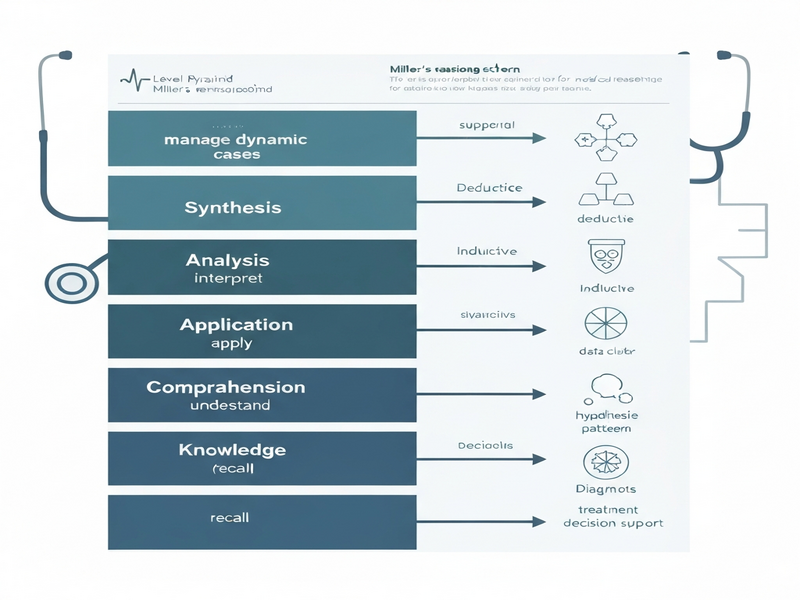
- Clinical competency axis: A five‑level scheme inspired by Miller’s Pyramid—Knows, Knows‑How, Shows‑How, Does, and Dynamic Management. Each level reflects a deeper integration of reasoning into patient care.
- Computational reasoning axis: Mapping of three canonical reasoning patterns—deductive, inductive, abductive—to the clinical tasks most often encountered at each competency level.
Key components of the framework include:
- Task taxonomy: A curated list of medical goals (e.g., differential diagnosis, treatment recommendation, patient counseling) linked to specific reasoning styles.
- Benchmark suite: A dataset spanning the five competency levels, each containing prompts, reference answers, and evaluation rubrics that capture both factual correctness and reasoning quality.
- Model taxonomy: Classification of LLMs into “specialist” (trained on biomedical corpora) and “generalist” (trained on broad web data) to study performance trade‑offs.
The framework does not prescribe a new model architecture; instead, it offers a systematic lens for assessing and improving existing LLMs in the medical domain.
How It Works in Practice
Implementing the dual‑view framework follows a clear workflow:
1. Define Clinical Scenario
Stakeholders select a target competency level (e.g., “Shows‑How” for simulated OSCE exams) and the associated reasoning pattern (e.g., abductive reasoning for differential diagnosis).
2. Assemble Prompt Templates
Prompt engineers craft structured inputs that explicitly request the desired reasoning mode. For abductive tasks, prompts might include “Given the symptoms, hypothesize the most plausible underlying condition.”
3. Run LLM Inference
Both specialist and generalist models are invoked via API or local deployment. The system logs raw outputs, token usage, and latency for later analysis.
4. Apply Automated Scoring
Using the benchmark’s rubric, a combination of lexical similarity metrics, clinical ontology checks (e.g., SNOMED CT mapping), and reasoning‑specific validators (e.g., logical consistency checks) produce a composite score.
5. Human Review Loop
Domain experts audit a stratified sample, focusing on safety‑critical errors, hallucinations, and alignment with clinical guidelines.
What sets this approach apart is the explicit coupling of clinical intent (competency level) with computational intent (reasoning pattern). Rather than treating LLM output as a monolithic answer, the pipeline forces the model to expose its reasoning chain, making errors easier to detect and remediate.
Evaluation & Results
The authors evaluated 18 leading LLMs—including GPT‑4, Claude‑2, MedPaLM‑2, and domain‑specific BioGPT—across the five‑level benchmark. Evaluation dimensions covered:
- Diagnostic accuracy: Correctness of disease identification in case vignettes.
- Treatment recommendation fidelity: Alignment with evidence‑based guidelines.
- Reasoning traceability: Presence of logical steps that match the targeted reasoning pattern.
- Safety metrics: Frequency of hallucinated drug dosages or contraindicated advice.
Key findings:
- Specialist models dominate “Diagnosis‑Centric” tasks. BioGPT‑3.5 and MedPaLM‑2 achieved >85% accuracy on Level 3 (Shows‑How) differential diagnosis, outperforming generalist models by 12–15 percentage points.
- Generalist models excel in decision‑support and dialogue. GPT‑4 and Claude‑2 showed superior performance on Level 4 (Does) and Level 5 (Dynamic Management) tasks, especially when the prompt required multi‑turn patient interaction.
- Reasoning alignment varies by model family. Deductive tasks (e.g., applying clinical guidelines) were handled well by both families, while abductive reasoning suffered from higher hallucination rates across the board.
- Safety gaps persist. Even top‑performing models generated unsafe suggestions in 3–5% of dynamic management cases, underscoring the need for robust post‑processing safeguards.
These results demonstrate that no single model currently covers the entire competency spectrum. Instead, a hybrid orchestration—leveraging specialist models for high‑stakes diagnosis and generalist models for conversational care—appears most promising.
Why This Matters for AI Systems and Agents
For AI practitioners building clinical assistants, the survey offers three actionable takeaways:
- Granular evaluation is essential. By aligning benchmark tasks with Miller’s Pyramid, developers can pinpoint exactly where a model falls short—knowledge recall vs. dynamic case management.
- Orchestration over monolith. Deploying a UBOS platform overview that routes queries to the most suitable model (specialist for diagnosis, generalist for counseling) can improve overall safety and user experience.
- Reasoning‑aware prompting reduces hallucinations. Explicitly requesting a reasoning chain forces the LLM to surface its internal logic, making downstream verification easier.
In practice, these insights translate into more reliable AI‑driven triage bots, automated charting assistants, and decision‑support dashboards that respect clinical workflows rather than disrupt them.
What Comes Next
While the dual‑view framework marks a significant step forward, several limitations remain:
- Data diversity. The benchmark relies heavily on English‑language case vignettes from academic sources; real‑world EHR data, multilingual scenarios, and underserved populations are under‑represented.
- Grounding mechanisms. Current LLMs lack robust integration with structured medical knowledge bases (e.g., UMLS, clinical trial registries), leading to occasional factual drift.
- Regulatory alignment. The framework does not yet map directly to FDA or EMA risk categories, which is necessary for commercial deployment.
Future research directions suggested by the authors include:
- Building grounded reasoning pipelines that combine LLMs with symbolic inference engines or retrieval‑augmented generation.
- Expanding the benchmark to cover longitudinal patient journeys, multimodal inputs (imaging, labs), and cross‑lingual cases.
- Developing automated safety monitors that flag abductive reasoning steps lacking sufficient evidence.
From an industry perspective, integrating these advances into an Enterprise AI platform by UBOS could accelerate the transition from prototype to production‑grade clinical AI, delivering measurable improvements in diagnostic speed, documentation accuracy, and patient satisfaction.
Conclusion
The survey by Peng et al. provides a pragmatic, clinically grounded map for aligning LLM capabilities with the nuanced reasoning demands of modern medicine. By marrying Miller’s competency levels with explicit reasoning patterns, the authors give developers a clear checklist for evaluating, orchestrating, and improving AI assistants across the entire care continuum. As healthcare organizations seek trustworthy, workflow‑ready AI, the dual‑view framework offers a blueprint for turning raw language models into disciplined, safety‑first clinical partners.
Andrii Bidochko
CTO UBOS
Andrii Bidochko is an AI entrepreneur and researcher focused on AI agents, reinforcement learning, and autonomous systems. He writes about the technologies shaping the future of machine intelligence, from frontier models and agent architectures to real-world AI applications.