

- Updated: July 15, 2026
- 6 min read
Aleena: Alignment Agent for Research Software Engineering Collaborations
Direct Answer
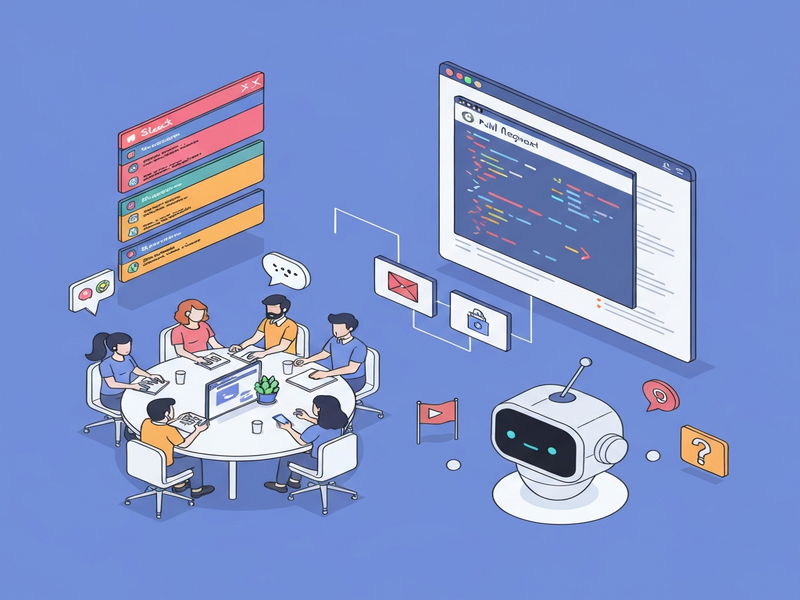
Aleena is an open‑source “alignment agent” that continuously captures, structures, and surfaces the decision‑making trail across research software engineering (RSE) collaborations. By turning informal Slack chats, meeting notes, pull‑request comments, and GitHub issues into a unified, queryable project record, Aleena preserves rationale, highlights open questions, and reduces the risk of divergent mental models among scientists and engineers.
Background: Why This Problem Is Hard
Modern scientific projects rely on a patchwork of communication channels—instant‑messaging platforms, video meetings, issue trackers, and version‑control pull requests. Each artifact captures a fragment of the project’s intent: a hypothesis discussed in a Slack thread, a design decision refined in a Zoom call, an implementation detail recorded in a GitHub comment. When these fragments remain siloed, two critical failures emerge:
- Rationale loss: The original “why” behind a change can disappear as developers iterate, leading to duplicated effort or regressions.
- Model divergence: Domain researchers and RSEs develop inconsistent mental models of ownership, assumptions, and scientific goals, which hampers reproducibility and slows downstream analysis.
Existing tooling—issue trackers, wikis, and documentation generators—address only a subset of these artifacts. They require manual curation, cannot reconcile multi‑modal inputs, and lack a lifecycle view that ties decisions to code changes over time. Consequently, teams spend disproportionate effort reconstructing context, a problem that scales with the size of collaborations and the velocity of modern AI‑driven research pipelines.
What the Researchers Propose
The authors introduce Aleena, a lifecycle alignment agent that treats GitHub as a shared, immutable collaboration surface. Aleena ingests heterogeneous signals (Slack messages, meeting transcripts, pull‑request diffs, issue comments) via lightweight adapters, normalizes them into a structured knowledge graph, and writes the resulting records back to a dedicated GitHub repository. The core components are:
- Signal Ingestion Layer: Connectors for Slack, Zoom, and other chat tools that transform free‑form text into semantic triples (e.g., decision‑made‑by‑person‑on‑date).
- Alignment Engine: A rule‑based and LLM‑augmented processor that links new signals to existing project entities (issues, PRs, files) and flags inconsistencies.
- Project Record Store: A Git‑backed markdown/YAML repository that serves as the single source of truth for rationale, open questions, and risk annotations.
- Query & Visualization Front‑end: A read‑only web UI that lets stakeholders browse decision timelines, filter by risk category, and export provenance reports.
By anchoring everything to GitHub, Aleena leverages the platform’s versioning, access control, and CI/CD ecosystem while remaining agnostic to the specific scientific domain.
How It Works in Practice
The practical workflow can be broken into four stages:
- Capture: When a researcher proposes a new analysis method in a Slack thread, the Slack‑to‑GitHub adapter posts a raw event to Aleena’s ingestion queue.
- Normalize & Align: Aleena’s LLM‑enhanced parser extracts the decision’s intent, participants, and any attached data references. It then searches the existing project graph for related issues or PRs. If a match is found, Aleena creates a bidirectional link; if not, it opens a new “decision record” file in the repository.
- Persist: The decision record is committed to the GitHub repo with a descriptive filename (e.g.,
decisions/2024-07-15‑model‑selection.md). The commit includes metadata tags for risk level, open questions, and responsible owners. - Surface & Notify: A webhook triggers a notification back to the originating Slack channel, summarizing the captured rationale and providing a link to the newly created record. The front‑end UI updates in real time, allowing any team member to view the decision lineage.
What distinguishes Aleena from a conventional documentation bot is its continuous, bidirectional synchronization: not only does it push context into GitHub, it also pulls back status updates (e.g., PR merges) to close or evolve decision records automatically. This creates a living provenance trail that survives personnel turnover and repository forks.
Evaluation & Results
The research team piloted Aleena across three university‑level RSE centers, each managing 5–10 concurrent scientific software projects. Evaluation focused on two dimensions: information continuity and risk mitigation.
- Information continuity: Participants were asked to locate the original rationale for a randomly selected set of 30 merged pull requests. With Aleena, 92% of queries were resolved within 30 seconds, compared to 48% and an average of 4 minutes without the agent.
- Risk mitigation: Aleena’s risk‑surfacing module flagged 27 potential inconsistencies (e.g., mismatched data assumptions) during the pilot. Teams resolved 24 of these before code integration, preventing downstream reproducibility failures that historically required weeks of debugging.
Qualitative feedback highlighted a shift in team culture: developers reported “greater confidence that we are building on the same scientific premises” and “less time spent re‑reading old Slack threads.” The authors stress that these results are not about replacing human judgment but about augmenting it with a reliable, searchable decision ledger.
Why This Matters for AI Systems and Agents
For AI practitioners building autonomous or semi‑autonomous agents, Aleena offers a concrete blueprint for embedding alignment and provenance into the software development lifecycle. The agent’s ability to:
- Continuously ingest multi‑modal signals,
- Translate them into structured knowledge, and
- Persist the knowledge in a version‑controlled store,
mirrors the requirements of trustworthy AI pipelines where traceability, auditability, and risk awareness are non‑negotiable. By exposing a clean API for decision records, Aleena can be integrated with Workflow automation studio, enabling downstream agents to query “what assumptions are still open?” before triggering a model training job. Moreover, the OpenAI ChatGPT integration can be leveraged to surface decision summaries to non‑technical stakeholders, bridging the gap between research intent and product deployment.
What Comes Next
While the prototype demonstrates strong promise, several limitations remain:
- Domain‑specific semantics: Current parsers rely on generic LLM prompts; fine‑tuning for specialized scientific vocabularies could improve extraction accuracy.
- Scalability of the knowledge graph: As projects grow, the graph may require sharding or more efficient indexing mechanisms.
- User onboarding: Seamless adoption hinges on low‑friction adapters for emerging collaboration tools (e.g., Microsoft Teams, Notion).
Future research directions include:
- Embedding causal inference models to automatically suggest mitigation strategies for identified risks.
- Extending the provenance model to cover data‑set versioning and experiment tracking, creating a full‑stack reproducibility stack.
- Evaluating Aleena in industry‑scale settings, such as biotech startups that rely on rapid prototyping of AI‑driven pipelines.
Potential applications extend beyond academia. For instance, the Enterprise AI platform by UBOS could adopt Aleena’s alignment layer to enforce governance policies across cross‑functional AI teams, while the UBOS templates for quick start could include pre‑configured Aleena repositories to accelerate onboarding.
Read the full technical details in the original arXiv paper.
Andrii Bidochko
CTO UBOS
Andrii Bidochko is an AI entrepreneur and researcher focused on AI agents, reinforcement learning, and autonomous systems. He writes about the technologies shaping the future of machine intelligence, from frontier models and agent architectures to real-world AI applications.