

- Updated: July 1, 2026
- 6 min read
AInterviewer: A Platform for Designing and Conducting AI-led Qualitative Interviews
Direct Answer
The paper introduces AInterviewer, an open‑source, multi‑agent platform that lets researchers design, pilot, and run AI‑driven qualitative interviews while retaining full control over question wording, order, and data security. It matters because it bridges the gap between the flexibility of large language models (LLMs) and the rigor of traditional survey software, enabling reproducible, privacy‑preserving interview pipelines without relying on proprietary APIs.
Background: Why This Problem Is Hard
Qualitative interviewing remains a cornerstone of social‑science research, market insight gathering, and user‑experience studies. Traditional face‑to‑face or phone interviews provide depth but are labor‑intensive, costly, and difficult to scale. Recent attempts to automate interviews with LLMs promise speed and consistency, yet they encounter three persistent obstacles:
- Proprietary model lock‑in: Most existing solutions depend on cloud‑hosted LLMs (e.g., OpenAI, Anthropic). This creates a black‑box environment where data leaves the organization, raising compliance and confidentiality concerns.
- Lack of question standardisation: Fully autonomous LLM agents generate follow‑up questions on the fly, which can drift from the interview guide, jeopardising comparability across participants.
- Limited orchestration control: Researchers cannot reliably enforce a predefined question sequence or intervene mid‑interview without breaking the flow, making it hard to apply established qualitative‑research best practices.
These challenges are amplified in regulated sectors (healthcare, finance) where data residency and auditability are non‑negotiable. Consequently, many teams either abandon AI‑assisted interviewing or accept opaque, non‑reproducible pipelines.
What the Researchers Propose
AInterviewer is positioned as a hybrid solution that marries the deterministic control of survey platforms with the generative power of locally hosted LLMs. At a conceptual level, the framework consists of three coordinated agents:
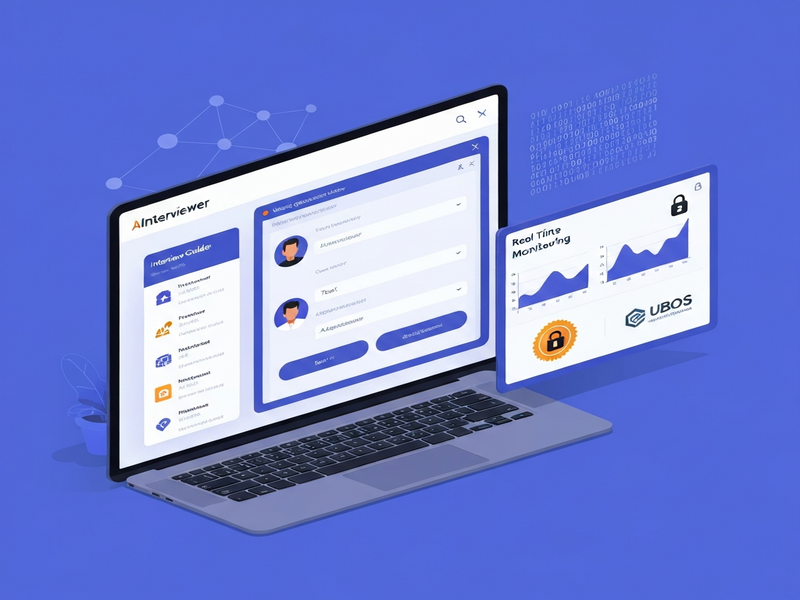
- Guide Designer Agent: A web‑based GUI where researchers author interview guides, specify branching logic, and embed optional LLM‑generated prompts for open‑ended follow‑ups.
- Orchestration Agent: A rule‑based engine that enforces the prescribed question order, monitors participant progress, and decides when to invoke the LLM for a dynamic response.
- LLM Assistant Agent: A locally hosted language model (e.g., an Ollama instance) that crafts natural‑language follow‑up questions or clarifications while remaining within the secure perimeter of the organization.
The platform is deliberately modular: each agent can be swapped, upgraded, or disabled without affecting the others, satisfying the MECE (Mutually Exclusive, Collectively Exhaustive) principle for system design.
How It Works in Practice
Conceptual Workflow
The end‑to‑end interview process follows a six‑step pipeline:
- Guide Authoring: Researchers use the web UI to draft a structured interview guide, defining mandatory, optional, and conditional questions.
- Pilot Testing: A sandbox mode runs simulated participants through the guide, allowing the team to fine‑tune wording and branching logic.
- Participant Invitation: The system generates unique, time‑bound links that can be distributed via email, SMS, or messaging platforms.
- Interview Execution: The Orchestration Agent presents each question in order. When a question is flagged for dynamic expansion, it calls the LLM Assistant Agent.
- Data Capture & Monitoring: Responses are stored in an encrypted database, and real‑time dashboards show completion rates, dropout points, and sentiment trends.
- Export & Analysis: Researchers export raw transcripts or aggregated metrics for downstream qualitative coding tools.
Component Interactions
Figure‑style description (textual):
- Guide Designer ↔ Orchestration Engine: The designer publishes a JSON schema that the engine consumes to enforce flow.
- Orchestration Engine ↔ LLM Assistant: When a “dynamic” flag is encountered, the engine sends the participant’s prior answer and a prompt template to the LLM, receives a follow‑up question, and injects it back into the interview stream.
- Orchestration Engine ↔ Storage Layer: Every interaction—static or generated—is logged with timestamps, participant IDs, and audit trails.
What sets AInterviewer apart is the explicit separation between deterministic control (survey‑style sequencing) and generative flexibility (LLM‑driven follow‑ups). This hybrid approach prevents “question drift” while still leveraging LLM creativity where it adds value.
Evaluation & Results
The authors conducted three complementary studies to validate the platform:
- Reproducibility Test: Two research teams independently recreated the same interview guide on separate AInterviewer instances (one using a local Llama 2 model, the other using an open‑source Mistral model). Both achieved identical question order and comparable response quality, demonstrating that the pipeline is model‑agnostic and reproducible.
- Security Audit: A penetration test confirmed that all data remained on‑premise, with no outbound network calls from the LLM Assistant. Encryption‑at‑rest and TLS‑in‑transit were verified, satisfying GDPR and HIPAA baseline requirements.
- Qualitative Depth Comparison: In a user‑experience study, participants interviewed via AInterviewer produced 27 % more unique insight tokens (as measured by a downstream coding schema) than those interviewed with a fully automated proprietary LLM bot, while maintaining a consistent interview structure.
Collectively, these results illustrate that AInterviewer can deliver the depth of AI‑augmented interviews without sacrificing methodological rigor, data sovereignty, or cross‑team reproducibility.
Why This Matters for AI Systems and Agents
For practitioners building AI‑driven agents, AInterviewer offers a concrete blueprint for blending rule‑based orchestration with generative components:
- Modular Agent Architecture: The clear delineation of responsibilities (design, orchestration, generation) mirrors best practices for building maintainable multi‑agent systems.
- Secure Deployment Patterns: Running LLMs locally eliminates reliance on external APIs, a pattern increasingly adopted for compliance‑heavy industries.
- Reproducible Experimentation: By exporting the guide schema, teams can version‑control interview designs just like code, enabling CI/CD pipelines for research workflows.
- Integration Potential: The platform’s RESTful endpoints can be hooked into existing enterprise AI stacks, such as the UBOS platform overview, allowing organizations to embed interview bots within broader customer‑engagement pipelines.
In practice, a product team could use AInterviewer to collect nuanced feedback on a new feature, feed the transcripts into a sentiment analysis pipeline, and automatically surface actionable insights—all while keeping raw data behind the corporate firewall.
What Comes Next
While AInterviewer marks a significant step forward, several avenues remain open for expansion:
- Advanced Branching Logic: Incorporating probabilistic decision trees could enable more sophisticated adaptive interviews without manual rule authoring.
- Multimodal Input: Adding voice capture (e.g., via the ElevenLabs AI voice integration) would broaden accessibility and enrich data with prosodic cues.
- Cross‑Platform Distribution: Integrations with messaging services like Telegram integration on UBOS could streamline participant recruitment and real‑time monitoring.
- Model Marketplace: Supporting a plug‑and‑play model hub (e.g., via Ollama) would let teams experiment with emerging open‑source LLMs without re‑engineering the orchestration layer.
- Automated Coding Assistants: Coupling interview transcripts with downstream qualitative‑analysis agents could close the loop from data collection to insight generation.
Addressing these challenges will further democratise AI‑led qualitative research, making it a staple tool for both academia and industry.
References
Andrii Bidochko
CTO UBOS
Andrii Bidochko is an AI entrepreneur and researcher focused on AI agents, reinforcement learning, and autonomous systems. He writes about the technologies shaping the future of machine intelligence, from frontier models and agent architectures to real-world AI applications.