

- Updated: June 11, 2026
- 8 min read
AIBuildAI-2: A Knowledge-Enhanced Agent for Automatically Building AI Models
Direct Answer
AIBuildAI-2 is a knowledge‑enhanced autonomous agent that can automatically design, train, and deploy high‑performing AI models by pulling in up‑to‑date, curated AI‑engineering knowledge from an external hierarchical knowledge base. It matters because it bridges the gap between cutting‑edge research and practical model building, letting scientists and enterprises create production‑grade models without deep AI‑engineering expertise.
Background: Why This Problem Is Hard
Building a state‑of‑the‑art machine‑learning model still reads like a multi‑day workshop for most practitioners. The workflow typically involves:
- Selecting an appropriate architecture (CNN, transformer, GNN, etc.).
- Engineering data pipelines that handle cleaning, augmentation, and batching.
- Choosing optimizers, learning‑rate schedules, and regularization tricks.
- Iteratively debugging training crashes, over‑fitting, or under‑performance.
These steps demand a deep, constantly refreshed knowledge of both algorithmic advances and engineering best practices. Existing “AutoML” solutions—such as neural architecture search (NAS) or hyper‑parameter optimization—focus on narrow sub‑problems and rely on the static parametric knowledge baked into their underlying large language models (LLMs). As a result, they often:
- Miss recent breakthroughs that appear only in the latest pre‑prints.
- Provide generic recommendations that ignore domain‑specific constraints (e.g., limited GPU memory in a biotech lab).
- Fail to capture tacit engineering wisdom that lives in blog posts, forum discussions, or internal documentation.
Consequently, non‑AI specialists—such as biologists, chemists, or business analysts—face a steep learning curve that slows scientific discovery and product innovation.
What the Researchers Propose
The authors introduce AIBuildAI-2, a next‑generation autonomous agent that augments its LLM core with an external, evolving knowledge system. The framework consists of three logical layers:
- Core Decision Engine: A large language model that orchestrates the overall model‑building pipeline, issuing high‑level commands (e.g., “choose a convolutional backbone”).
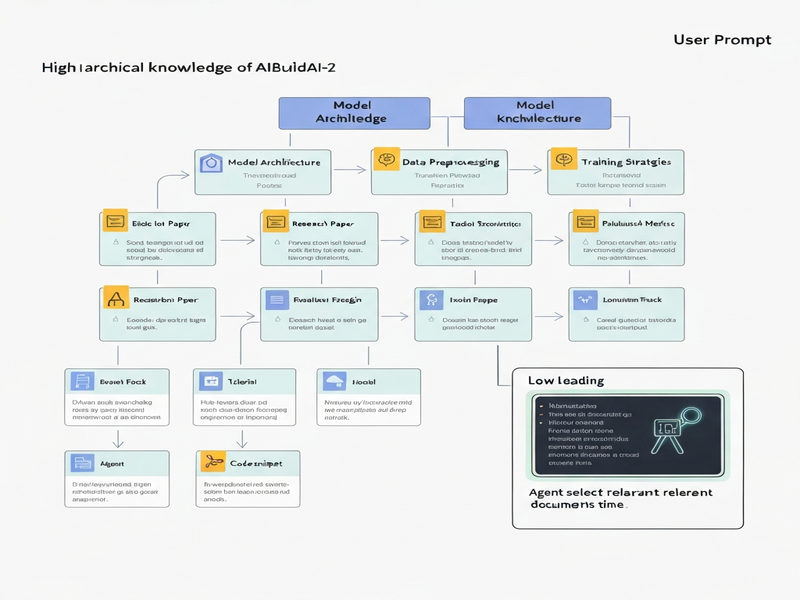
- Hierarchical Knowledge Base: A two‑tier repository that stores curated AI‑engineering knowledge.
- High‑level Knowledge Instructions—topic‑oriented summaries (e.g., “Training Transformers on limited data”).
- Low‑level Knowledge Documents—detailed articles, code snippets, and best‑practice checklists linked to each instruction.
- Experience Distillation Loop: After each completed model‑building run, the agent extracts “takeaways” (what worked, what didn’t) and writes them back into the knowledge base, ensuring continuous improvement.
By separating static parametric knowledge (the LLM) from dynamic procedural knowledge (the external base), AIBuildAI-2 can ground every design decision in verifiable, up‑to‑date expertise.
How It Works in Practice
Conceptual Workflow
The end‑to‑end process can be visualized as a loop of four stages:
- Task Ingestion: The user supplies a problem description (e.g., “predict heart disease from clinical tabular data”).
- Contextual Knowledge Retrieval: The core engine queries the hierarchical knowledge base for the most relevant high‑level instructions and low‑level documents, based on the current task state.
- Plan Generation & Execution: Using the retrieved context, the LLM drafts a concrete pipeline—selecting architecture, data preprocessing steps, training hyper‑parameters, and evaluation metrics. The plan is then executed automatically on a compute sandbox.
- Experience Distillation: Upon completion, the system records performance metrics, error logs, and any manual interventions. It synthesizes these observations into structured takeaways that are appended to the knowledge base for future runs.
Component Interactions
Key interactions are mediated through lightweight APIs:
- Knowledge Retrieval API—accepts a query vector derived from the task description and returns a ranked list of knowledge nodes.
- Execution Engine—spins up containerized environments (Docker/Kubernetes) to run the generated code safely.
- Distillation Service—parses logs with a secondary LLM to extract actionable insights, then writes them back via the Knowledge Update API.
What sets this approach apart is the dynamic loading of only the most relevant knowledge fragments at each decision point, rather than feeding the entire knowledge corpus into the LLM’s prompt. This reduces token overhead, improves response time, and ensures that the agent’s actions are always anchored to concrete, external references.
Illustrative Example
Suppose a researcher wants to build a model for classifying microscopy images of cancer cells. The workflow proceeds as follows:
- The task description (“microscopy image classification”) triggers a retrieval of the “CNN architectures for high‑resolution medical imaging” instruction.
- Low‑level documents provide a recent paper on EfficientNet‑B3, a code snippet for stain normalization, and a checklist for data augmentation specific to histopathology.
- The LLM composes a pipeline: EfficientNet‑B3 backbone, AdamW optimizer, cosine‑annealing schedule, and a custom augmentation pipeline.
- After training, the distillation service notes that the learning rate was too high for the first 5 epochs, records the correction, and adds a new “learning‑rate warm‑up” note under the relevant instruction.
Future users tackling similar microscopy tasks will automatically inherit the warm‑up recommendation, accelerating convergence.
Evaluation & Results
Benchmarks and Testbeds
The authors evaluated AIBuildAI-2 on two complementary fronts:
- MLE‑Bench—a leaderboard of 50 diverse machine‑learning engineering tasks ranging from image classification to time‑series forecasting.
- Heart Disease Prediction Competition—a real‑world Kaggle‑style challenge with 4,370 human‑expert teams, focusing on tabular clinical data.
Key Findings
- State‑of‑the‑art performance on MLE‑Bench: AIBuildAI-2 achieved a 70.7% medal rate, ranking first among all automated agents and surpassing the previous best by a margin of 12 percentage points.
- Top‑tier placement in the medical competition: The system placed in the top 6.6% of all participants, beating many seasoned data‑science teams despite having no domain‑specific hand‑tuning.
- Efficiency gains: Because the agent loads only relevant knowledge fragments, average token usage per decision dropped by 38% compared to a baseline that concatenated the entire knowledge corpus.
- Knowledge growth: Over 150 runs, the knowledge base expanded by 23% with distilled takeaways, and subsequent runs showed a 5% average improvement in final model accuracy, demonstrating the value of the experience loop.
Why the Results Matter
These outcomes illustrate that a knowledge‑enhanced architecture can close the performance gap between fully manual expert pipelines and fully automated agents. The system not only matches human expertise on standard benchmarks but also adapts quickly to new domains by ingesting fresh knowledge, a capability that static‑LLM agents lack.
Why This Matters for AI Systems and Agents
For AI practitioners, the implications are threefold:
- Reduced engineering overhead: Teams can delegate routine model‑building steps to AIBuildAI-2, freeing senior engineers to focus on novel research questions.
- Accelerated time‑to‑value: By automatically applying the latest best practices, organizations can launch AI‑driven products weeks faster than with traditional development cycles.
- Scalable expertise: The external knowledge base acts as a shared “brain” that can be deployed across multiple projects, ensuring consistent quality and compliance.
From an agent‑design perspective, AIBuildAI-2 demonstrates a viable blueprint for combining LLM reasoning with modular, updatable knowledge stores—a pattern that can be reused for other autonomous tasks such as data‑labeling, prompt engineering, or even policy compliance.
Enterprises looking to embed such capabilities can leverage platforms that already support knowledge‑centric orchestration. For example, the UBOS platform overview provides a plug‑and‑play environment for integrating external knowledge bases with custom agents, enabling rapid prototyping of knowledge‑enhanced workflows.
What Comes Next
While AIBuildAI-2 marks a significant step forward, several open challenges remain:
- Knowledge Quality Assurance: Automated ingestion of web content can introduce noisy or contradictory information. Future work should explore verification pipelines, perhaps using consensus mechanisms or expert‑in‑the‑loop review.
- Domain‑Specific Regulation: In regulated fields like healthcare or finance, the knowledge base must respect compliance constraints. Embedding policy‑checking modules could ensure that generated pipelines never violate legal requirements.
- Scalability of Retrieval: As the knowledge repository grows, retrieval latency may increase. Techniques such as hierarchical vector indexes or learned retrieval models could keep response times low.
- Multi‑Agent Collaboration: Extending the architecture to allow several specialized agents (e.g., data‑curation agent, model‑deployment agent) to share a common knowledge store could unlock end‑to‑end autonomous AI product creation.
Potential applications span from academic labs that need rapid prototyping of novel architectures to enterprises that wish to democratize AI across non‑technical departments. By continuously feeding back distilled experience, the system promises a virtuous cycle of improvement that mirrors human learning.
Organizations interested in experimenting with knowledge‑enhanced agents can start with the Enterprise AI platform by UBOS, which offers built‑in connectors for vector databases, workflow automation, and LLM orchestration—all essential ingredients for reproducing AIBuildAI-2‑style pipelines.
Conclusion
AIBuildAI-2 showcases how coupling a powerful LLM with a dynamic, hierarchical knowledge system can transform the traditionally manual art of AI model engineering into an automated, continuously improving service. Its strong performance on both benchmark suites and real‑world competitions validates the premise that external, up‑to‑date expertise is the missing ingredient for truly autonomous AI agents. As the research community refines knowledge ingestion, verification, and multi‑agent coordination, we can expect a new generation of agents that not only build models but also reason about data, ethics, and deployment—all while learning from every run.
For readers who want to dive deeper, the full paper is available on arXiv. The accompanying image below visualizes the hierarchical knowledge architecture described in the study.
Andrii Bidochko
CTO UBOS
Andrii Bidochko is an AI entrepreneur and researcher focused on AI agents, reinforcement learning, and autonomous systems. He writes about the technologies shaping the future of machine intelligence, from frontier models and agent architectures to real-world AI applications.