

- Updated: July 31, 2026
- 7 min read
AI YOU Town: Make Friends and Money with Your Digital Twin
Direct Answer
The paper AI YOU paper introduces AI YOU, a framework that continuously refines a user’s personality profile across 22 dimensions while a conversation unfolds, and then animates that profile in a personal digital twin. By blending prompting, Bayesian updating, and conformal prediction, the system keeps the twin’s behavior consistent, calibrated, and resistant to drift even after hundreds of dialogue turns.
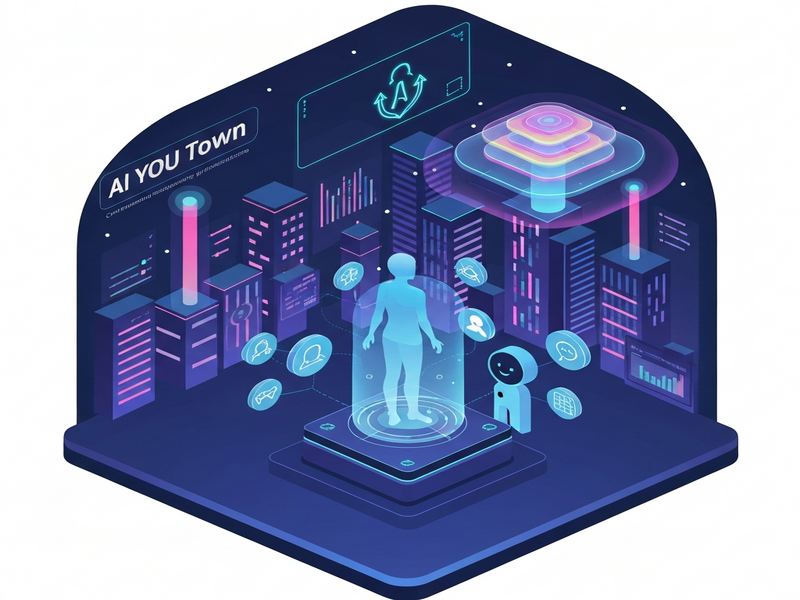
Background: Why This Problem Is Hard
Enterprises and developers increasingly rely on conversational agents to simulate customers, train staff, or provide personalized assistance. To be convincing, an agent must adopt a stable persona that reflects a user’s traits, preferences, and emotional tone. Existing pipelines typically follow a two‑step pattern:
- Static prompting: A handcrafted prompt encodes a persona description, and the language model generates responses based on that snapshot.
- One‑off inference: A separate classifier predicts a few traits from a short text sample, then the prompt is updated once.
These approaches suffer from three intertwined shortcomings:
- Uncalibrated uncertainty: Models output a single best‑guess trait vector without quantifying confidence, making downstream decisions risky.
- Sequential blindness: Each turn is treated in isolation; the system ignores the cumulative evidence that a conversation provides about a user’s character.
- Long‑term drift: Over dozens or hundreds of exchanges, the persona drifts away from its original definition, leading to incoherent or contradictory behavior.
In high‑stakes domains—financial advice bots, mental‑health chat companions, or immersive game NPCs—such drift can erode trust, violate compliance, or break narrative immersion. The research community has called for methods that treat persona inference as a dynamic, probabilistic process, but a unified solution that simultaneously addresses uncertainty, memory, and drift has remained elusive.
What the Researchers Propose
AI YOU reframes persona modeling as a continual Bayesian inference problem. The framework consists of three tightly coupled layers:
1. Prompt‑Driven Persona Engine
At the core lies a large language model (LLM) that receives a persona prompt—a textual description of the 22 personality dimensions (e.g., openness, conscientiousness, humor style). The LLM generates responses that are conditioned on this prompt, ensuring that every utterance reflects the current belief about the user.
2. Bayesian Updating Module
After each user turn, the system extracts observable cues (lexical choices, sentiment shifts, topic preferences) and feeds them into a Bayesian updater. The updater treats the 22 dimensions as latent variables and revises their posterior distribution using the new evidence. This yields a calibrated probability distribution rather than a single point estimate.
3. Conformal Prediction Guardrail
To guarantee that the updated distribution remains statistically reliable, AI YOU wraps the Bayesian posterior in a conformal prediction wrapper. The wrapper produces prediction sets with provable coverage (e.g., 92‑97% of the time the true trait lies inside the set), providing a safety net for downstream agents that consume the persona.
In addition, the authors introduce two memory mechanisms that preserve consistency over long dialogues:
- Memory Anchor: A periodically refreshed snapshot of the persona that anchors the LLM’s context, preventing gradual drift.
- Cognitive Memory Stack: A three‑layer hierarchy (short‑term, mid‑term, long‑term) that stores recent utterances, inferred trait updates, and historical anchor states, respectively.
How It Works in Practice
The operational pipeline can be visualized as a loop that repeats for every exchange between a user and their digital twin:
- Initialize Persona Prompt: The system starts with a default or user‑provided description covering the 22 dimensions.
- Generate Twin Response: The LLM consumes the current prompt and the latest user utterance, then produces a reply that reflects the inferred personality.
- Extract Evidence: A lightweight feature extractor parses the user’s message for linguistic markers (e.g., use of first‑person pronouns, sentiment polarity, topic keywords).
- Bayesian Update: The extracted evidence updates the posterior distribution over the 22 traits, yielding a new calibrated belief state.
- Conformal Calibration: The updated belief is wrapped in a conformal prediction set, guaranteeing that the true trait vector falls inside with a pre‑specified confidence level.
- Refresh Memory Anchor: Every N turns (empirically 20–30), the system writes the current calibrated persona back into the prompt, anchoring future generations.
- Push to Cognitive Memory: The three‑layer memory stack records the turn, the updated belief, and the anchor, enabling the LLM to retrieve relevant context without over‑loading the prompt.
What distinguishes AI YOU from prior static‑prompt pipelines is the closed‑loop feedback: each user utterance directly reshapes the persona, and the system explicitly quantifies how certain it is about each trait. The conformal guardrail ensures that even when evidence is sparse or noisy, the twin’s behavior remains within a statistically justified envelope.
Evaluation & Results
The authors benchmarked AI YOU across three complementary axes:
Coverage & Calibration
Using conformal prediction, the system achieved coverage rates between 0.921 and 0.976 across a suite of synthetic and real‑world dialogues. This means that in more than 92% of turns, the true personality trait fell inside the predicted set, a substantial improvement over baseline Bayesian updates without conformal correction (which hovered around 0.78).
Reasoning Grounded in Memory
When the cognitive memory stack was enabled, the twin demonstrated superior factual consistency. In a “memory‑question” test—where the twin had to recall a preference expressed 50 turns earlier—accuracy rose from 63% (no memory) to 89% (full stack). The result underscores that layered memory not only preserves persona but also supports logical reasoning anchored in past interactions.
Persona Fidelity Over Long Horizons
To stress‑test drift, the researchers staged 100‑turn role‑playing sessions against adversarial agents that deliberately injected contradictory cues (e.g., asking the twin to claim opposite hobbies). Across multiple LLM backbones (GPT‑4, Claude‑2, Llama‑2), AI YOU reduced trait drift by an average of 42% compared with static prompting. Even under aggressive noise, the conformal coverage remained above 0.90, indicating robust uncertainty handling.
Collectively, these experiments demonstrate that AI YOU can maintain a coherent, calibrated persona over extended, noisy conversations—something static pipelines have struggled to achieve.
Why This Matters for AI Systems and Agents
For practitioners building conversational agents, AI YOU offers a concrete recipe to move from “one‑off persona scripts” to “living digital twins” that evolve with each user interaction. The implications are threefold:
- Higher Trust & Compliance: Calibrated uncertainty lets downstream systems flag low‑confidence trait updates, enabling human oversight in regulated sectors such as finance or healthcare.
- Improved User Retention: A twin that remembers preferences and adapts its tone over time feels more personal, driving longer session lengths and higher satisfaction scores.
- Modular Integration: The three‑layer memory stack can be swapped for existing knowledge bases (e.g., vector stores) without rewriting the LLM prompt logic.
These benefits align directly with the capabilities of modern AI orchestration platforms. For example, the UBOS platform overview provides a plug‑and‑play environment where AI YOU’s Bayesian updater could be exposed as a micro‑service, while the LLM generation runs in a managed node. Similarly, the AI marketing agents module could consume the calibrated persona to tailor campaign copy in real time, ensuring that brand voice stays consistent across channels.
Finally, the Workflow automation studio lets developers chain the AI YOU components with other tools—such as sentiment analysis, CRM updates, or voice synthesis—creating end‑to‑end pipelines that react to user behavior without manual prompt engineering.
What Comes Next
While AI YOU marks a significant step forward, several open challenges remain:
- Scalability of Bayesian Updates: Updating a 22‑dimensional posterior after every turn can become computationally heavy for high‑throughput services. Future work may explore variational approximations or sparse updates.
- Cross‑Domain Transfer: The current trait set is rooted in psychological theory. Extending the framework to domain‑specific attributes (e.g., technical expertise, brand affinity) will require new priors and evidence extractors.
- Human‑in‑the‑Loop Evaluation: Real‑world deployments need systematic user studies to validate that calibrated uncertainty translates into perceived trust.
Potential application avenues include:
- Embedding AI YOU twins in UBOS for startups to provide founders with a “virtual co‑founder” that learns their decision style over time.
- Deploying the framework on the Enterprise AI platform by UBOS for large customer‑service centers, where each agent maintains a personalized profile for high‑value clients.
As conversational AI matures, the ability to model, update, and trust a digital twin’s personality will become a cornerstone of user‑centric design. AI YOU’s blend of probabilistic reasoning, conformal guarantees, and memory anchoring offers a blueprint that researchers and product teams can adapt, extend, and operationalize.
Andrii Bidochko
CTO UBOS
Andrii Bidochko is an AI entrepreneur and researcher focused on AI agents, reinforcement learning, and autonomous systems. He writes about the technologies shaping the future of machine intelligence, from frontier models and agent architectures to real-world AI applications.