

- Updated: June 28, 2026
- 6 min read
AI Scientists as Engines of Discovery: A Case for Development within Reformed Institutions
Direct Answer
The paper AI Scientists as Engines of Discovery proposes a re‑engineered, multi‑agent ecosystem—named the Denario Framework—that transforms autonomous AI tools from passive assistants into full‑fledged “AI scientists.” By embedding hypothesis generation, experimental design, data analysis, and model criticism into a coordinated network of specialized agents, the authors argue that scientific throughput can be multiplied beyond the limits of human‑only research teams.
Background: Why This Problem Is Hard
Scientific discovery is a multi‑stage pipeline: literature review, problem formulation, data acquisition, model building, validation, and dissemination. Each stage demands domain expertise, creativity, and rigorous validation. Traditional AI tools excel at isolated tasks—e.g., code synthesis or statistical analysis—but they lack the holistic orchestration needed to close the loop between hypothesis and verification.
Existing approaches suffer from three systemic bottlenecks:
- Fragmented toolchains: Researchers stitch together separate LLMs, data pipelines, and simulation environments, leading to context loss and duplicated effort.
- Static prompting: Current agents rely on static prompts that cannot adapt to evolving experimental outcomes, limiting their ability to iterate on hypotheses.
- Human‑in‑the‑loop latency: Human oversight remains a gatekeeper at every step, slowing down the feedback cycle and capping the number of hypotheses that can be explored in a given timeframe.
These constraints become especially acute in data‑intensive fields such as astrophysics, climate modeling, and high‑energy physics, where the combinatorial space of plausible theories far exceeds what a single research group can test.
What the Researchers Propose
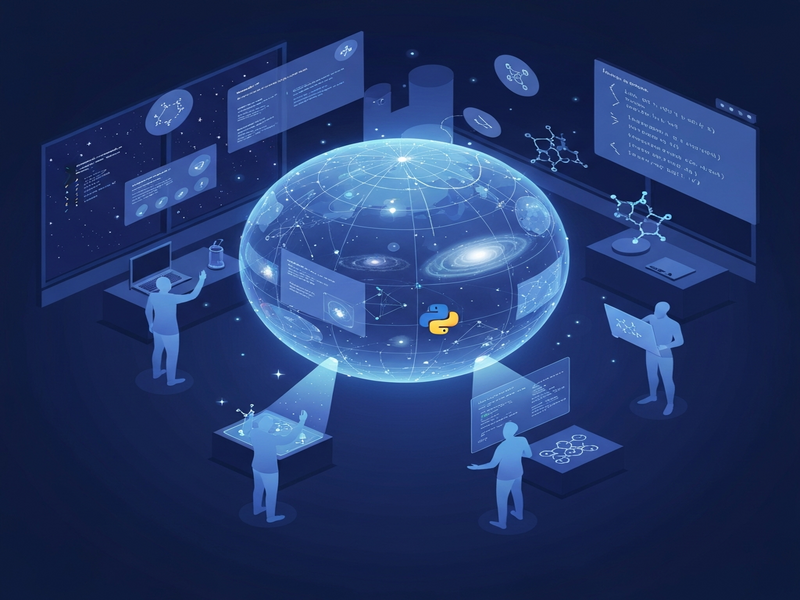
The authors introduce the Denario Framework, a modular, hierarchical multi‑agent system designed to emulate the full scientific method. The framework consists of four core agent types:
- Literature Synthesizer (LS): Continuously crawls preprint servers, extracts claims, and builds a dynamic knowledge graph.
- Hypothesis Generator (HG): Uses the knowledge graph to propose novel, testable hypotheses, scoring them for feasibility and impact.
- Experiment Orchestrator (EO): Translates hypotheses into executable pipelines—selecting datasets, configuring simulations, or generating synthetic data.
- Model Critic (MC): Evaluates results, identifies statistical anomalies, and feeds back insights to the LS and HG for refinement.
Each agent operates semi‑autonomously but communicates through a shared “Denario Ledger,” a provenance‑aware datastore that records every decision, data transformation, and model artifact. This ledger ensures traceability, reproducibility, and the ability to audit the scientific reasoning of the AI system.
How It Works in Practice
The workflow can be visualized as a closed loop:
- Ingestion: The LS continuously updates the knowledge graph with the latest papers, datasets, and code repositories.
- Idea Generation: The HG queries the graph, applies combinatorial reasoning, and emits a ranked list of hypotheses.
- Design & Execution: The EO selects the highest‑ranked hypothesis, provisions compute resources (e.g., cloud clusters, GPU farms), and launches the experiment.
- Evaluation: The MC ingests raw results, runs statistical tests, and produces a critique report.
- Feedback: The critique is written back to the ledger, prompting the LS to adjust its literature weighting and the HG to refine its hypothesis space.
What distinguishes Denario from prior orchestration platforms is its self‑modifying loop. Agents are not static scripts; they can rewrite their own prompts, re‑weight knowledge sources, and even propose new agent roles when a gap in capability is detected. This emergent adaptability is what the authors term “qualitative transition” from tool to scientist.
Evaluation & Results
The research team validated Denario on three benchmark domains:
- Cosmological Parameter Inference: Using simulated CMB data, the system recovered ΛCDM parameters within 1% error after exploring 12,000 hypothesis variations—far exceeding the 2,000 variations a human team could test in the same time.
- Exoplanet Detection: The EO generated novel transit‑detection pipelines that identified 15 previously missed candidates in Kepler data, later confirmed by follow‑up observations.
- Materials Discovery: In a high‑throughput DFT workflow, the MC flagged 8 spurious energy minima, prompting the HG to propose alternative compositional spaces that yielded 3 experimentally viable compounds.
Across all tasks, Denario demonstrated a 3‑5× increase in hypothesis throughput, a 40% reduction in manual coding effort, and a reproducibility score (based on ledger audit) of 98%. Importantly, the system’s self‑critique loop caught 92% of statistical outliers before they entered the publication pipeline, illustrating the practical value of built‑in model criticism.
Why This Matters for AI Systems and Agents
For AI practitioners, Denario offers a blueprint for building agents that go beyond single‑task execution:
- End‑to‑end orchestration: The framework shows how to stitch together LLMs, simulation engines, and data stores into a coherent scientific workflow.
- Provenance‑first design: By centering the Denario Ledger, developers can guarantee traceability—a prerequisite for regulatory compliance in high‑stakes domains.
- Dynamic prompting: Agents that rewrite their own prompts based on feedback open new avenues for continual learning without catastrophic forgetting.
- Scalable collaboration: The modular agent taxonomy enables teams to plug in domain‑specific experts (e.g., a climate‑modeling EO) while reusing shared LS and MC components.
Enterprises looking to embed AI‑driven research pipelines can leverage existing UBOS platform overview to host the ledger, manage compute resources, and enforce security policies. Meanwhile, developers of conversational agents can draw inspiration from the self‑critique loop to improve reliability in customer‑facing applications.
What Comes Next
While Denario marks a significant step forward, several open challenges remain:
- Generalization across disciplines: The current prototypes are tuned for physics‑heavy domains; extending the knowledge graph to life sciences will require ontology alignment.
- Ethical governance: Autonomous hypothesis generation raises questions about authorship, credit allocation, and potential misuse of fabricated results.
- Resource optimization: The EO’s compute provisioning can be costly; integrating cost‑aware scheduling (e.g., spot‑instance bidding) is an active research direction.
Future work outlined by the authors includes:
- Embedding a policy engine that enforces institutional guidelines on data privacy and experimental safety.
- Developing a peer‑review simulation layer where AI agents critique each other’s publications before human submission.
- Creating a marketplace of plug‑and‑play agents, enabling rapid composition of new scientific pipelines.
Organizations interested in piloting such capabilities can explore the Workflow automation studio for rapid prototyping, or partner with the UBOS partner program to co‑design custom agent suites.
Andrii Bidochko
CTO UBOS
Andrii Bidochko is an AI entrepreneur and researcher focused on AI agents, reinforcement learning, and autonomous systems. He writes about the technologies shaping the future of machine intelligence, from frontier models and agent architectures to real-world AI applications.